


Goodbye to the Metaverse-style "blindly throwing money"! Renting out infrastructure, Meta monetizes with AI to rebuild Wall Street's trust
Meta's stock price surged 17% in July after announcing its AI monetization plan and considering leasing its infrastructure, making it the third-best performing stock in the S&P 500. This move reversed the previous sluggish trend, boosting investor confidence in its AI strategy and drawing attention to the potential for valuation recovery
The Zhitong Finance APP noticed that in just two weeks, Meta (META.US) has transformed from a forgotten supporting role in the market to one of the hottest stocks. Investors have finally bought into the AI plans articulated by the company.
The stock rose 17% in July, making it the third-best performer in the S&P 500 index, and is on track to achieve its best single-month performance since May 2025. This marks a significant turnaround compared to June, when Meta fell 11%, nearly ranking at the bottom of the S&P 500 index. Although the stock has only recorded flat performance year-to-date, this is a substantial improvement compared to the first half of the year, when it dropped 15%, making it one of the weakest performers among large tech stocks.
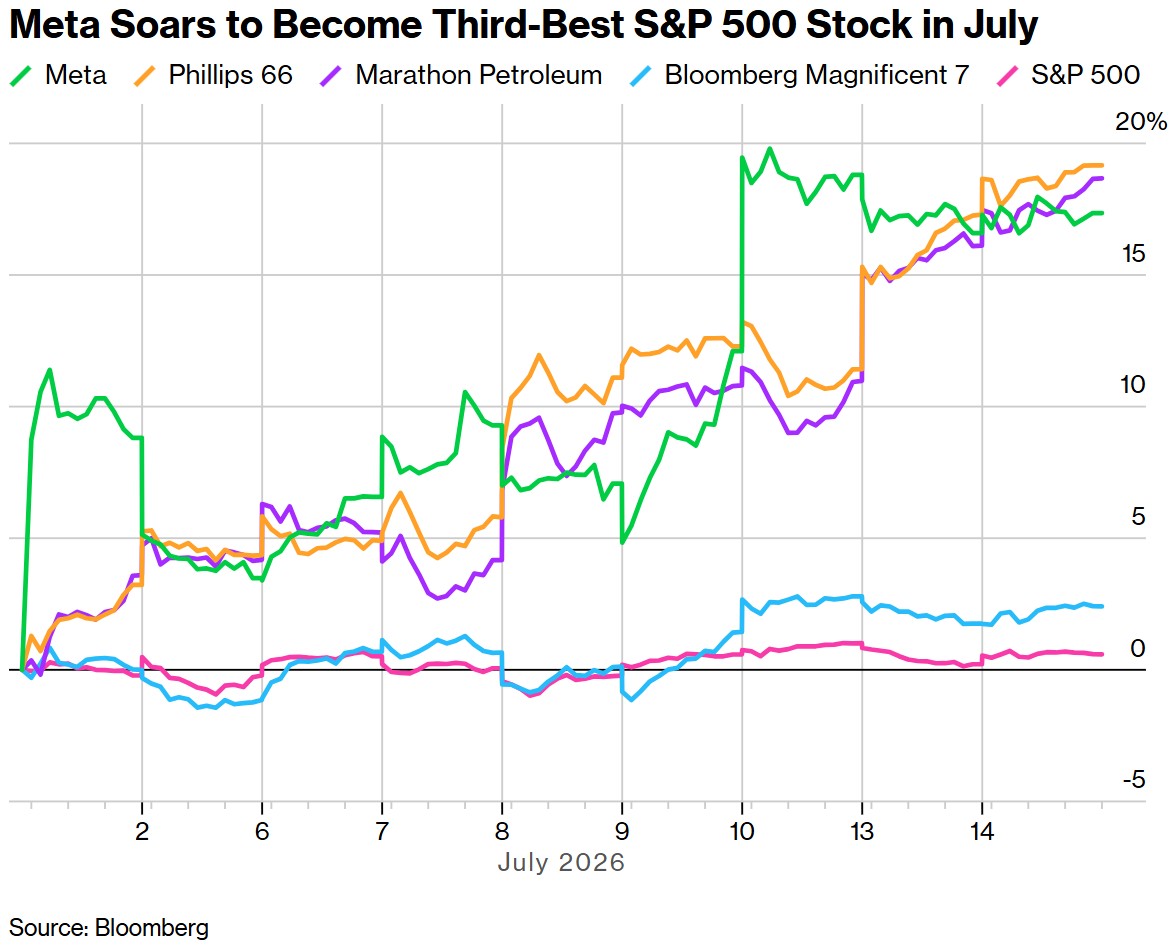
Meta's stock price surged, becoming the third-best stock in the S&P 500 index in July.
This rebound began on July 1, when media reports indicated that Meta was formulating a cloud computing business plan, driving the stock up 8.8% that day. Last week, CEO Mark Zuckerberg stated that given the strong demand for computing capacity, Meta is considering leasing some of its AI infrastructure to external organizations. The social media giant also recently launched a new version of its AI model, Muse Spark 1.1, which includes a new paid tier for developers, marking the first time Meta has charged businesses for access to its models.
John Belton, a fund manager at Gabelli Funds who holds Meta stock, stated, "If the catalysts start to take effect, stocks like Meta, which are trading at extremely low valuations, will have more room to rise, or their performance will resemble that of a compressed spring."
As Belton mentioned, the previous sell-off has left Meta's stock at a historic low. The stock is currently priced at about 16 times expected earnings for the next 12 months, while its 10-year average is over 20 times. It has the lowest valuation among the "Tech Seven" and is trading at a discount to both the S&P 500 index and the Nasdaq 100 index.
In late June, Meta's price-to-earnings ratio fell to around 13 times forward earnings. This is the lowest level in its history, second only to the inflation collapse in early 2022 and 2023, which coincided with the company's launch of its controversial and costly metaverse project.
It has been a long decline for Meta's stock. The stock reached a high of $790 on August 12, 2025, but fell about 30% over the next 10 months, closing around $563 at the end of June. Part of the decline was due to broader market rotation—investors sold stocks of high AI expenditure companies like Meta and shifted to chip manufacturers Memory manufacturers and other companies that can benefit from hundreds of billions of dollars in capital expenditures.
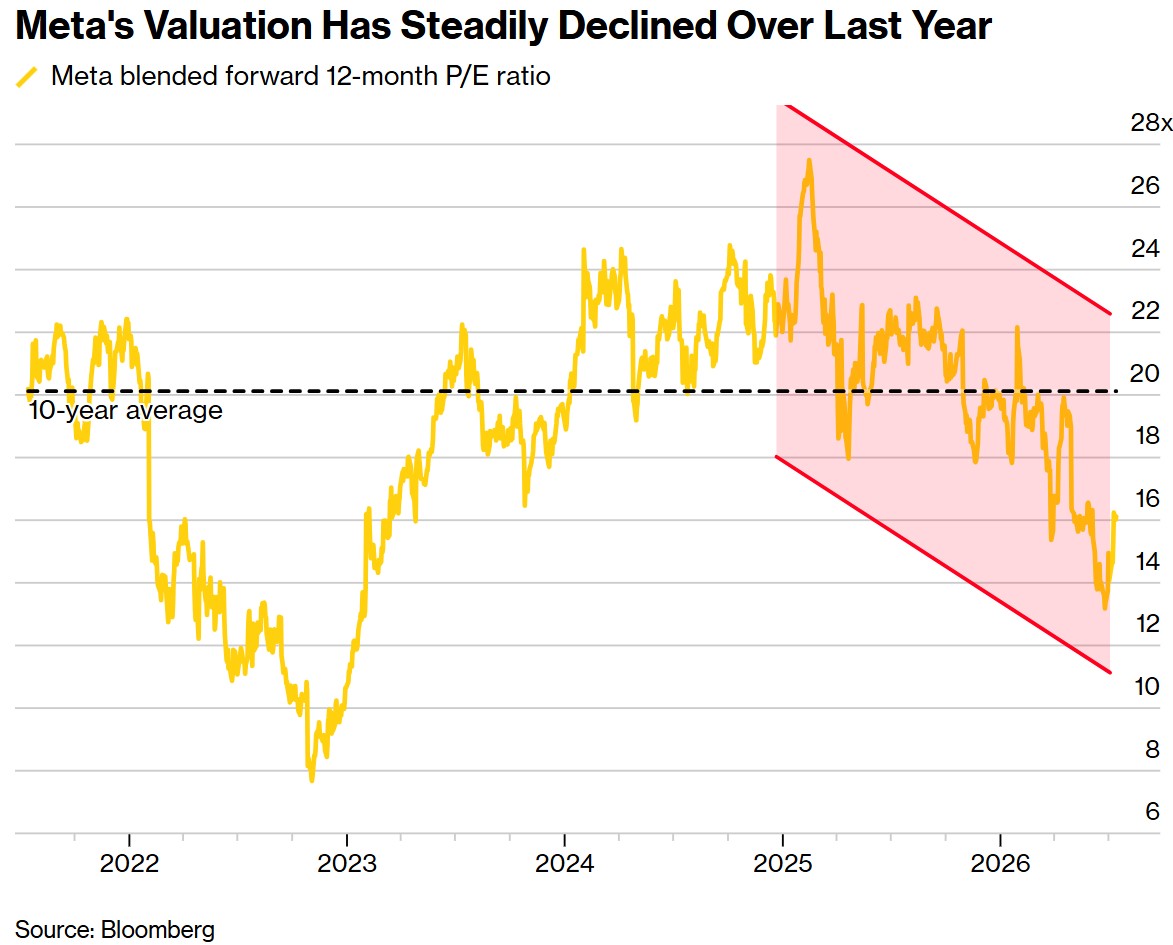
Meta's valuation has continued to decline over the past year.
However, this trend is also related to Meta's own situation. Although the company has seen early signs of AI boosting advertising revenue, it struggles to explain how it will apply this technology across its various businesses. Additionally, its large language model lags behind competitors like OpenAI's ChatGPT and Anthropic's Claude.
The trigger for the recent round of declines was the company's last earnings report released on April 29. At that time, due to additional data center costs and "higher component pricing," the company raised its spending outlook for 2026. Just a day later, Meta issued $25 billion in bonds to fund part of its AI expenditures. These announcements heightened investor concerns that Meta's massive spending on AI may not yield returns. This also evoked memories of 2022 when Zuckerberg made a big bet on the metaverse but failed to succeed.
Lack of Trust
Angelo Zino, head of the CFRA technology team, stated, "The compression of valuation multiples is largely related to the investment community's lack of trust in Meta."
Clearly, Wall Street has been looking for signs that the company's AI plans are more concrete than simply throwing money at it. Now, as results begin to show promise, investors have found reasons to buy the stock again.
Wall Street is optimistic about the company, with 73 of the 79 analysts tracking the stock giving it a rating equivalent to a buy. The average target price of around $816 implies that the stock will rise more than 23% over the next 12 months.
Meanwhile, Meta has not slowed its pace of spending. This week, the company added another $4 billion for a data center campus in Louisiana, bringing the expected total investment for this site to over $25 billion.
Dan O'Keefe, chief fund manager of Artisan Partners Global Value Team, which holds Meta stock, stated, "As jurisdictions resist these constructions, political and social pressures could potentially slow or even interrupt some of these investments. Therefore, I believe making this massive investment in advance is the right decision, and I do see it bringing returns to the business."
When Meta reports its second-quarter results at the end of July, investors will receive more information. The company is expected to record a 27% revenue growth, while earnings per share are expected to be roughly flat compared to the same period last year. But as always, what investors are most eager to hear are the latest updates on AI progress and the direction of Meta's various businesses CFRA's Zino stated, "If we look back at Meta's performance over the past two years, they may have monetized AI within their core ecosystem better than anyone else," adding, "And now, building on that, they are showcasing some diversified capabilities and new initiatives, which, combined with their valuation, lays a very good foundation for a strong rebound in the coming quarters."
