


Escape the AI Arms Race Storm! Wall Street funds flock to the "King of Cash," Apple surges by $600 billion in market value in 20 days
Affected by investors' concerns about the high returns on AI spending, funds have flowed from chip and cloud computing stocks to Apple. Apple's stock price has rebounded 15% since the end of June, with its market value surging nearly $600 billion, returning to the historical high region. The market views its non-participation in the data center arms race as a solid advantage, making it the best performer among the "Seven Giants," effectively avoiding related risks
The Zhitong Finance APP noted that due to concerns over artificial intelligence spending dragging down the stocks of chip manufacturers and cloud computing giants, investors are increasingly turning back to Apple (AAPL.US).
The iPhone maker's stock price plummeted last month due to a disappointing future AI feature demonstration, but has rebounded 15% since hitting a low on June 25, adding nearly $600 billion in market value and pushing the stock price back into the historical high range. During the same period, the Philadelphia Semiconductor Index fell 7%, the S&P 500 Index rose 3%, while the tech-heavy Nasdaq 100 Index only increased by 1.3%.
The stock's reversal reflects growing market unease over whether high AI spending will yield returns, while Apple's decision not to participate in the data center arms race is increasingly seen as an asset rather than a liability, despite its AI product launches repeatedly frustrating investors.
Mark Bronzino, Chief Investment Strategist at Rye Strategic Partners, stated, "There is a game being played in the market, and right now Apple is benefiting from it because it hasn't been caught up in the storm that other AI players are in. People are concerned about what kind of returns mega-cap companies can get from their AI spending, while others believe the semiconductor sector has already gotten ahead of itself. The result is that investors are flocking back to Apple, viewing it as a solid choice that has avoided these risks."
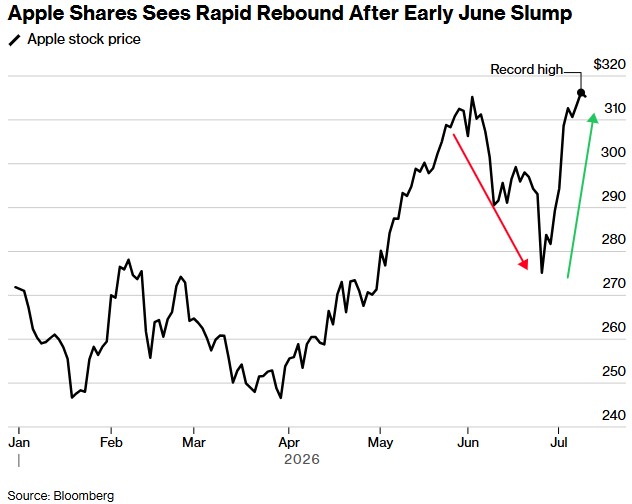
Apple's stock price quickly rebounded after a sharp decline in early June.
Despite a recent pullback due to concerns over the sustainability of AI computing spending, the Philadelphia Semiconductor Index is still up 83% in 2026, on track for its best annual performance since 1999.
However, Apple's 16% increase this year makes it one of the best performers among the so-called "Seven Giants" of tech, which also includes Nvidia, Google's parent company Alphabet, Microsoft, Amazon, Meta, and Tesla. Both Alphabet and Amazon have fallen more than 10% from their May highs, while Microsoft's 20% drop in 2026 is set to mark its worst annual performance since 2022.
Considering that Apple is facing headwinds from rapidly rising storage chip prices (which threaten the company's profit margins), its strong performance is even more impressive. In response, Apple raised the prices of all Mac, iPad, and smart home devices on June 25, leading to the stock's largest single-day drop since April 2025.
Although the price increase does not include the iPhone, the company hinted that more price hikes may be forthcoming. Reports indicate that Apple is negotiating with two Chinese semiconductor manufacturers to purchase chips at lower prices Analysts are optimistic that these measures will protect the company's profit margins and believe that Apple is not as vulnerable as other hardware companies, as its customers are less likely to abandon purchases due to price increases.
"Long-term trends indicate that the impact of pricing on sales opportunities is limited over many years," wrote JP Morgan analyst Samik Chatterjee in a report on July 7. "Apple has previously implemented substantial price increases across its entire product lineup, and despite these price hikes, its sales continue to expand."
Meanwhile, investors see a potential catalyst in the anticipated release of a foldable iPhone in September. This device is expected to come with a hefty price tag and may attract more customers to upgrade their phones. Earlier this month, Apple informed its suppliers that it is preparing to produce about 10 million foldable iPhones this year, up from the previously forecasted 7 to 8 million units.
Louis Navellier, Chief Investment Officer of Navellier & Associates, stated, "While Apple is somewhat immune to the weakness in AI, the main reason not to sell it is that it may soon launch a huge hit product. The pricing of the foldable phone will be strong enough to offset the impact of storage issues on profit margins, and I believe demand will be very strong, capable of truly supporting growth."
Apple's revenue is expected to grow nearly 15% in fiscal year 2026 (ending September 30). This would represent its fastest annual growth since 2021, when sales of electronic devices surged due to the pandemic. Net profit is expected to grow by 17%.
Although the company's profit and revenue growth remain modest compared to its mega-cap peers, its conservative spending approach means it is accumulating more cash while others are going in the opposite direction.
Apple's free cash flow is expected to reach a record $140 billion this year, an increase of over 40% compared to 2025. In contrast, Alphabet's free cash flow is expected to decline by about 67% to $210 billion this year.
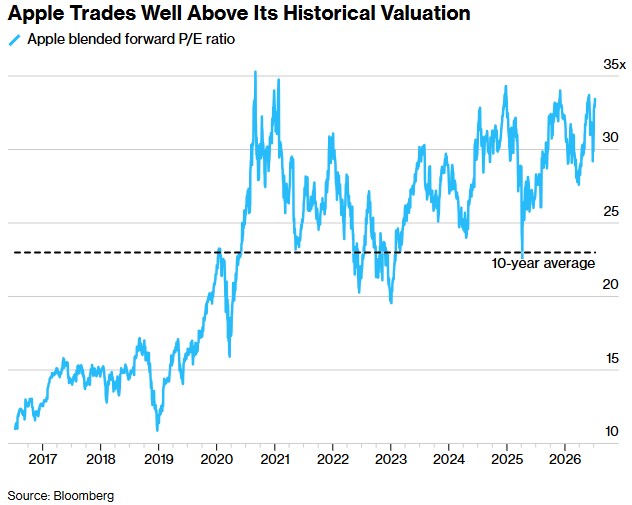
Apple's current trading price is well above its historical valuation.
Of course, investors are paying a high premium for this. Apple's price-to-earnings ratio based on estimated profits for the next 12 months is 33 times, making it the most expensive stock among the "seven giants" except for Tesla, and well above its average of 23 times over the past decade.
This is also a key reason why only 61% of Wall Street analysts tracking the stock, as tracked by Bloomberg, recommend buying it. In contrast, among analysts covering Microsoft, Amazon, Meta, and Nvidia, 90% have given these stocks a buy rating.
"Right now, I hold Nvidia instead of Apple because Nvidia's growth and valuation look more attractive," said Blonzo of Rye. "However, as long as we are in a market full of uncertainty, Apple's cash flow and microservices business will help it gradually rise "If you believe that AI capital expenditures will continue to expand, then buy NVIDIA. But if you think it will slow down, Apple is the better choice."
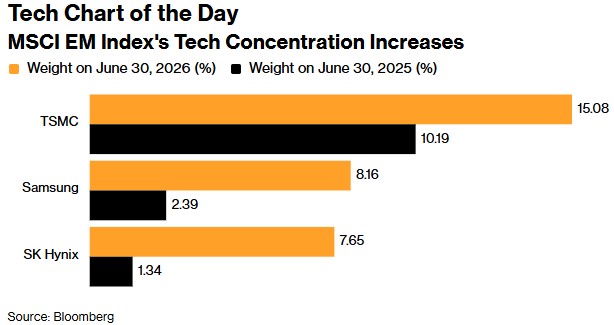
The concentration of technology stocks in the MSCI Emerging Markets Index is increasing.
Investors are rotating away from AI winners in emerging markets, where only three technology stocks with a market capitalization of $4.4 trillion are driving the majority of returns
