


SK Hynix has become the "money tree" for the US and South Korean governments: while expanding production in the US, it also needs to bet on the domestic market. Can the "goose that lays golden eggs" continue to lay eggs forever?
SK Hynix's US stock listing raised $26.5 billion, with a market value exceeding one trillion. As the global leader in HBM, it is expected to generate over $30 billion in free cash flow in the next two years. Both the South Korean and US governments are pressuring it to expand production: the South Korean government is promoting the establishment of a factory in the southwest to stimulate the economy, while the US is urging an increase in production capacity in the US. The company faces the challenge of meeting the stringent expectations from all parties
According to Zhitong Finance APP, SK Hynix (SKHY.US) officially landed on the US stock market last Friday and raised $26.5 billion, setting a record for the largest financing scale for a foreign company going public in the US for the first time. The current question is whether this company, with a market value exceeding $1 trillion, can meet the stringent expectations from various competing stakeholders.
Investor enthusiasm for SK Hynix stems from its transformation into a true "golden goose." The company is the world's second-largest supplier of dynamic random-access memory (DRAM) chips and the largest supplier in the high-bandwidth memory (HBM) sector, which is used in conjunction with NVIDIA (NVDA/US) graphics processing units (GPUs). Analysts expect that due to a supply shortage that may last until 2027, the company will generate over $300 billion in free cash flow this year and next.
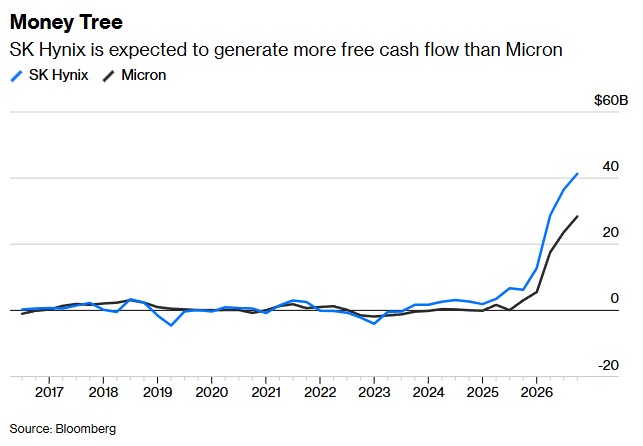
The free cash flow generated by SK Hynix is expected to exceed that of Micron Technology.
Now, everyone wants to shake this "money tree," with the first to act being the left-wing government of South Korea. The South Korean government views this chip manufacturer as key to solving the country's socioeconomic issues.
South Korean President Lee Jae-myung has promised to drive the nation towards a "great leap forward" and announced last month a super project with a total scale of at least 1350 trillion won (approximately $880 billion). In response, SK Hynix agreed to invest 400 trillion won to build a new semiconductor industry cluster in the less industrialized southwestern region of South Korea. This area is the political stronghold of Lee Jae-myung's liberal party but is quite far from the mature chip manufacturing center south of Seoul.
The South Korean government naturally equates "production capacity" with national wealth. This is also the most direct way to stimulate an economy that has stagnated—South Korea's economy grew only 1% last year. Business confidence has become a drag—private investment in South Korea is expected to decline consecutively in 2024 and 2025.
Of course, Washington also hopes to get a piece of the pie. US Secretary of Commerce Gina Raimondo has been urging SK Hynix to expand its production scale in the US. Perhaps in response to political pressure, SK Group Chairman Choi Tae-won has promised that the company will invest "far beyond the $35 billion already invested" in the US in the future.
However, just like the massive capital expenditures by US hyperscale cloud computing companies to build artificial intelligence infrastructure, such large-scale capital spending is beginning to raise concerns among investors. SK Hynix has clearly stated its goal to double wafer production capacity in the next five years, but it is not the only company expanding. Samsung Electronics is attempting to challenge SK Hynix's leading position in the HBM sector and is building new HBM production facilities. Meanwhile, Micron Technology is also increasing its investment in the US. Additionally, while the entire industry is still dominated by these three companies, China's Changxin Memory is beginning to pose a potential threat that cannot be ignored and may even impact the industry landscape SK Hynix's management may now be full of confidence. CEO Guo Lu believes that the shortage of memory chips will last until after 2030, longer than Wall Street's most optimistic predictions—but the company must also consider the interests of investors. Doubling production capacity does not necessarily mean that shareholder returns will increase correspondingly. In the next five years, a large amount of new capacity will be gradually released into the market, which may break the already fragile supply-demand balance and exacerbate the next downturn in the industry.
Today, SK Hynix's profits have reached an all-time high, but let's not forget that just three years ago, the company was still in a loss-making state. After all, it operates in a highly cyclical industry, where it can fall from a peak of prosperity to a trough in just two years.
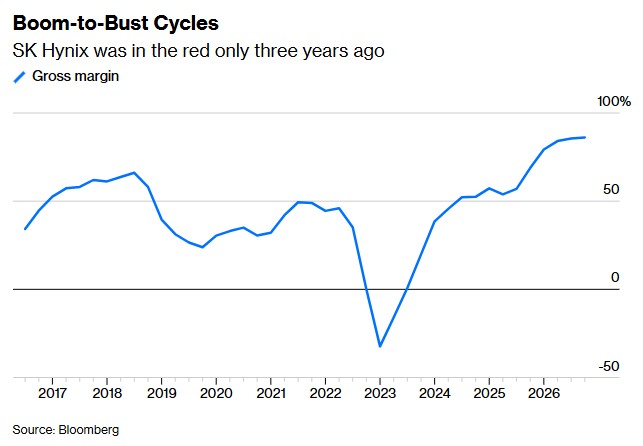
Just three years ago, SK Hynix was still in a loss-making state.
Although institutional investors need to bear the risks of buying SK Hynix stocks themselves, billionaire Choi Tae-won still needs to be accountable to millions of small and medium-sized investors, especially in a society that places a high value on equality.
Since the beginning of this year, as global asset management companies have been taking profits amid rising stock prices, a large number of Korean retail investors have continued to buy SK Hynix stocks, filling the gap left by institutional selling. To amplify their returns, many have also purchased leveraged exchange-traded funds (ETFs) that were launched only at the end of May this year.
However, as SK Hynix's stocks listed in Seoul have experienced severe fluctuations in recent weeks, these retail investors have already paid the price. Due to a phenomenon known as "volatility decay," they have suffered investment losses.
If SK Hynix cannot continue to generate excess profits, and the bets made by retail investors ultimately fail, then the Korean middle class may face a real shrinkage of wealth. In recent days, an increasing number of investment positions have been forced to close, which may indicate that some inexperienced investors have become involved in a high-risk game without fully understanding the risks involved. As for American investors, they joined the party later, so they should be more cautious.
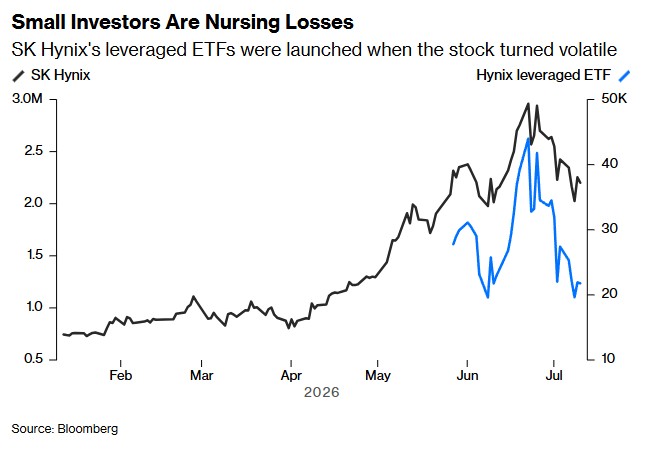
The leveraged ETF for SK Hynix was launched just as stock prices began to fluctuate dramatically, and small and medium-sized investors are suffering losses.
SK Hynix's sensational listing in the United States marks Korea's formal entry into an important position on the global economic stage, but it also brings potential social risks. Its success is so dazzling that, in an economy that generally lacks structural growth stories, chip manufacturers have almost become the only engine of growth. The Korean government hopes for it to achieve national rejuvenation, while ordinary families hope to accumulate wealth through rising stock prices and create their own "golden savings." Therefore, this chip manufacturer must strike a balance between these competing interests, and its future capital expenditure decisions will largely influence the ultimate direction of the global artificial intelligence investment boom. This "golden goose" of billionaire Choi Tae-won must lay more "golden eggs" in the future
