


U.S. Stock Market Outlook | Three Major Index Futures Rise Together, Wall Street Downplays Concerns of "Excess Computing Power," U.S. June Non-Farm Payrolls to be Released Tonight
On July 2nd, before the US stock market opened, the three major stock index futures rose together. Major European stock indices also generally increased, while oil prices fell. The market focus is on the US non-farm payroll data for June, which is expected to show an increase of 110,000 jobs, indicating continued resilience in the labor market. Federal Reserve Chairman Waller hinted at a decrease in inflation risks but remained silent on whether to raise interest rates in July, complicating the policy outlook
Pre-Market Market Trends
- As of July 2 (Thursday), U.S. stock index futures are all up before the market opens. As of the time of writing, Dow futures are up 0.18%, S&P 500 futures are up 0.15%, and Nasdaq futures are up 0.25%.

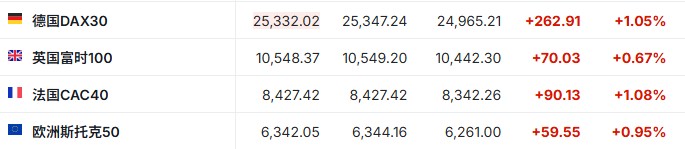
- As of the time of writing, the German DAX index is up 1.05%, the UK FTSE 100 index is up 0.67%, the French CAC 40 index is up 1.08%, and the Euro Stoxx 50 index is up 0.95%.
- As of the time of writing, WTI crude oil is down 2.04%, priced at $67.18 per barrel. Brent crude oil is down 1.83%, priced at $70.26 per barrel.

Market News
U.S. June Non-Farm Payrolls to be released tonight. The market generally expects that the U.S. June non-farm employment is expected to add 110,000 jobs, the smallest monthly increase in four months, following three consecutive months of better-than-expected growth; May added 172,000 jobs, and some analysts pointed out that World Cup-related hiring may have temporarily boosted employment. The unemployment rate is expected to remain steady at 4.3% for the fourth consecutive month; average hourly earnings are expected to increase by 0.3% month-on-month, unchanged from May, while year-on-year wage growth is expected to rise slightly from 3.4% to 3.5%. Although employment growth is expected to slow, the June employment report may still indicate that the labor market remains resilient.
"New Federal Reserve News Agency": Waller says inflation risks are declining but refuses to disclose whether there will be a rate hike in July. Federal Reserve Chairman Waller signaled an improvement in inflation conditions during the European Central Bank forum in Portugal but remained deliberately silent on whether there will be a rate hike at the July meeting, complicating market judgments about the Fed's next steps. On Thursday, Wall Street Journal's "New Federal Reserve News Agency" Nick Timiraos reported that Waller stated in Sintra, Portugal, that inflation expectations have declined over the past four weeks, and inflation risks have eased, viewing this as early evidence that the market has fully understood his tough stance. He explicitly warned that anyone expecting the Fed to tolerate inflation consistently above the 2% target "will be disappointed." However, the "New Federal Reserve News Agency" believes that Waller remains vague on tactical matters. When pressed on whether there should be a rate hike at the meeting on July 28-29, he merely expressed a desire for a "healthy family debate" among colleagues, refusing to provide a clear direction. This attitude has further increased market uncertainty regarding the Fed's policy path The controversy over Federal Reserve reforms intensifies, and the game of independence resurfaces. Warren demands Waller to stop advancing the comprehensive reform plan for the operations of the 12 regional branches under the Federal Reserve, questioning whether the proposal may not comply with the federal legal framework and poses a risk of undermining the independence of the Federal Reserve. Related statements have further heightened the political sensitivity of the reform issue. According to existing information, Waller, as a board member responsible for regional reserve bank affairs, although possessing certain supervisory powers, faces structural disputes and coordination difficulties in the execution of the reform plan due to the strong autonomy attributes of the regional branches in institutional design, which have relatively independent decision-making space in daily operations and management. Warren further pointed out that this reform direction seems more like a tendency to centralize the appointment and management rights of regional branch presidents, suggesting a connection with political demands related to Trump, which could weaken institutional independence. From a market perspective, this event reflects more the tension within the governance structure of the monetary policy system, with subsequent focus on the evolution of Congressional attitudes and internal consensus within the Federal Reserve.
Meta (META.US) with a single phrase "selling computing power" crashes AI hardware! Wall Street quickly dissects: Don't panic, this does not mean computing power surplus, this is not an industry turning point. Earlier, a message about Meta selling excess computing power stated that the company is formulating a cloud business plan and may offer two types of services: one is hosting models/API access, similar to AWS Bedrock; the other is renting "raw computing power" similar to Neocloud. Following this news, the stock price of the next-generation GPU cloud star service provider CoreWeave plummeted by 13%, Nebius fell by 15%, and the AI hardware sector faced a sharp decline. In response, Wall Street investment banks such as UBS, Morgan Stanley, and Bernstein quickly analyzed this event. This may not be a collapse of AI fundamentals, but rather a pragmatic move by giants seeking a balance between computing power constraints and financial returns. This matter should not be simply equated with "Meta no longer needs computing power." However, it has different implications for different assets.
SoftBank targets the US AI cloud market with a 10GW scale! Masayoshi Son and Mark Zuckerberg both want to turn idle GPUs into cash flow. Is AI computing power surplus confirmed? Just as market news indicated that Facebook's parent company Meta is preparing to lease/sell idle AI computing power infrastructure, raising concerns about an oversupply of AI computing power and severely impacting AI computing investment themes, leading to a global tech stock crash, SoftBank Group and its telecommunications business department will start leasing its large-scale AI computing power infrastructure resources to US companies in the next fiscal year, attempting to leverage the company's expanding AI data center project reserves to achieve a stronger profit path.
Unfazed by the "AI computing power surplus" panic, SK Hynix plans to invest 100 trillion won to build NAND and advanced packaging plants. SK Hynix announced on Thursday that it plans to invest 80 trillion won (approximately 51.46 billion USD) to build a NAND flash wafer factory in Cheongju, South Chungcheong Province, South Korea, to address the chip shortage caused by the AI boom. The factory, named M17, is expected to be operational by 2029. SK Hynix also plans to invest an additional 20 trillion won to build a chip packaging factory in Cheongju by the end of 2027
Individual Stock News
Silence period lifted! 22 investment banks will collectively "open the mic" next week, and SpaceX (SPCX.US) faces a valuation test of 2 trillion. Since SpaceX (SPCX.US) completed a record-breaking initial public offering (IPO) last month, investors have essentially been in an "information blackout"—with very few financial forecasts available, making it difficult to assess the true value of the stock. However, this situation will change next week. The silence period for analysts involved in the $86 billion IPO, led by Goldman Sachs and co-underwritten by Morgan Stanley, Bank of America, Citigroup, and JP Morgan, is about to end. Starting next Tuesday, investors are expected to receive a wealth of research reports, target prices, and earnings growth forecasts, which will help clarify the stock's potential trends in the short term and over the coming years.
Amazon (AMZN.US) hardware chief reveals self-developed AI chip strategy; Echo, Fire TV, and future devices will all "swap chips." Amazon's Devices and Services head, Panos Panay, recently disclosed in an interview the company's strategic layout for self-developed semiconductor chips in its hardware, revealing that Amazon is actively advancing experiments with various types of AI-driven devices. Panay stated, "We indeed design end-to-end silicon for the devices we ship." He pointed out that Amazon's self-developed chips have been applied in products such as Echo Show 8, Echo Show 11, and Fire TV.
€4.1 billion final ruling! EU's highest court rejects appeal, Google (GOOGL.US) loses an 8-year antitrust battle over Android. Google has ultimately lost a long-running lawsuit concerning a €4.1 billion (approximately $4.7 billion) antitrust fine from the EU. Judges at the EU's highest court stated that the regulators' previous decision to penalize the American giant for abusing its dominant position in the Android market was correct. The European Court ruled on Thursday to uphold the previous ruling against Google in its appeal against the European Commission's penalty. This decision is legally binding and marks a significant victory for the Brussels-based regulatory body, which has been engaged in a tug-of-war with Google since the fine was first issued in 2018.
Nvidia (NVDA.US) will provide financial guarantees for GPU purchases and take a cut from cloud service revenues. Nvidia is leveraging its strong balance sheet to help more companies purchase its expensive AI chips, with the potential for profit. According to executives from GPU cloud service providers Firmus and Sharon AI (SHAZ.US) (both involved in the project) and three other companies that do business with Nvidia, the company has committed to providing financial support to young cloud service providers renting its graphics processing units (GPUs), in exchange for a share of the revenue. If these companies cannot find AI developers to rent the GPUs, Nvidia will provide support in the form of a commitment to buy back unused GPUs. Sources indicate that these transactions are part of what some Nvidia employees internally refer to as the "AI Computing Partner" program. Nvidia has proposed to pay cloud service providers for unsold GPU capacity at a guaranteed price
Important Economic Data and Event Forecast
Beijing time 20:30: U.S. June non-farm payroll data, U.S. initial jobless claims for the week ending June 27, U.S. May durable goods orders month-on-month revision.
Beijing time 22:00: U.S. May factory orders month-on-month.
Beijing time the next day 04:30: U.S. Federal Reserve balance sheet as of July 1
