


SpaceX Plans to Raise Funds for "Space Data Centers" in IPO, Yet Leases Compute Power at Premium Prices to Alphabet and Anthropic! Netizens Debate: Why?
SpaceX is gearing up for the largest IPO in U.S. stock market history. Its signing of $26 billion annual compute leasing contracts with Alphabet and Anthropic appears impressive. However, critics argue that the transaction pricing exceeds market rates and involves "circular finance," merely monetizing the mess left by xAI after its GPU architecture chaos and model training setbacks. The logical contradiction between the so-called space data center vision and the leasing of idle compute power is causing undercurrents in the $75 billion IPO narrative
SpaceX is transforming its massive compute infrastructure into a high-speed cash machine, but the contradictions hidden behind this business logic are triggering increasing skepticism in the market.
According to a Reuters report on the 6th, SpaceX has signed huge compute leasing agreements with Anthropic and Alphabet respectively—Anthropic will pay $1.25 billion per month, and Alphabet will pay $920 million per month starting from October this year. The annualized revenue scale of the two contracts reaches approximately $26 billion, with a total combined contract value exceeding $70 billion.
This series of transactions provides strong revenue narrative support for SpaceX's sprint toward the largest IPO in U.S. stock market history, with a target fundraising scale of up to $75 billion.
However, multiple market observers and analysts on social media are asking a more fundamental question: Why is SpaceX leasing compute power to competitors instead of using it for model training at its own AI laboratory, xAI? The answer to this question may point to a costly design error within xAI, thereby triggering a chain of doubts about the entire transaction logic and even the IPO narrative.
Doubts Over Compute Leasing Pricing; Critics Point to "Circular Finance"
Sharp questions regarding the pricing rationality of these two transactions have emerged on social media.
Former Assistant Research Professor Roger posted on X, dismantling the deal with Alphabet through detailed mathematical deduction. He pointed out:
CoreWeave ($CRWV) quotes GB200 compute power at approximately $10.50 per hour, equivalent to $5.25 per hour per Blackwell GPU chip. Based on this calculation, the annual cost for 110,000 chips is approximately $5.06 billion.
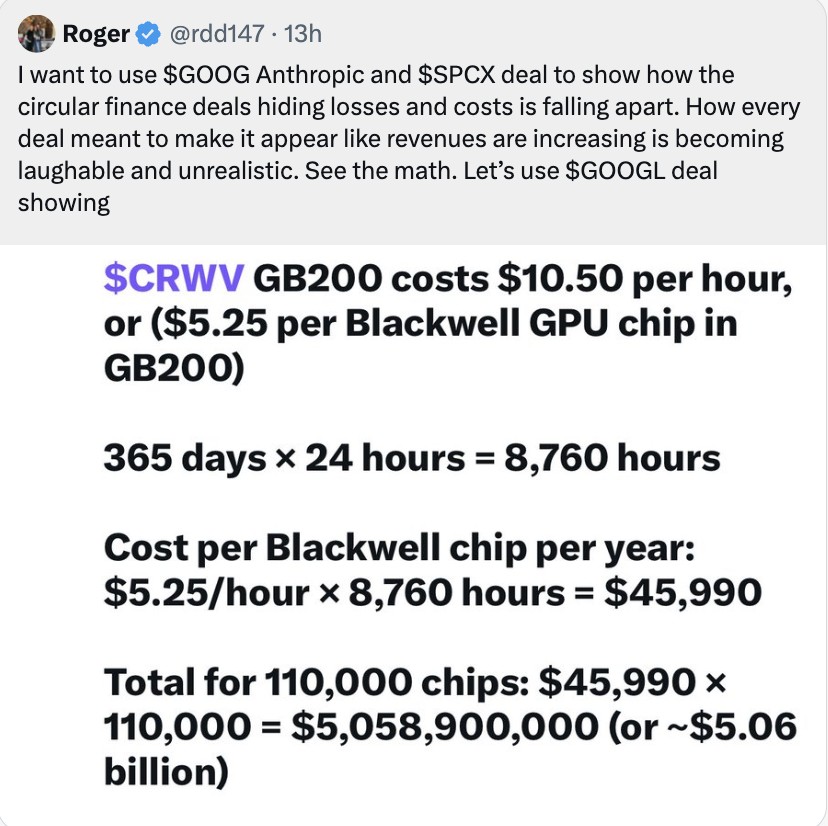
In other words, Alphabet could obtain equivalent compute power from CoreWeave at a lower price. Even if it paid CoreWeave a 100% premium, it would still save approximately $1 billion—yet Alphabet chose to lease SpaceX's compute power at a higher price.
Based on this, Roger concluded that the prices paid by Alphabet and Anthropic to SpaceX exceed the cost of building their own data centers, characterizing such transactions as a "circular finance" game where mega-tech companies use pension funds to inflate each other's valuations and create fake revenue growth.
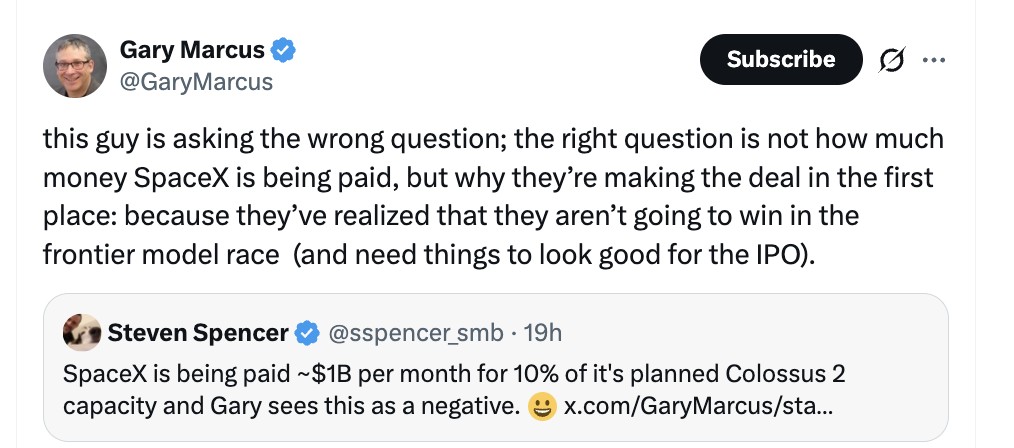
AI researcher Gary Marcus approached the issue from another angle, arguing that focusing on how much SpaceX charges is "asking the wrong question." He pointed out that the real question is why SpaceX is making this deal—in his view, the answer is that xAI has realized it cannot win the race in frontier models, and thus needs such transactions to maintain good financial performance before the IPO.
Inherent Contradictions in IPO Narrative; "Space Data Center" Vision Questioned
SpaceX's IPO filings list "orbital data centers" as one of the core growth narratives, with deployment planned to begin around 2028. However, X user Chief Agenteer directly pointed out the logical crack between this narrative and reality.
He wrote: "SpaceX is leasing out idle compute power, which itself indicates that space data centers are unnecessary and will never be economically viable. If they cannot even fully utilize the compute power built on the ground, why build more in space?"
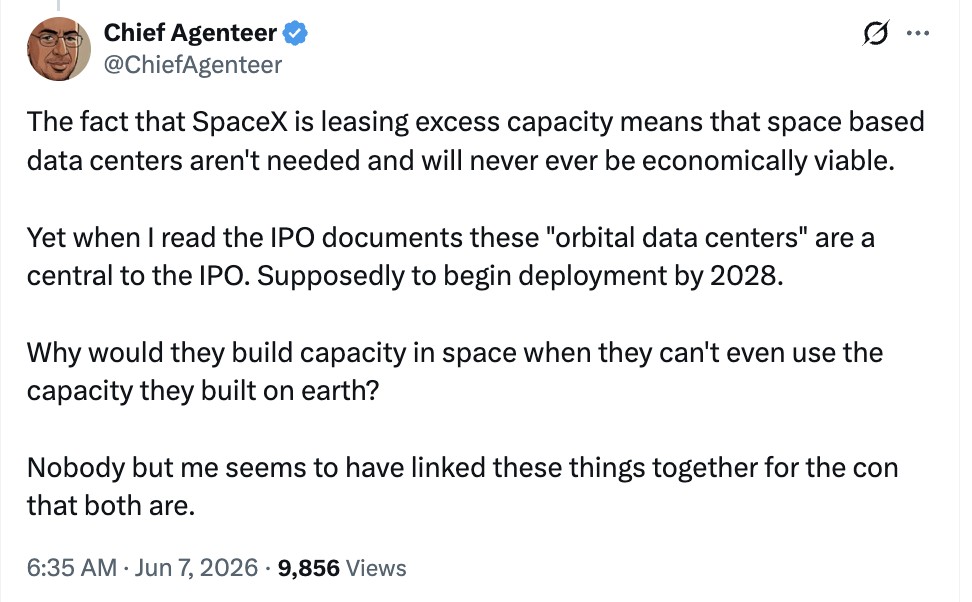
This question links two originally separate pieces of information: on one hand, SpaceX is forced to lease out ground-based compute power due to setbacks in xAI training; on the other hand, its IPO filings depict an ambitious blueprint for space compute expansion. The tension between the two has led some investors to question the overall strategic coherence of SpaceX's AI business.
xAI Training Setbacks; Colossus 1 Architecture Chaos Becomes the Trigger
According to tech media WccfTech, xAI, the laboratory under SpaceX, encountered severe technical obstacles at its Colossus 1 data center in Memphis, Tennessee. The data center deployed a mix of three different Nvidia GPU architectures: H100, H200, and GB200. This heterogeneous design prevented xAI from effectively training the Grok model on it, ultimately forcing the migration of training tasks to the Colossus 2 data center.
This technical dilemma directly explains SpaceX's motivation for leasing out compute power. WccfTech's analysis points out that SpaceX is essentially attempting to monetize xAI's poor design decisions—by signing cloud service agreements with external clients such as Alphabet and Anthropic, it converts the originally idle or inefficiently utilized Colossus 1 compute power into substantial rental income.
This background has further intensified external doubts about xAI's independent R&D capabilities. SpaceX's AI laboratory is facing dual pressures of core talent loss and R&D setbacks, and the architectural issues of Colossus 1 have undoubtedly added insult to injury.
Currently, SpaceX plans to complete its listing next week. While the highly visible revenue from the compute leasing business provides strong support for its IPO, controversies surrounding the transaction pricing logic, xAI's R&D capabilities, and the commercial viability of space data centers may become variables that investors need to carefully weigh during the pricing process.
