


NVIDIA reignites the bull market in the AI computing power industry chain! From Vera to RTX Spark to DSX, Jensen Huang unveils the "full-stack AI empire" super blueprint
NVIDIA CEO Jensen Huang unveiled the "Full-Stack AI Empire" blueprint at the GTC conference, announcing the company's transformation from a GPU supplier to a comprehensive AI infrastructure giant covering data centers, PCs, CPUs, and robotics. The speech covered the Vera Rubin architecture, DSX platform, and Nemotron 3 Ultra model, signaling that the demand for AI computing power is expanding from single-point accelerators to full-stack infrastructure, with the bullish trend in the industry chain remaining unchanged
According to the Zhitong Finance APP, on June 1st, Jensen Huang, founder and CEO of NVIDIA (NVDA.US), delivered a significant AI-themed speech before the opening of the Computex conference in Taipei, China. At this NVIDIA GTC event held in Taipei, the world's highest market capitalization company NVIDIA is accelerating its transformation from an "AI GPU supplier" to a comprehensive large-scale AI computing infrastructure supplier, encompassing "AI data center full-stack computing platform + personal computer AI chips + CPU processor integration + robotic AI infrastructure + AI software operation and maintenance system centered around CUDA."
During this GTC event, which attracted global investors' attention, Huang's AI-themed speech covered the latest capacity advancement dynamics of the next-generation AI computing architecture Vera Rubin, as well as the newly launched Vera CPU series products, the next-generation AI PC, AI Agent, the platform DSX focusing on AI super factory construction, and the latest developments in humanoid robot developers, even highlighting NVIDIA's self-developed AI large model—the brand new AI model Nemotron 3 Ultra. This underscores NVIDIA's efforts to advance the artificial intelligence computing power cluster from the "AI GPU/ASIC artificial intelligence accelerator era" to the "AI factory-led full-stack NVIDIA operating system era."
For the global AI computing power industry chain's bull market trajectory, the signals released by Huang's latest speech are very clear: there are no signs of a retreat from the high demand for AI computing power infrastructure, but rather an expansion from the single-point AI acceleration demand of AI GPU/AI ASIC to a full-stack AI computing power infrastructure layer that includes data center CPU, GPU, network infrastructure, storage chips, data center power chains, liquid cooling systems, etc. It is even accelerating towards systematic expansion in the underlying AI computing power fields of enterprise-level AI software operation/management systems around AI Agents (i.e., AI intelligent agents), as well as AI terminal chips for PCs, smartphones, smart glasses, and humanoid robots.
These latest positive developments regarding the AI computing power industry chain explain why the "AI super bull market" has not ended with the valuation increase of the Magnificent Seven but is instead transitioning from valuation narratives to profit realization and supply chain breadth expansion. Microsoft, Google, Meta, and Amazon continue to expand AI Capex, leading to systemic demand for AI server racks, advanced packaging, HBM, PCB, MLCC, ABF, optical modules, liquid cooling, power, and data center power chains. In other words, the next phase of the AI super bull market is not just about AI chips being faster and stronger in performance, but also about how chips, advanced packaging systems, network infrastructure, optical interconnect systems, underlying innovative materials, liquid cooling, PCB, MLCC, ABF substrates/glass substrates, rack-level computing clusters, and power systems collectively determine the "AI factory economics" initiated by NVIDIA CEO Jensen Huang.
Therefore, in the stock market, NVIDIA has once again ignited the AI computing power bull market frenzy—evident in the stock price of Samsung Electronics, one of NVIDIA's HBM suppliers and the world's largest memory chip giant headquartered in South Korea, which rose over 10%, driving the Korean Composite Index to a new high, with an increase of 100% this year. NVIDIA's Vera CPU architecture adopts the ARM architecture, leading to an over 8% increase in ARM's pre-market trading on the US stock market, with ARM's stock price rising over 220% this year. ** In the Japanese stock market, the stock price of MLCC giants has also risen over 8%, with a similar increase exceeding 220% this year. SoftBank, the largest shareholder of ARM and one of the major shareholders of OpenAI, surpassed Toyota in market value at the close on Monday, becoming the highest-valued company in Japan.
Currently in the mass production stage, the Vera Rubin architecture is not just the next-generation chip architecture but a redesigned data center platform centered around Agentic AI: The Vera CPU is responsible for scheduling, tool invocation, database access, code execution, reinforcement learning, and long-chain reasoning control in agent tasks; the Rubin GPU handles large-scale parallel inference and training; and the BlueField-4 STX pushes storage, networking, and security capabilities to chip-level collaboration.
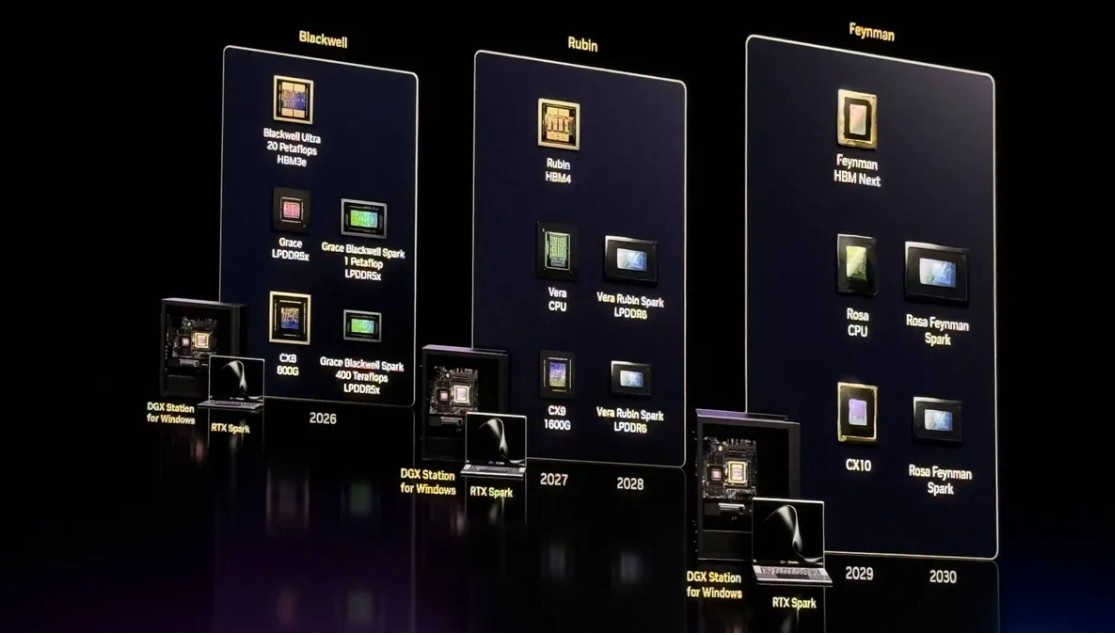
NVIDIA officially states that the Vera CPU is a processor designed for the era of Agentic AI and reinforcement learning, offering about 50% faster performance and approximately 2 times the energy efficiency compared to traditional rack-level CPUs. Jensen Huang stated at the Taipei GTC conference that OpenAI, Anthropic, and SpaceX will be among the first large users of Vera, and that Vera is entering the approximately $200 billion data center CPU market.
** RTX Spark represents another more aggressive front: NVIDIA has officially integrated data center-level AI technology into the Windows personal computer ecosystem, directly challenging Intel, AMD, and Qualcomm. According to disclosures from The Verge and the official Windows blog, RTX Spark is a super chip based on ARM architecture that integrates CPU/GPU, aimed at high-end ultrabooks, desktops, and AI development terminals, with up to 20 CPU cores, 6144 Blackwell GPU cores, and 128GB LPDDR5X unified memory, providing approximately 1 petaflop of edge-level AI performance; the first partners include Microsoft, Dell, HP, ASUS, and Lenovo. Its strategic intent is not merely to recreate a PC chip but to transform personal computers from "application running terminals" into "local agent terminals": capable of securely running large models locally, handling creative tasks, searching emails, executing code development, debugging websites, and even completing cross-application automated workflows.
** From the perspective of the AI computing power industry chain, Vera Rubin, RTX Spark, DSX, Nemotron, Hyperion, and Isaac GR00T together form a very clear NVIDIA AI technology roadmap: globally, NVIDIA aims to standardize AI factories with Vera Rubin and DSX Simulation and deployability; on the enterprise side, DGX Station and Windows AI PC bring developers into the local AI ecosystem; on the automotive side, Hyperion continues to bind autonomous driving and robot taxi platforms; on the robotics side, Isaac GR00T and Jetson Thor transition humanoid robots from laboratory prototypes to reference platforms and mass production development frameworks.
In the view of NVIDIA CEO Jensen Huang, the future scope of artificial intelligence will absolutely not be limited to chatbots, but will fully integrate with software systems, enterprise office, smart cars, robots, industry, creation, and personal computers, becoming a "real-time level AI productivity super factory" that continuously consumes AI chips, storage chip capacity and data throughput capability, network infrastructure performance, data center power chains, and AI large model service resources, etc.
NVIDIA's AI Empire Expands Again! Vera Targets OpenAI, Anthropic, and SpaceX, CPU Product Line Extends from Data Center CPUs to Windows PCs
NVIDIA CEO Jensen Huang stated that the leaders in the global AI application field—such as Anthropic PBC, OpenAI, and SpaceX, which recently acquired xAI, are among the first large users of its upcoming mass-produced data center central processing units, locking in crucial customers for further expanding its high-performance CPU business landscape in artificial intelligence data centers.
In a speech before the opening of the Computex exhibition in Taiwan, NVIDIA co-founder and CEO Jensen Huang specifically mentioned these AI development giants. He stated that they will be among the first customers to use NVIDIA's Vera central processor (i.e., Vera CPU) in their data centers. This new product will be fully produced in the third quarter of this year.
NVIDIA is focusing its efforts on proving to large customers and major institutional investors on Wall Street that it has recognized and is ahead of the changes in AI data center technology trends.
Vera is NVIDIA's first standalone data center microprocessor, which will compete directly with Intel's Xeon series, AMD's Epyc series data center server CPUs, and self-developed data center CPU projects from major cloud computing companies like Amazon Graviton. Last month, Huang stated that despite customers like Amazon attempting to seek independence in some AI components, NVIDIA continues to gain market share among these customers. He also emphasized that NVIDIA is the only company capable of producing all AI-related infrastructure components required by data center operators and integrating them efficiently into data center computing power clusters, enabling even customers with limited expertise to quickly build and deploy AI data centers.
Additionally, NVIDIA has updated and expanded its software products for planning, deploying, and monitoring data center computers. NVIDIA stated that users can adopt all or part of the open-source DSX products on demand. The company claims that the advantage of this new product lies in its ability to manage and monitor the power required for data centers more efficiently NVIDIA claims that its exclusive technologies based on NVIDIA's computing systems can enable data centers to use up to 40% more NVIDIA accelerator chips within the same power budget, which is a significant advantage.
NVIDIA has also partnered with personal computer manufacturers to launch new high-end workstation-level AI computers. NVIDIA stated that the Nvidia DGX Station for Windows will help enterprises using Microsoft's Windows system quickly develop and deploy artificial intelligence software. Dell Technologies (i.e., "Dell") and other computer manufacturers will begin selling these devices in the fourth quarter of this year.
To ignite the still nascent humanoid robot market, NVIDIA announced it is collaborating with Chinese robotics giant Yushu Technology to strive for mass production of humanoid robots, and also aims to accelerate researchers' studies on this technology and expedite the manufacturing capabilities for real-world devices. NVIDIA stated that currently, laboratories spend too much time dealing with "Frankenrobots" that require setup and fine-tuning before they can be used for research. NVIDIA indicated that the products developed through this collaboration will be equipped with dexterous five-fingered hands, as well as built-in high-performance chips and software, ensuring they can run immediately out of the box.
Undoubtedly, one of the most significant disclosures at this GTC event in Taipei is that NVIDIA is accelerating its entry into the personal computer CPU market with a new chip, aiming to weaken the technological control of the two x86 chip giants, Intel and AMD, in this field, and also striving to modernize these machines for the AI era with edge AI upgrades.
NVIDIA CEO Jensen Huang stated that this product is a combination of a central microprocessor and graphics processing chip (i.e., a PC product line based on NVIDIA's CPU+GPU architecture), developed with the assistance of MediaTek located in Taiwan, and will operate efficiently on Microsoft's Windows for Arm operating system.
Now a dominant player in the data center field, NVIDIA is accelerating its entry into the personal computer processor market. Over a decade ago, NVIDIA attempted a related effort but ultimately failed. This time, it is advancing this plan from a strong position, able to invest more computing resources than any existing manufacturer or potential competitor, such as investments exceeding those of Qualcomm and its Snapdragon product line for personal computers. For NVIDIA, this attempt further strengthens its efforts to maintain a core position among all artificial intelligence developers and users.
The company, headquartered in Santa Clara, California, stated that the first laptops equipped with RTX Spark will target the high-end market and aim to eliminate trade-offs found in competing products. The energy efficiency of this chip means that personal computer manufacturers will be able to offer extremely powerful machines that are still thin and light. NVIDIA indicated that subsequent versions of this technology will also cover a broader price range.
In the past, a deeper entry into the personal computer market would have represented a significant expansion of business scope and opportunities for NVIDIA. However, today, its data center chip product line brings in massive revenue figures that far exceed the total sales of its closest competitors NVIDIA's data center business sales in the most recent quarter are roughly equivalent to the total sales of Intel and AMD for the entire last year.
Nevertheless, investors who have driven up NVIDIA's stock price due to the rapid rise of artificial intelligence may welcome NVIDIA's enhanced presence of AI technology in delivering AI technology to end users of products like PCs. Although NVIDIA has achieved growth that surpasses other chip giants, its stock performance this year has significantly lagged behind the Philadelphia Semiconductor Index, the benchmark valuation for chip stocks, despite being the world's highest market capitalization company exceeding $5 trillion.
The RTX Superchip will be equipped with a personal computer central processing unit (PC CPU) with up to 20 computing cores, as well as a Blackwell generation graphics processor with 6,144 cores. These two components will share built-in memory, allowing for better handling of large AI models and AAA-level super games. They will use NVIDIA's NVLink interface for high-speed communication, indicating that NVIDIA is beginning to bring some data center technology into personal computers. This chip design will be manufactured using TSMC's 3N process technology, a long-term foundry partner of NVIDIA, known as the "king of global chip foundries."
NVIDIA has stated that it has been collaborating with Microsoft for many years to prepare for these new devices and ensure software support, allowing ARM chip architecture technology to ultimately gain a foothold in the Windows PC world. Microsoft and Qualcomm have jointly promoted similar personal computers for over a year, but with limited impact. Aside from Apple's Mac product line, most personal computers use x86 architecture central processing units built by Intel or AMD.
Based on NVIDIA's new computing machines, they will be better equipped to handle AI models and AI functionalities within commonly used software systems. For example, the American software giant Adobe's Photoshop application is being reconfigured based on NVIDIA technology to better respond to AI-based prompts for generating images and video content. NVIDIA has stated that these new devices will also enhance gaming capabilities, allowing laptops to efficiently run high-end gaming masterpieces.
Overall, NVIDIA-based personal computers will be able to securely and efficiently run large AI models on the edge, enabling users to easily implement controls and decide which data and software can be accessed. NVIDIA claims that such protective measures will accelerate the transformation of personal computers into personal super AI assistants, making it easier not only to respond to user inputs, search emails, and perform common operational flows but also to tackle more complex tasks like identifying and fixing website vulnerabilities.
From AI Data Centers to AI PCs to Robotic Terminals, NVIDIA Does Not Hide Its Ambition for Full-Stack Computing Power
Overall, from AI data centers to PCs, and to robots with NVIDIA's self-developed focus on AI agents, the AI large model Nemotron 3 Ultra, Jensen Huang is truly discussing a **"ubiquitous AI" full-stack AI computing power and a grand path towards a global "AI factory." Through this GTC 2026 AI-themed speech held in Taipei, NVIDIA has clearly conveyed a strategic turning signal to the global industrial chain: AI computing power is transitioning from a purely GPU-accelerated system to an ecological industrial system advancing on dual tracks of "AI factories" and "localized AI agent terminals." At the data center end, NVIDIA's Vera Rubin platform has entered full-scale production (Vera Rubin represents the third generation MGX architecture and supports POD-level ultra-large-scale deployment), and has been included in the first batch of adopters by top AI research laboratories and cloud service providers, including OpenAI, Anthropic, and SpaceX.
This computing infrastructure architecture platform integrates Vera CPU, Rubin GPU, BlueField-4 STX storage/security DPU, and Spectrum-X optical interconnect technology, aiming to significantly improve the energy efficiency and throughput of agentic AI inference and training. Compared to previous architectures, it achieves higher performance and lower token consumption costs, and supports AI factory-level deployment with millions of GPU-level high-speed interconnections, fundamentally reshaping the energy efficiency and economies of scale of AI data center infrastructure.
In the CPU dimension where NVIDIA has been making continuous efforts in recent years, the significant release of Vera CPU means that NVIDIA has designed a data center CPU entirely driven by the massive computing power demand of AI inference for the first time. According to official information, Vera has significant performance and energy efficiency advantages over traditional x86 CPUs when running agent tasks, and serves as the host control chip for the Rubin platform and BlueField-4 STX modules. This strategy responds to the new demands of agentic AI (multi-step inference, tool embedding, online execution, and other composite workloads) for general-purpose processors on one hand, and on the other hand, allows NVIDIA to move towards an integrated full-stack computing architecture of CPU + GPU + DPU beyond the originally GPU-dominated AI stack, consolidating its central position in foundational AI infrastructure. In terms of system manufacturing and ecosystem, companies including Dell, HP, Lenovo, Supermicro, and several OEM/ODM manufacturers in Taiwan have planned server and system products based on Vera, which will further promote ultra-large-scale and enterprise-level computing deployments.
In parallel with the advancement of the data center ecosystem, NVIDIA announced at the GTC conference that it will bring AI infrastructure down to the personal computer level, launching the RTX Spark super chip for Windows—a supercomputing platform that integrates ARM CPU, Blackwell GPU, and large-capacity unified memory on a single chip, enabling high-speed communication between CPU and GPU through NVIDIA's exclusive NVLink in AI data centers.
According to official and media reports, the design architecture and goals of RTX Spark aim to make personal computers a local AI agent operating platform capable of handling large model inference, graphics rendering, video creation, and other tasks, and to collaborate with Microsoft to create a native agent experience on Windows, thus transforming PCs from traditional application tools into "intelligent partners collaborating with users." This layout indicates that NVIDIA aims not only to maintain a lasting dominance in computing infrastructure for AI data centers but also to establish a new AI entry point and human-computer interaction revolution at the personal level, similar to how Apple's self-developed chip system—Apple Silicon—reconstructed the global consumer electronics chip and application design ecosystem, but with the goal of transforming the entire Windows ecosystem and personal intelligent experience
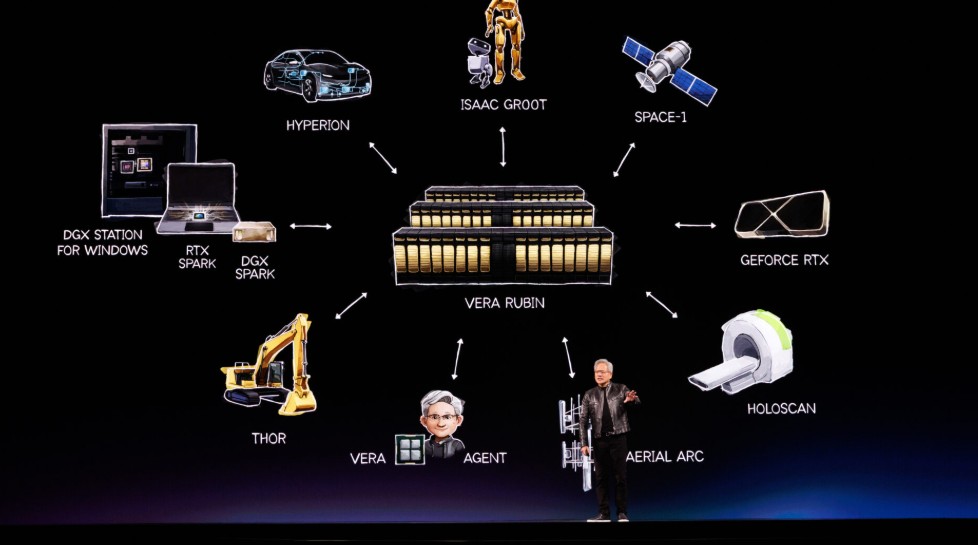
In addition, Jensen Huang's latest keynote speech also shows that NVIDIA's expansion in autonomous driving, humanoid robots, and AI developer toolchain ecosystems (such as Nemotron 3 Ultra AI large model, NVIDIA DSX platform, Isaac GR00T robot development platform) reflects its attempt to establish a full-scenario AI ecological closed loop. The autonomous driving Hyperion platform and the open inference model Alpamayo 2 further consolidate NVIDIA's layout in the smart mobility field, while the platform for physical AI and entity robot development helps promote the implementation of intelligent agents in the real world. This ambitious full-stack computing layout from chips to software to upper-layer AI applications may become the core driving force for the rapid spread of AI application systems across various industries in the future.
The bull market narrative of the AI computing power industry chain is far from over! Wall Street anticipates NVIDIA's market value to set sail and challenge $7 trillion.
For the global AI computing power industry chain bull market, NVIDIA's signals at the GTC conference and the Computex 2026 opening ceremony are very clear: There are no signs of a retreat from the high demand for AI computing power infrastructure; instead, it is expanding from single-point AI accelerators like AI GPUs/AI ASICs to full-stack AI computing power infrastructure layers including data center CPUs, GPUs, network infrastructure, storage chips, data center power chains, liquid cooling systems, and more.
Vera proves that NVIDIA aims to capture the incremental data center CPU market; DSX enhances power efficiency and cluster management; RTX Spark pushes AI computing power to Windows terminals; DGX Station for Windows serves enterprise AI development; and robot collaborations open up physical AI demand. In other words, the main line of the AI computing power bull market is not just "selling more GPUs," but "restructuring the entire computing resource industry chain around AI model training, inference, intelligent agents, and real-world execution."
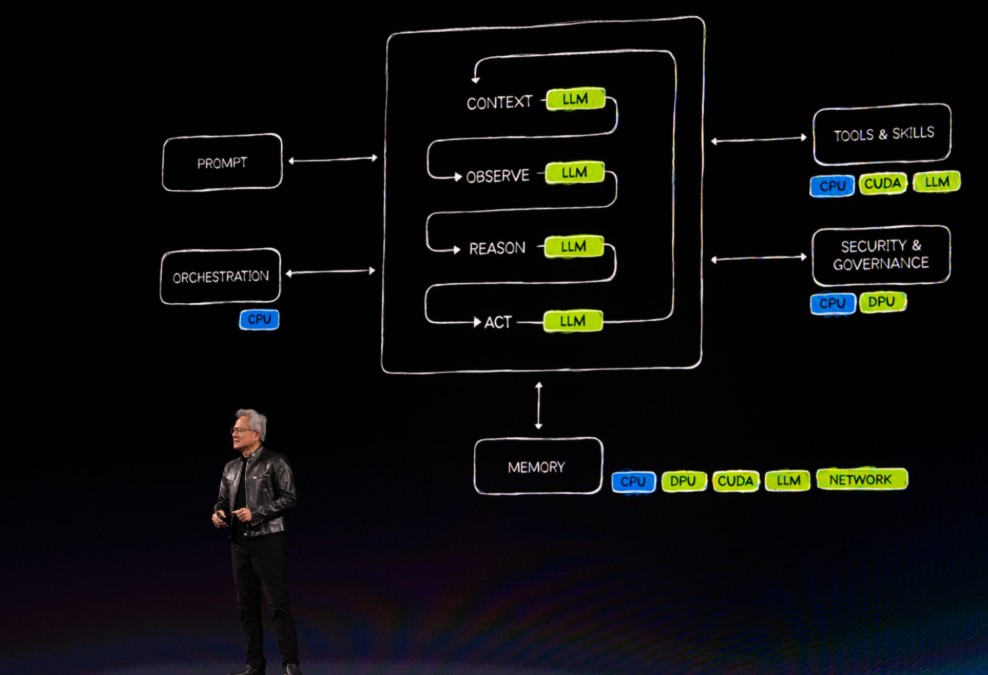
The trend of "AI integrating into everything" is becoming increasingly irreversible. If the AI market in the past two years mainly traded on "model training/inference requiring GPUs," then the next phase will trade on "all software systems, all terminals, all robots, and all data center operation systems must become AI native." NVIDIA's product matrix at Computex 2026 is laying the foundation for this world of computing power: **Vera is responsible for general computing in data centers, and Rubin/Vera Rubin is responsible for the next generation of AI clusters DSX is responsible for cluster efficiency, RTX Spark is responsible for personal terminals, DGX Station is responsible for enterprise development, and the robotics platform is responsible for the physical world.
The logic of the AI computing power bull market is expanding from a single chip shortage to a long-term capital expenditure cycle for full-stack computing power infrastructure. According to the analyst team at Wall Street financial giant Bank of America, AI computing power infrastructure is entering a more durable and broader capital expenditure cycle. Almost simultaneously, another Wall Street financial giant, Morgan Stanley, released a research report indicating that the AI computing arms race has entered a system-level expansion phase, with AI infrastructure demand showing a rare "inelastic" trend—meaning that regardless of cost curves, tech giants continue to ramp up the construction of AI data centers, and this "inelastic demand" will continue to strengthen the resilience of the U.S. economy and the overall profit growth rate of the S&P 500.
Global funds are actively betting on the segments of the global AI value chain that are more robust, scarcer, and harder to replace, rather than traditional application software that still needs to prove the resilience of business models in the Agent era, highlighting that the "sell software, flood into semiconductors" investment strategy is arguably the perfect answer in the current stock market investment field.
Morgan Stanley stated that the AI computing arms race has entered a system-level expansion phase. The institution has significantly revised its capital expenditure expectations for U.S. tech giants in 2026 from $433 billion a year ago to $805 billion, with capital expenditures in 2027 expected to reach $1.1 trillion, up from the previous forecast of $950 billion. Furthermore, it predicts that by 2028, nearly $3 trillion in AI-related infrastructure investment will flow through the global economy, with over 80% of the spending still ahead.
Morgan Stanley's latest expectations highlight that the supply chain bottleneck in AI computing power infrastructure has expanded from "large-scale purchases of GPUs/ASICs" to "striving to simultaneously address the entire delivery process of AI data centers, including data center power equipment, liquid cooling, data center CPUs, DRAM/NAND/HBM, optical communication/optical interconnect, high-performance Ethernet network infrastructure/data center DCI high-speed interconnection, transformers, gas turbines, etc."
On Wall Street, analysts are increasingly bullish on NVIDIA, believing that NVIDIA's latest performance clearly highlights that the global AI computing power infrastructure construction frenzy is far from over and is expanding from AI GPUs/AI ASICs to data center CPUs, high-performance network infrastructure, machine-level server clusters, AI super factories, and enterprise-level large-scale AI cloud computing systems.
Recently, NVIDIA has brought to Wall Street not just a single AI GPU or graphics card growth story, but an explosive expansion of AI factory economics. This also means that NVIDIA is upgrading from "AI GPU leader" to "AI infrastructure platform company" encompassing data center GPUs + CPUs + network infrastructure + rack-level systems + edge AI underlying computing architecture + CUDA developer software ecosystem, even violently cutting into the value pool of data center servers and PC CPUs long dominated by the two x86 chip giants, Intel and AMD
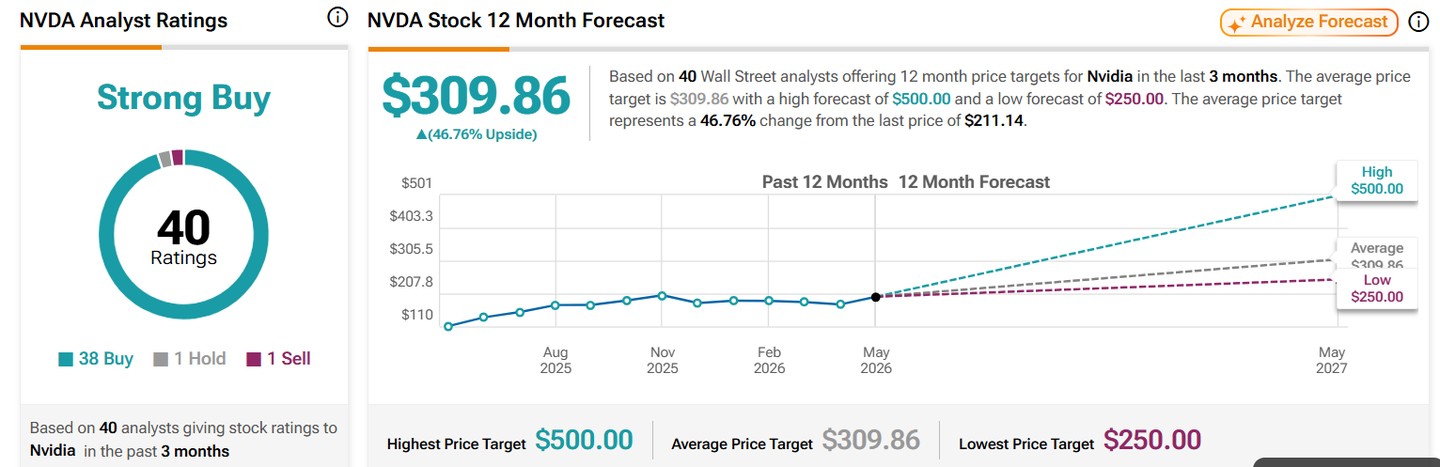
According to the target price data compiled by MarketScreener from 61 Wall Street analysts, the average target price for NVIDIA over the next 12 months is as high as $296.81, with the highest target price reaching $500. Based on the current market capitalization (as of last Friday's U.S. stock market close, NVIDIA's market capitalization was approximately $5.11 trillion, with the stock price around $211), the average target price of $296.81 corresponds to a market capitalization of about $7.24 trillion, representing a potential upside of over 40% from the current level. The highest target price of $500 corresponds to a market capitalization of about $12.2 trillion, indicating an astonishing potential upside of approximately 136.8%, which means a potential increase in market capitalization of about $7.0 trillion.
The implications of these numbers regarding potential market capitalization and growth are quite dramatic: Wall Street's highest target price implies that NVIDIA could become a super AI empire worth over $12 trillion. Previously, the average market capitalization range given by Wall Street analysts was between $1 trillion and $5 trillion, which NVIDIA has already surpassed, leading investors to increasingly believe that $7 trillion will be the next significant market capitalization milestone.
