


AI Sparks a Power Architecture Revolution: Who Will Be the Biggest Winner in the 800VDC Wave?
The explosive growth in AI computing density is driving a power architecture revolution in data centers: rack power is set to jump nearly 100-fold within a decade, pushing the legacy 54V system to its physical limits and paving the way for the new 800VDC architecture. Bank of America Securities estimates that the addressable market for analog semiconductors will expand to $27 billion by 2030, with Infineon Technologies showing the most significant share gain, Texas Instruments firmly holding the top spot, while SiC and GaN materials accelerate their capture of high-value segments
The exponential growth in AI computing density is triggering a historic restructuring of data center power infrastructure. Rack power demand is expected to surge nearly 100-fold within a decade, forcing a comprehensive overhaul of the entire power distribution system from the grid entry point to the chip core. This shift opens up a long-term incremental market worth $27 billion for the analog semiconductor industry.
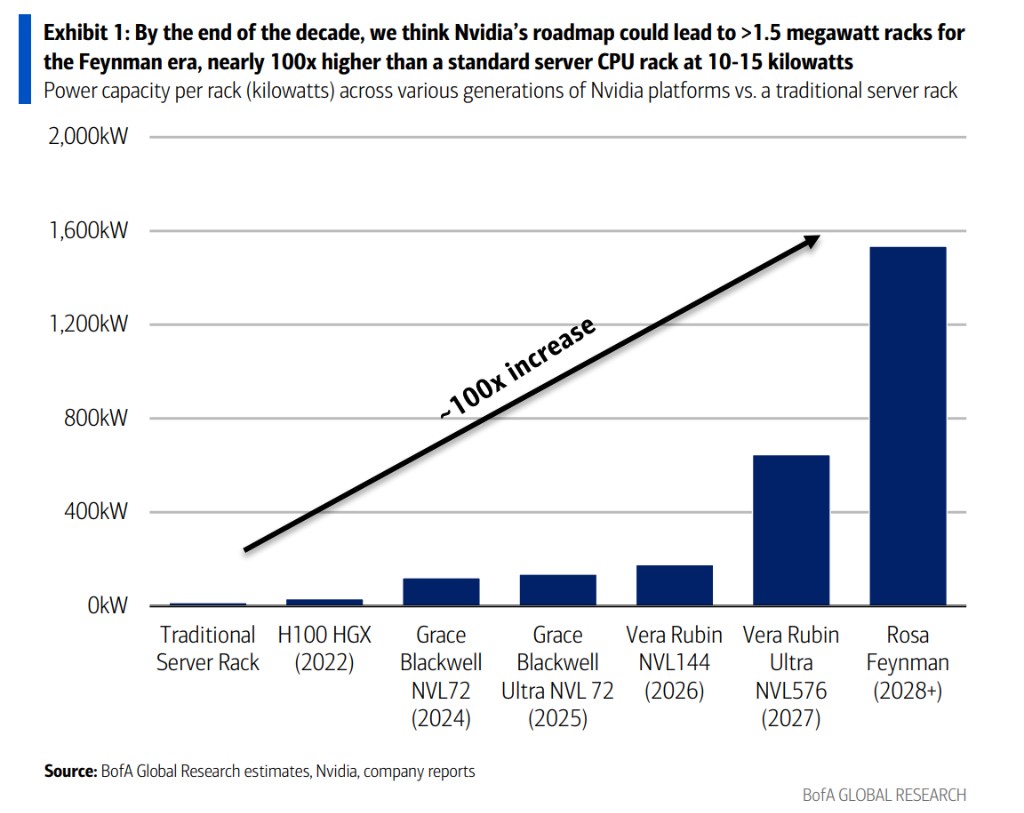
According to an in-depth report on the semiconductor industry released by Bank of America Securities on May 25, the evolution of AI computing power will drive data center rack power from the 10–15 kW range of traditional servers to over 1.5 MW for NVIDIA's Feynman platform (expected to launch in 2029/2030), representing an increase of nearly 100 times.
The existing power distribution architecture, centered on 54V DC, is approaching its physical limits—copper busbar weight, space occupancy, and conversion losses can no longer support next-generation power demands. The new generation architecture, centered on 800V DC (800VDC), is becoming an inevitable industry choice. The bank expects 800VDC to enter the commercialization phase first alongside the deployment of NVIDIA's Rubin Ultra platform (with rack power exceeding 600 kW).
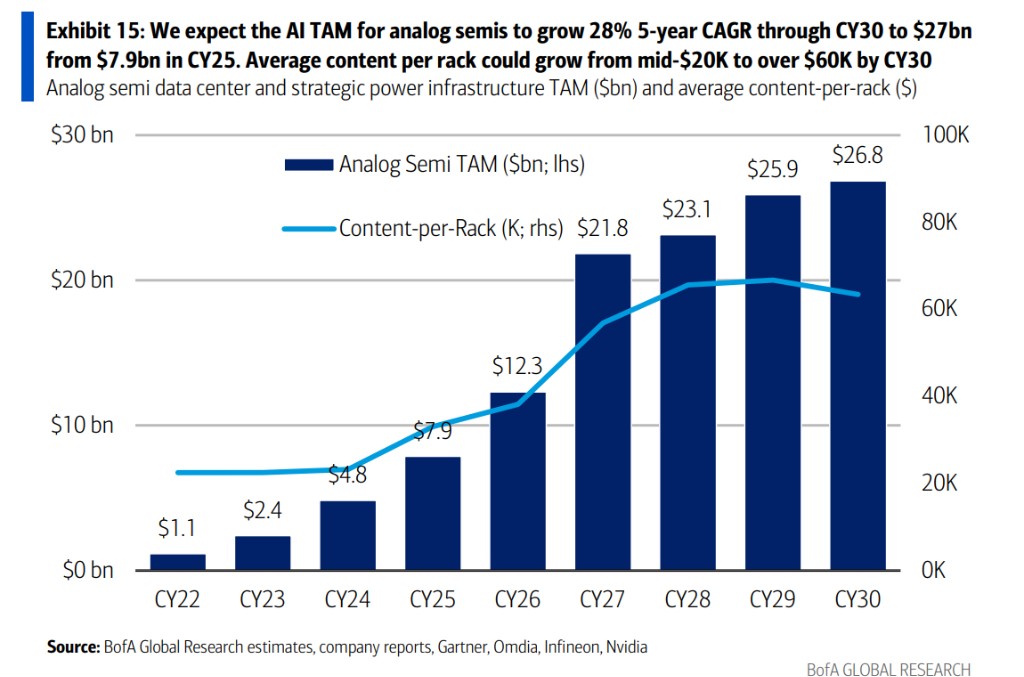
This structural change brings unprecedented incremental space for analog semiconductor suppliers. Bank of America Securities' bottom-up industry demand model shows that the addressable market size for AI analog semiconductors will expand from $7.9 billion in 2025 to $27 billion in 2030, with a compound annual growth rate (CAGR) of 28%. The content value of analog semiconductors per rack will also jump from the current ~$36,000 to nearly $300,000 for racks above 600 kW, and over $900,000 for megawatt-level racks.
Bank of America Securities believes that the final beneficiary landscape will be highly concentrated among manufacturers with broad "full power tree" portfolios. Texas Instruments continues to lead with the highest existing share; Infineon Technologies stands out for the breadth of its AI product portfolio and is expected to see the most significant share increase between 2025 and 2030; Analog Devices ranks third, bolstered by the acquisition of Empower; and onsemi achieves considerable wallet share expansion through new material technologies like silicon carbide (SiC) and gallium nitride (GaN).
Power Surges 100-Fold as Existing Architecture Hits Physical Limits
Every architectural upgrade in AI infrastructure comes at the cost of a significant leap in rack power.
According to Bank of America Securities' research report, rack power in the NVIDIA Hopper H100 era was only about 32 kW. It surged to 100–120 kW with the Blackwell GB200 NVL72, is expected to exceed 646 kW for the upcoming Rubin Ultra (NVL576 configuration), and is projected to break 1.5 MW for the Feynman platform.
The fundamental driver behind this sharp expansion in power demand is the continuous expansion of the GPU scale-up domain. Since GPUs communicate at high speeds via copper interconnects, physical distance is limited by signal attenuation, requiring GPUs to be densely packaged within the same rack. As the number of GPUs per node expands from 32 in the Hopper era to 576 in the Feynman era, and with the thermal design power (TDP) of each GPU generation increasing by an average of ~20%, overall rack power grows multiplicatively. This "performance density trap" is the core logic driving the continuous rise in power for NVIDIA platforms.
The same trend is spreading to non-NVIDIA camps.
AMD's Helios platform rack power has already exceeded 100 kW, and self-developed ASIC platforms from Google, AWS, and others are showing similar trajectories. Bank of America Securities predicts that between 2025 and 2030, AI computing-related data centers will add a cumulative 233 GW of installed power capacity, with annual additions growing from ~17 GW in 2025 to ~60 GW in 2030.
The existing power distribution architecture, centered on 54V or 48V DC, faces three structural constraints: If a single 600 kW rack continues to use 54V distribution, the copper busbar weight reaches 200 kg, significantly encroaching on computing space; multi-layer AC/DC conversions 叠加 efficiency losses of ~1–2% each; and redundant conversion stages simultaneously increase system failure points. Bank of America Securities points out that this architecture can no longer support the large-scale deployment of next-generation computing platforms.
800VDC: A Systemic Solution to Break Power Distribution Bottlenecks
The 800VDC architecture fundamentally 重构 s the traditional power distribution process. Medium-voltage AC power is directly converted to 800V DC at the data center campus entrance, eliminating multiple intermediate conversion layers. High-voltage DC is transmitted via row-level power distribution units (PDUs)/busbars to the racks, where it is stepped down stage-by-stage via intermediate bus converters (IBCs) to the sub-1V operating voltage required by GPU cores.

Compared to the 54V solution, the advantages of the 800VDC architecture are evident in multiple dimensions: power transmission capacity for the same wire cross-section increases by ~85%, and copper usage can be reduced by ~45%; overall system energy efficiency improves by up to 5 percentage points; maintenance costs decrease by up to ~70% due to lower power supply unit (PSU) failure rates; and total cost of ownership (TCO) is expected to improve by ~30%. Citing NVIDIA data, Bank of America Securities notes that 800VDC also supports future rack density expansion to 1 MW and beyond, offering significant forward compatibility.
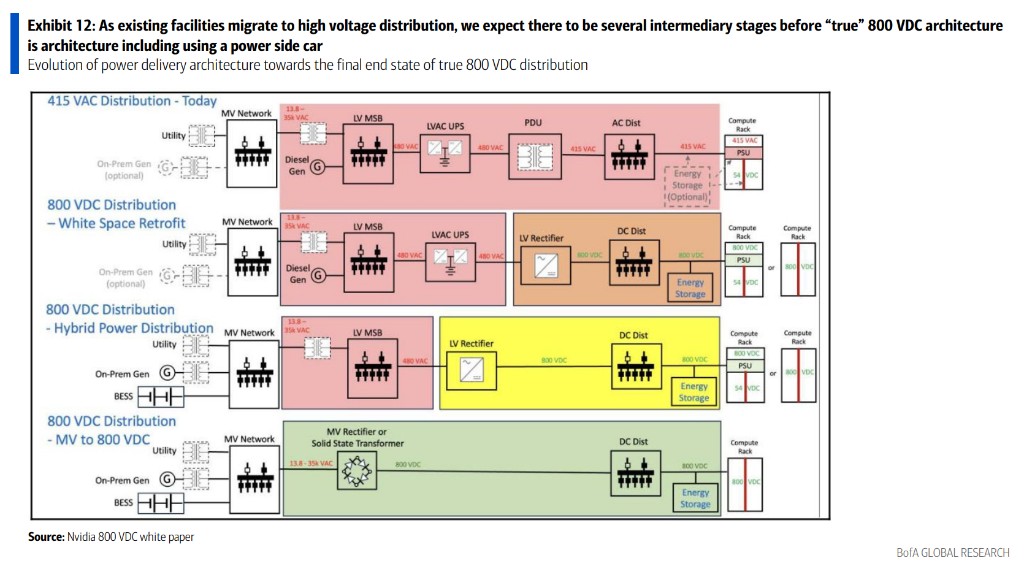
Bank of America Securities points out that the implementation of 800VDC will proceed in phases. The first phase is "white space retrofitting," reducing IT rack complexity by moving AC/DC conversion to independent power sidecars; the second phase is "hybrid distribution," where facility-level rectifiers uniformly output 800V DC to racks; the final phase is a "DC microgrid" architecture centered on solid-state transformers (SSTs) and solid-state circuit breakers (SSCBs), expected to land first in greenfield new construction projects between 2028 and 2030. The Kyber rack accompanying NVIDIA's Rubin Ultra is expected to be a key node for the first large-scale commercial deployment of 800VDC.
Data Centers: A $25 Billion Revaluation of Content Value
Architectural upgrades bring not only market expansion but also a profound migration in value distribution. Bank of America Securities splits the AI analog semiconductor market into two categories: "Data Center" (rack to chip) and "Power Infrastructure" (grid to server room), each corresponding to different growth logics.
The TAM on the data center side is expected to increase from $7.6 billion in 2025 to $25 billion in 2030, with growth rates of ~56% and ~77% in 2026 and 2027 respectively, mainly driven by the accelerated volume ramp-up of high-power racks.
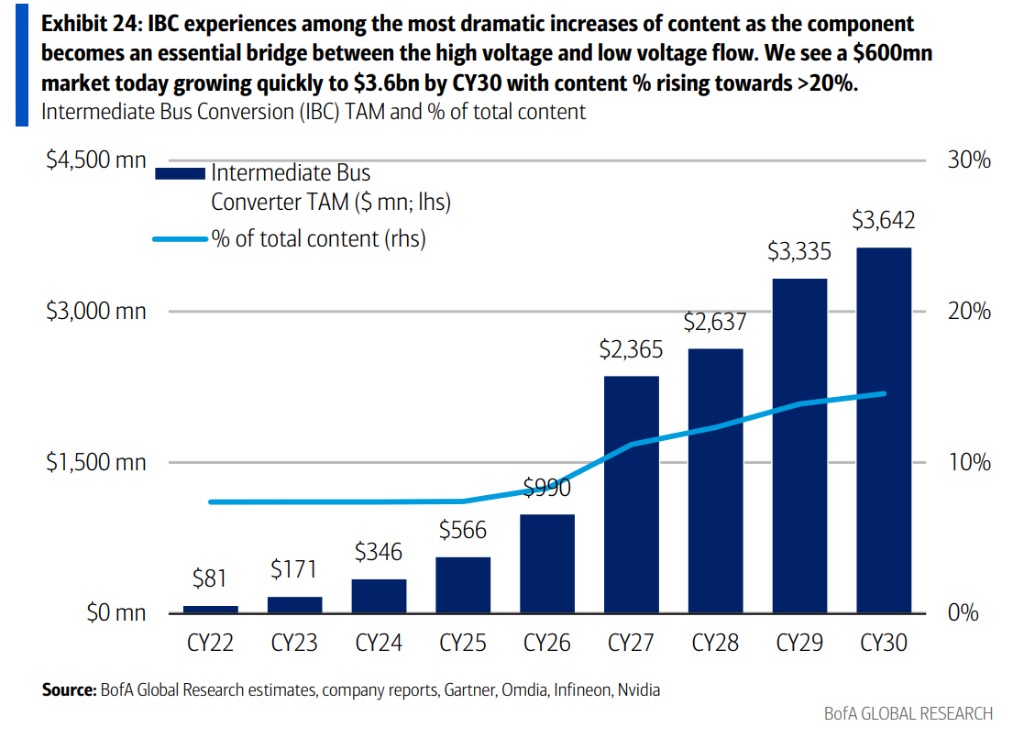
Component categories with the most significant value vectors include: high-voltage intermediate bus converters (IBC, TAM share rising from 7% to ~15%), GPU board-level power supplies (steadily occupying ~25–27%), CPU composite power supplies (share rising from ~9% to ~13%), and optical infrastructure (~13%).
IBC is one of the components undergoing the most drastic value reconstruction in the 800VDC architectural shift.
As racks upgrade from 100–160 kW to 600 kW and megawatt levels, IBCs must handle step-down conversion from 800V high voltage to 54V, 12V, or even 6V. The market size is expected to jump from ~$566 million in 2025 to $3.6 billion in 2030, an increase of over 6 times. GPU board-level power supplies (including multi-phase VRMs and vertical power delivery designs) see their content value expand from ~$9,700 for 100–160 kW racks to ~$270,000 for megawatt-level racks, driven by the continuous growth in GPU count, current density per accelerator, and phase count.
ADI's acquisition of Empower is a concrete manifestation of positioning for this trend—Empower possesses integrated voltage regulator and silicon capacitor technology, which can push conversion functions closer to the processor package, directly entering the highest-value "last inch" power delivery slot.
Device Types: Wide-Bandgap Materials Accelerate Penetration
At the device material level, Bank of America Securities predicts a clear path from silicon dominance to accelerated penetration by wide-bandgap semiconductors.
Analog ICs currently account for ~66% of the AI analog semiconductor TAM and will remain the largest segment in 2030, with absolute scale increasing to ~$15.9 billion. However, SiC and GaN will be the fastest-growing device types, with CAGRs of 63% and 69% respectively from 2025 to 2030, raising their combined TAM share from ~4% to ~12%.
In high-voltage environments, SiC dominates in IBC high-voltage input stages, PSU power factor correction (PFC), and solid-state transformers; GaN has advantages in dense DC/DC conversion scenarios close to the compute end. Bank of America Securities believes GaN is poised to become the dominant material for IBCs in high-power racks. onsemi's development of vertical GaN (vGaN)—a longitudinal conductive structure fabricated on bulk GaN substrates—is an emerging technical route that combines the voltage robustness of SiC with the high-frequency switching advantages of GaN, viewed as a potential important breakthrough for IBCs.

Silicon-based devices maintain dominance in cost-sensitive scenarios such as low-voltage secondary-side rectification and VRM control drivers, but high-value-added incremental share will tilt towards wide-bandgap materials. The TAM share of MCUs and sensors will also steadily rise with increasing demand for distributed power orchestration and real-time monitoring of megawatt-level racks.
Supplier Landscape: Infineon Shows Most Significant Share Jump
Bank of America Securities' bottom-up revenue model provides a detailed breakdown of eight major suppliers, revealing a clearly differentiated landscape.
Texas Instruments (TXN) continues to hold the highest market share with its leading power semiconductor portfolio. AI-related revenue is expected to grow from ~$1.55 billion in 2025 to ~$5.7 billion in 2030, with market share remaining in the ~20–21% range.
Infineon Technologies, with the broadest AI product matrix spanning silicon, SiC, and GaN, is expected to see its market share climb significantly from ~11.5% in 2025 to ~17.3% in 2030. This corresponds to revenue growth from ~$900 million to ~$4.6 billion, making it the supplier with the largest share increase in the TAM.
ADI ranks third, with market share rising from ~13% to ~17%, and AI revenue reaching ~$4.4 billion in 2030; the Empower acquisition further strengthens its competitive position in the high-value "last inch" power delivery slot near processor packages. onsemi (ON) sees its share jump from ~3.8% to ~8.6%, the second-largest increase after Infineon, primarily driven by new penetration of SiC and vGaN technologies in high-power IBC and solid-state protection scenarios.
Bank of America Securities emphasizes that the common characteristics of the ultimate winners are: (1) possessing a broad product portfolio covering the entire power tree, rather than being single-product suppliers; (2) meeting elite reliability requirements in high-voltage scenarios; (3) having system-level design support capabilities from grid to chip, and maintaining deep ties with ecosystem leaders like NVIDIA.
Power Infrastructure: Solid-State Technology Opens Up an Additional $2 Billion Space
The reshaping of power infrastructure by data centers is equally profound, but this part of the market is typically reflected in the industrial or infrastructure business segments of relevant suppliers, rather than the data center segment.
Bank of America Securities expects the strategic power infrastructure analog semiconductor TAM to grow from ~$245 million in 2025 to $1.8 billion in 2030, with a CAGR of 49%. The growth inflection point is expected around 2028. The current content value per megawatt is ~$12,400, which could rise to ~$38,900 with the implementation of hybrid microgrid architectures.
Solid-state transformers (SSTs) are the core carrier of this upgrade. Compared to traditional low-frequency transformers, SSTs reduce volume by ~14 times, weight by ~40 times, and construction time by ~50%, while directly converting medium-voltage AC to 800V DC, significantly simplifying downstream distribution links.
Traditional transformers contain almost no analog semiconductors, whereas SSTs consist of high-voltage power devices, gate drivers, isolation, current and voltage sensing, controllers, protection, and digital control modules, with SiC being the preferred device material. Infineon expects the overall SST market size to reach $1 billion by 2030. Based on this, Bank of America Securities estimates the analog semiconductor opportunity at ~$500 million, with the scale inflection point for actual commercial deployment expected between 2028 and 2030.
Solid-state circuit breakers (SSCBs) are the key guarantee for the safety and reliability of 800VDC high-voltage DC distribution. Compared to traditional mechanical circuit breakers, SSCBs can isolate faults within nanoseconds to microseconds, while offering real-time monitoring and remote control capabilities. Their applicable voltage range aligns highly with the advantage zone of SiC devices. Bank of America Securities estimates the SSCB analog semiconductor opportunity to reach ~$400 million by 2030. Both Infineon Technologies and onsemi possess strong competitiveness in this niche market thanks to their respective SiC JFET-to-MOSFET product lines.
