


Is AI Agent Apple's Big Opportunity?
Bank of America Securities has significantly raised Apple's Price Target from $330 to $380, with logic pointing directly to the core proposition of the agentic AI era: the winner is not necessarily the one with the strongest model, but the entry platform that controls user intent, permissions, payments, and trust. The iPhone naturally sits at this intersection, and Agentic Siri could bring up to $65 billion in incremental revenue by 2030, provided Siri truly evolves from "able to answer" to "able to execute."
In the next phase of AI investment, Apple could transform from a "bystander" into a core beneficiary—but only if Siri truly evolves.
According to Zhuifeng Trading Desk, Bank of America Securities analyst Wamsi Mohan raised Apple's Price Target from $330 to $380 in a research report on May 26, maintaining a Buy rating. The core logic is: In the agentic AI era, value will flow to platforms that control user intent, personal context, app access, permissions, identity authentication, payments, and trust, not necessarily to the party with the most powerful model capabilities. The iPhone happens to sit at the intersection of these elements.
This Price Target Revision corresponds to 37 times the expected calendar year 2027 earnings per share (EPS) of $10.29, up from 32 times previously. The basis for the increased valuation multiple is not short-term sales expectations, but Apple's potential to regain pricing power over the service layer, transaction layer, and entry layer in the agentic AI era. Bank of America estimates that Agentic Siri could generate $15 billion to $30 billion in net incremental revenue by fiscal year 2030, reaching $40 billion to $65 billion in a bull case, with EPS increment potentially approaching $2.
The greatest uncertainty also arises here: Siri has disappointed the market in the past. If user task habits have already shifted to external assistants like ChatGPT, Gemini, or Claude, Apple still controls hardware and permissions, but the AI value it can capture will shrink significantly.
Apple's AI Opportunity Lies Not in the "Strongest Model," but in the "Most Trusted Entry Point"
The core experience of the first generation of generative AI was Q&A, summarization, writing, and code generation, where users asked questions directly to the model interface, allowing the model side to capture value more easily. The logic of agentic AI is different: it requires planning steps, calling tools, reading context, requesting confirmation, and completing actions. A strong model alone is not enough; it also requires comprehensive coordination of calendar, contacts, email, messages, location, payments, identity authentication, and app permissions.
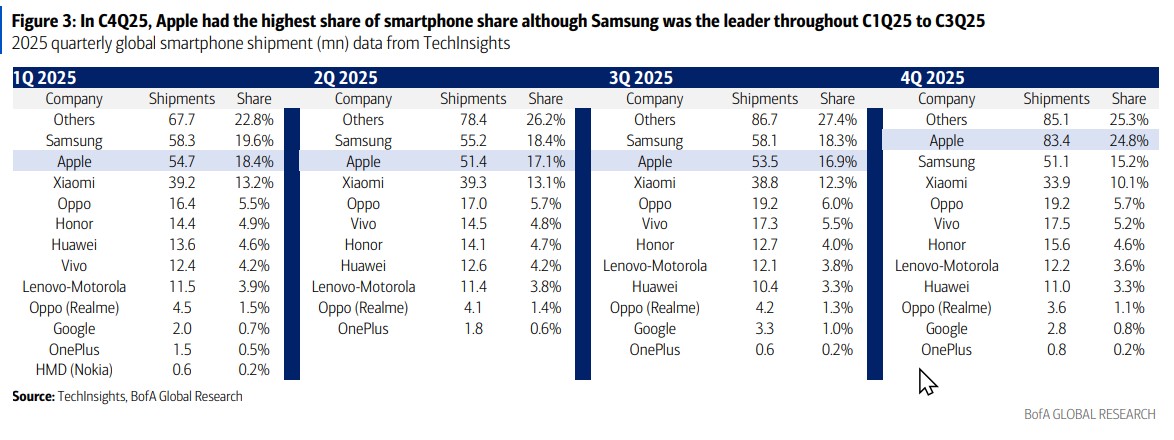
Smartphones are naturally at the intersection of these elements. Compared to emerging AI hardware, phones already have scale, an app ecosystem, payment rails, biometrics, and daily usage habits. Apple's global smartphone shipments in 2024 were 232.1 million units, with a market share of 18.7%; shipments in the fourth quarter of 2025 were 83.4 million units, with the share rising to 24.8%. This is an entry point that does not require educating users from scratch.
Agentic AI scenarios directly rewrite value distribution. Users no longer manually open calendars, emails, maps, and wallets, but simply say, "Help me reschedule the meeting, notify attendees, update the route, and make the payment." Whoever controls the routing, permissions, and confirmation after this statement has the opportunity to redefine how search, app distribution, transactions, and advertising generate revenue.
iPhone's Moat Is Apple Silicon Working Together with iOS
Apple's hardware advantages in agentic AI are divided into two layers.
The first layer is Apple Silicon. Agentic tasks require frequent processing of voice, images, text, notifications, search, and intent classification. If all requests are sent to the cloud, latency, privacy, reliability, and cost become obstacles. On-device inference can shorten response times and compress cloud inference expenses. The iPhone 17 series sees increased memory compared to the previous generation, with the iPhone 17 having 8GB, and the iPhone Air, iPhone 17 Pro, and Pro Max having 12GB; however, to support a more robust on-device AI experience, the report judges that memory needs to reach at least 16GB, and more likely 24GB, meaning current hardware does not yet meet the standard.
The second layer is iOS. The chip determines how much intelligence can run locally, while iOS determines whether this intelligence can truly act on behalf of the user. Agentic AI requires accessing personal data, calling apps, confirming user identity, and executing payments, all of which are operating system-level capabilities. Apple does not need to own every strongest model, but it can decide which tasks are processed locally, which enter Private Cloud Compute, and which are handed off to external models—as long as Siri is the user's default entry point, underlying models can be routed, replaced, or combined.
According to third-party information, Siri may be significantly rebuilt in iOS 27, shifting from a command-based voice assistant to a more persistent, conversational agent form that can call personal context and act across apps. If this comes true, it will directly address Apple's most needed shortcoming: not creating a Siri that "can answer," but one that "can execute."
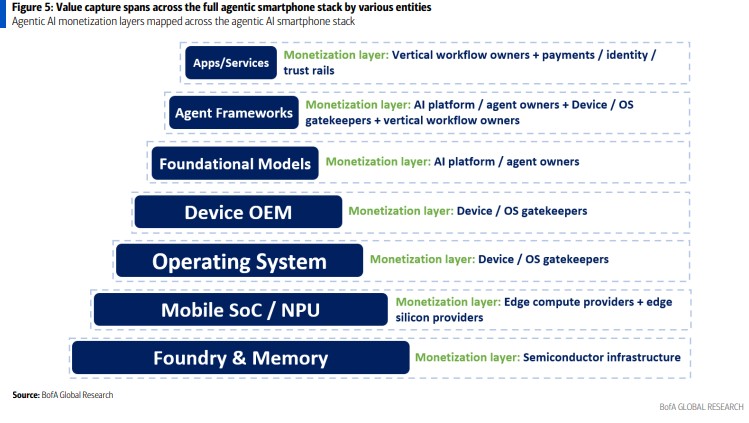
Siri Must Become iPhone's Execution Layer, Otherwise the Valuation Story Falls Apart
There are five key paths; if any are missing, the entire logic is questionable.
- New iPhones must become better AI devices. This requires stronger NPUs, higher memory, greater bandwidth, better heat dissipation, and battery efficiency.
- Hybrid inference must make economic sense. High-frequency, low-complexity tasks should be processed locally as much as possible; complex but privacy-sensitive tasks should enter Private Cloud Compute; only some tasks should be handed off to external models.
- Siri must understand intent, retrieve context, call apps, and complete workflows. This is not just a voice recognition upgrade, but a system-level workflow reconstruction.
- App Intents must become a widespread action framework for apps. Third-party apps should not just be clicked open by users, but called by Siri on demand.
- The trust layer must not be lost. Which data is readable, which actions are permissible, which steps require confirmation, and which transactions need Face ID or Apple Pay verification must all be finely controlled by iOS.
Real-world risks are concentrated here: Apple can control devices, systems, the App Store, Apple ID, Face ID, Apple Pay, and privacy architecture, but if Siri's execution capability is insufficient, users will not entrust real tasks to it.
Apple Currently Relies on Hardware for User Acquisition, Future May Rely on "Intent Execution" to Enhance Service Monetization
Apple's current business model centers on a hardware-driven installed base flywheel. In fiscal year 2025, product revenue was $307 billion, accounting for about 74% of total revenue; service revenue was $109.2 billion, accounting for about 26%. The iPhone remains the core entry point, with fiscal year 2025 revenue of $209.6 billion, higher than the $201.2 billion in fiscal year 2024.
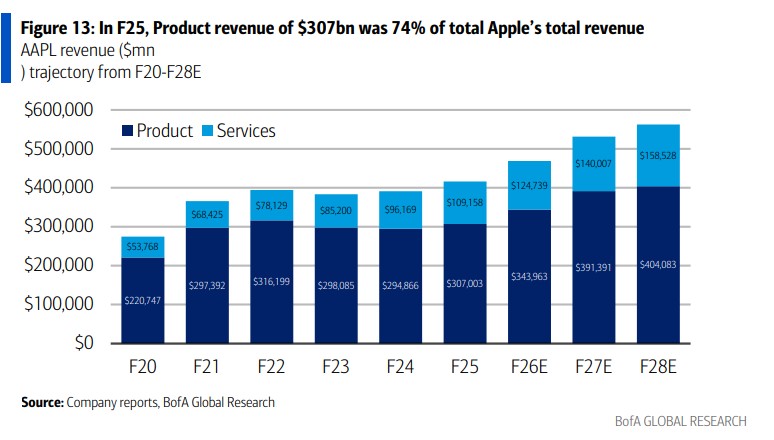
The profit structure further illustrates strategic motives. In fiscal year 2025, product gross margin was 36.8%, while service gross margin reached as high as 75.4%. The services business contributed approximately $82.3 billion in gross profit, accounting for 42.2% of Apple's total gross profit, despite representing only about 26.2% of revenue. This means that any entry point that can increase the frequency of user service usage and transactions has a highly leveraged effect on Apple's profit structure.
The strategic value of agentic AI lies precisely here: It may advance service monetization from "app access and transactions" to "intent routing and trusted execution." Users may not necessarily open a specific app, but Siri can distribute demands to certain apps, merchants, payment tools, or model services. By controlling the front door, Apple has the opportunity to participate in the entire subsequent chain of distribution, transactions, payments, advertising, and subscriptions.
Six categories of potential incremental revenue sources include: Apple Intelligence Pro subscriptions, fees for default model placement or routing, App Store agentic e-commerce commissions, Apple Pay/Wallet routing fees, advertising in agentic results, and iCloud+ AI layer upgrades. After deducting 20% to 30% overlap between various revenue sources, the base case for net incremental revenue is $15 billion to $30 billion, and the bull case is $40 billion to $65 billion.
Cost Issues Will Determine Whether AI Thickens Profits or Pressures Gross Margins
Agentic AI consumes more tokens than traditional Q&A—task execution requires reading context, planning steps, calling tools, generating confirmations, executing transactions, and maintaining state, with token consumption far exceeding simple Q&A.
Estimated under high-usage scenarios: In 2030, there will be approximately 1.729 billion iPhone AI users, with 20 requests per person per day, each involving about 5,000 tokens, resulting in annual cloud token consumption of approximately 31.6 quadrillion. Converted into infrastructure requirements, this equals processing about 1 billion tokens per second, corresponding to 8 million to 18 million M5 Max-level chips, with total facility power of about 0.7GW to 2.5GW, and potential infrastructure capital expenditure of about $6.7 billion to $50.4 billion.
This range has significant elasticity. Apple's data center and hosting electricity consumption in fiscal year 2025 was about 2.585 billion kWh, converting to an average load of about 295MW, indicating a certain foundation already exists. The key variable lies in the proportion of task allocation: if a large number of requests are handed off to external models, AI will resemble a variable cost business, where more usage leads to higher token expenditures, thereby pressuring service gross margins. If high-frequency tasks are mainly completed locally and via Private Cloud Compute, coupled with subscriptions, upgrade cycles, transaction commissions, and payment income, AI has the potential to transform into a long-term profit-thickening item.
The Next Step for the App Store Is Shifting from "Downloading Apps" to "Calling Actions"
Agentic AI will also reshape the positioning of the App Store. Currently, the App Store operates around charging for downloads, subscriptions, in-app purchases, search ads, and developer distribution. In the future, users may no longer search for a specific app, but directly tell Siri to "book a hotel," "buy tickets," "reimburse expenses," or "create a document"—travel apps provide flight inventory, e-commerce platforms provide merchants and logistics, banks provide accounts and payments, and productivity software provides documents and workflows.
The competitive logic thus shifts: from "which app is downloaded" to "which app is called by Siri." Apple's monetizable nodes also shift accordingly, covering agentic app discovery, App Intent certification, transaction commissions, agentic behavior governance, developer analytics tools, and potentially emerging model and agent markets.
Developers' willingness to cooperate is a key variable. If developers view Siri integration as a new commission layer, adoption speed may be slow; only if App Intents can bring incremental demand and higher conversion rates can a new distribution flywheel form. For Apple, lowering or even waiving fees early on, and first proving value with real transaction data, may be more critical than setting commissions from the start.
