


From NVIDIA's Q1 performance, looking at the investment prospects of AI: Reasons for the key allocation of E Fund AI ETF
NVIDIA's Q1 fiscal year 2027 results show total revenue of $81.6 billion, a year-on-year increase of 85%. Among them, the Data Center business contributed $75.2 billion, accounting for 92% of total revenue. The company is optimistic about its guidance for the second quarter, expecting revenue to be between $89.1 billion and $92.8 billion. CEO Jensen Huang stated that the construction of AI infrastructure is accelerating, and intelligent AI has begun to create value across various industries, driving comprehensive growth in the AI industry chain
According to the performance report for the first quarter of fiscal year 2027 released on NVIDIA's (NVDA.US) investor relations website, the company's total quarterly revenue reached $81.6 billion, a year-on-year increase of 85% and a quarter-on-quarter increase of 20%, setting a new historical record. Notably, the Data Center business, as the core engine of AI, contributed $75.2 billion, a staggering year-on-year increase of 92%, accounting for as much as 92% of total revenue, indicating that AI infrastructure remains a strong growth driver for the company.
More importantly, the company has a positive outlook for the second quarter, expecting revenue to be between $89.1 billion and $92.8 billion, again exceeding market consensus. The shipment progress of the Blackwell platform is smooth, and the new Vera CPU has opened up additional demand, with AI training and inference needs continuing to surge, reflecting that the construction of AI infrastructure is still accelerating.
NVIDIA's impressive performance once again proves its strong growth momentum in the AI field. In addition to the bright financial data, the most talked-about trend this year—Agentic AI—was also a focal point in this performance report. Quoting Jensen Huang, the founder and CEO of NVIDIA, during the earnings call: "The construction of AI factories is accelerating at an astonishing pace, marking the largest infrastructure expansion in human history. Agentic AI has arrived and is beginning to create real value across various industries, rapidly gaining popularity."
In fact, Huang had already likened the structure of the current AI industry chain to a "five-layer cake" in an article he authored earlier this year, with layers from bottom to top being: energy, chips, infrastructure, models, and applications. He pointed out that the top layer of applications is rapidly gaining popularity, and this force will strongly drive demand across the entire AI industry chain from the top down, forming comprehensive and sustained growth momentum.
NVIDIA's performance also confirms this point. Beyond focusing on surface numbers, in terms of the details of the data center business, NVIDIA's Data Center Networking revenue reached $14.8 billion, a year-on-year increase of 199%, while core Compute revenue rose 77% year-on-year to $60.4 billion. Both metrics are equally strong but indicate that the growth highlights in the AI sector have shifted from "chip performance" to "system-level efficiency."
From the above viewpoints, it can be seen that beneficiaries in the AI sector are no longer limited to single chip companies. As Huang mentioned in his "five-layer cake" analogy, the entire industry chain can benefit simultaneously. In terms of AI investment, using ETFs allows for low-cost direct investment across multiple fields while deploying growth opportunities in various sectors. For example, the E Fund Artificial Intelligence ETF (03489) closely tracks the FTSE Custom AI Select Index, selecting 50 leading AI companies in Hong Kong and the U.S. According to data from foreign media, as of May 21, the largest holding in this ETF is NVIDIA, accounting for 9.17%, while also covering leading global computing and semiconductor companies such as Advanced Micro Devices (AMD.US), Broadcom (AVGO.US), Taiwan Semiconductor Manufacturing Company (TSM.US), Micron Technology (MU.US), Lumentum (LITE.US), and SanDisk (SNDK.US) In applications and models, it simultaneously covers Microsoft (MSFT.US), Apple (AAPL.US), Amazon (AMZN.US), Google-C (GOOG.US), and Apple (AAPL.US), among others.
The reason for the ETF to deploy in both the US and China is that the AI sector is important in both regions. In the AI race, the US dominates the model layer and computing chips, but the power generation is insufficient, and the expansion of data centers is easily constrained by "power shortages"; China controls hardware production capacity such as optical modules and PCBs, with power generation exceeding one hundred trillion kilowatt-hours, possessing an energy advantage but relying on imports for advanced processes. Model innovation requires energy support, and computing expansion needs chip supply; the ETF can invest in important leaders in both regions, benefiting throughout the entire AI sector. In the Hong Kong stock market, it includes SMIC (00981), Hua Hong Semiconductor (01347), Alibaba-W (09988), Xiaomi Group-W (01810), Tencent Holdings (00700), Horizon Robotics-W (09660), UBTECH (09880), Kintor Pharmaceutical (00148), and others.
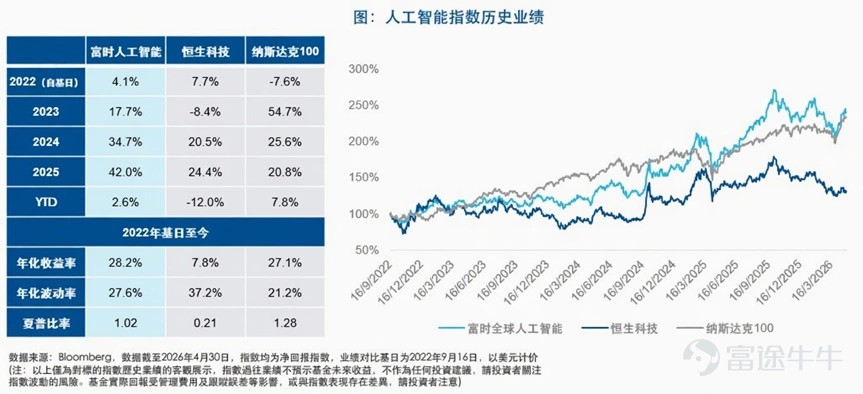
The ETF tracks the FTSE Customized Global AI Select Index, which demonstrates excellent balanced characteristics. Since its base date in 2022, the index's Sharpe ratio has reached 1.02, a figure above 1, reflecting its risk-adjusted return performance with good cost-effectiveness. In terms of returns, as of April 30, 2026, the annualized return of the index since its base date slightly outperformed the NASDAQ 100 Index (.NDX.US), while significantly outperforming the Hang Seng Tech Index Compared to the Hang Seng Tech Index, it shows significant advantages in both total returns and Sharpe ratio.
According to media reports, as of May 21, 2026, the FTSE Custom Global AI Select Index has returned 20.0% since the second quarter.
(Note: The above is only an objective display of the historical performance of the benchmark index. Past performance of the index does not predict future returns of the fund and should not be considered as any investment advice. Investors should pay attention to the risks of index fluctuations. The actual returns of the fund are affected by management fees and tracking errors, which may differ from the index performance. Investors should take note.)
The E Fund AI ETF (03489) is a thematic ETF focused on the global AI industry chain, helping investors to comprehensively allocate across the entire AI sector, while covering leading companies in both the Chinese and U.S. markets. Investors do not need to focus solely on the Hang Seng Tech Index (800700) or the Nasdaq Composite Index (.IXIC.US), but can broadly allocate to key areas such as AI computing power, models, infrastructure, and applications. In the wave of AI, whether it is the Hang Seng Index (800000), S&P 500 Index (.SPX.US), or other major markets, semiconductor and AI-related companies are important beneficiaries, providing a balanced and efficient allocation method that allows investors to grasp long-term growth opportunities in AI more comprehensively
