


Intel Surges 214% in Six Weeks; Shorts Lose Over $10 Billion but Remain Stubborn as Wall Street Warns of 34% Pullback Potential
Short sellers have incurred paper losses exceeding $12 billion over the past six weeks. Nevertheless, their short interest as a percentage of Intel's float remains near its 52-week high. Intel is the stock with the weakest expected return among constituents of the Philadelphia Semiconductor Index, with an average analyst target price of approximately $85, implying about 34% downside from Monday's closing price
Intel's stock price has more than tripled since late March, creating a market miracle while pushing short sellers into massive losses—yet this has not deterred them from continuing to bet on a price decline.
According to data from S3 Partners, Intel's stock price has risen 214% since its low on March 30, adding over $440 billion to its market capitalization, while short sellers have suffered paper losses exceeding $12 billion. Despite this, Intel's short interest as a percentage of its float remains near its 52-week high. Last week, Intel's stock surged 25% in a single week, marking its best weekly performance since January 2000, and continued to climb on Monday to hit new all-time highs.
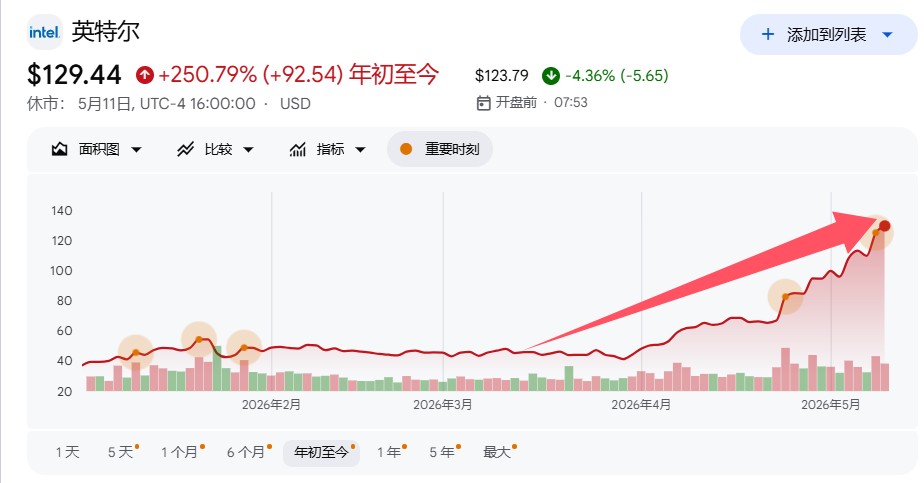
The latest catalyst for this rally was reports that Intel and Apple had reached an initial agreement on chip foundry services. Since early April, Intel has become the best-performing stock in the S&P 500, outpacing even strong performers like Sandisk Corp. during the same period. Meanwhile, analysts' expectations for Intel's adjusted earnings per share (EPS) in 2026 have more than doubled in the past month.
Shorts Add Positions Against the Trend, Betting Momentum Will Peak
Despite mounting paper losses, short sellers have not retreated. Data from S3 Partners shows that Intel's short interest as a percentage of its float remains near its one-year high.
Matthew Unterman, Managing Director at S3 Partners, stated, "Intel is now almost the benchmark for momentum trading. Momentum will eventually stall at some point."
However, the cost of betting against the trend is extremely high. Brad Lamensdorf, co-manager of the AdvisorShares Ranger Equity Bear ETF, warned, "Trying to pick the top in a momentum stock is simply unrealistic; risk cannot be controlled. Shorts fighting the price trend will lose significant alpha, and it is difficult to maintain a robust portfolio in the short term."
Bearish sentiment has also spread to other chip stocks. S3 data indicates that short interest has also risen in Micron Technology and Advanced Micro Devices (AMD), which ranked second and third in gains within the Philadelphia Semiconductor Index since late March. The Philadelphia Semiconductor Index has risen nearly 60% since early April, with its 14-day Relative Strength Index (RSI) recently touching its highest level since 2011, indicating that the entire sector is severely overbought.
Fundamental Improvements Provide Support, but Valuations Reach Extremes
Intel's recent surge is not driven purely by momentum; there have been substantive fundamental improvements. The U.S. government took a stake in Intel last summer, followed by a $5 billion investment from AI chip giant NVIDIA in September. In March this year, Intel announced that its new Xeon chips were being used in one of NVIDIA's systems, sending its stock soaring. A few weeks ago, management's sales forecasts significantly exceeded Wall Street Expectations, further boosting market confidence.
However, fundamental improvements have not alleviated valuation pressures. Intel is currently one of the ten most highly valued stocks in the S&P 500 and the most expensive chip stock in the market. Its stock price corresponds to a forward P/E ratio of over 100 times for the next 12 months, which is not only a historical high but also approximately five times its 10-year average. In comparison, NVIDIA's forward P/E ratio is around 24 times.
Thomas George, a portfolio manager at Grizzle Investment Management who holds Intel stock, said, "If growth accelerates, this high valuation multiple could quickly become reasonable. If AI brings higher efficiency, adoption will increase, and demand will rise accordingly."
Wall Street Target Prices Imply Significant Downside Potential
Despite surging market sentiment, Wall Street remains overall pessimistic about Intel stock.
According to data compiled by Bloomberg, among the 53 analysts tracking Intel, only 17 have issued Buy ratings, while 3 have issued Sell ratings. The average analyst target price is approximately $85, implying about 34% downside from Monday's closing price, making it the stock with the weakest expected return among constituents of the Philadelphia Semiconductor Index.
George believes that the probability of a significant pullback of up to 30% for high-momentum stocks like Intel within the next 12 months is not low. However, he also pointed out that the dual support of price momentum and fundamentals makes timing such a pullback extremely difficult.
"Companies view AI as a critical strategic imperative and will not stop investing and building," he said. "As a short seller, you cannot stand in the way of this force."
