Figure CEO: Humanoid Robots to Enter Homes Soon at $600 Per Month

Wallstreetcn
2026.05.06 08:33

Brett Adcock, CEO of Figure, revealed that the company plans to offer humanoid robot leasing services to household users at a subscription price of approximately $600 per month, with capabilities covering daily chores such as laundry and dishwashing. This model prioritizes home scenarios, but variables such as mass production capacity, safety certification, and consumer acceptance remain to be verified

The commercialization process of humanoid robots continues to accelerate.

Brett Adcock, CEO of the US humanoid robot company Figure, publicly stated that the company will launch a leasing plan for household users, introducing humanoid robots to the ordinary consumer market at a subscription price of several hundred dollars per month.

Adcock provided a clear pricing reference: “You can lease a Figure 03 for about $600 per month.” He likened this model to car leasing, positioning it as a consumer-grade service for the mass market. He also disclosed that the company is in the preparation stage for advancing into home scenarios “in the near future,” with planned robot functions covering basic household chores such as daily laundry, dishwashing, and multiple room tidying sessions.

These statements provide a more specific expected timeframe for the commercial implementation of the humanoid robot sector, also sparking market attention on the industry's scaled mass production capabilities and competitive landscape.

Business Model Shifts to Households, Implementation Remains to Be Verified

The business model described by Adcock has a certain novelty: users do not need to make a one-time purchase but instead obtain the right to use the robot through a monthly subscription. The device can be charged via standard household sockets and features the ability to automatically return to its charging dock for standby.

Notably, he positions home scenarios as the “near-term” highest-priority commercial entry point, rather than the factory and warehouse environments previously widely anticipated by the industry. If this judgment materializes, it means the potential market size expectation for humanoid robots will be significantly amplified.

However, whether this model can succeed still faces multiple key variables, including mass production capacity, operational reliability, safety compliance certification, and end-consumer acceptance. Currently, there is no systematic public data supporting the maturity of these conditions.

Company Production Capacity Data in Question, Chinese Manufacturers Lead in Scale

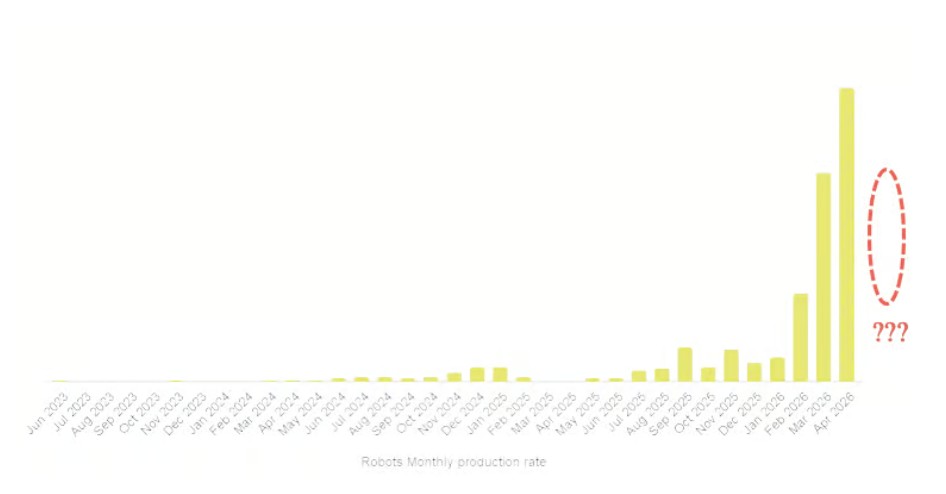
Adcock posted a chart on the social media platform Threads, claiming to show the number of humanoid robots produced by Figure month by month, with production capacity showing a clear upward trend in the chart.

It is worth noting that the chart did not label the Y-axis scale, making actual shipment volumes unverifiable. According to Forbes estimates, Figure's monthly shipments may have risen from about 60 units in February to about 120 in March and about 240 in April, but these figures remain highly uncertain.

In terms of absolute production scale, the gap between Figure and its Chinese counterparts is particularly significant. Taking the Chinese company Agibot as an example, it is reported that its humanoid robot shipments reached approximately 5,000 units within three months, far exceeding the aforementioned estimated levels for Figure. This gap indicates that Chinese manufacturers such as Agibot have entered another order of magnitude in supply chain integration and manufacturing capabilities.

While Figure is still in the phase of ramping up production, Chinese companies, leveraging larger shipment volumes, have already accumulated significant advantages in actual deployment and data feedback, which holds important strategic significance for long-term technological iteration in the humanoid robot field.