


S&P 500 Hits New ATHs, but Smart Money Is Retreating; Goldman Sachs Trading Desk Warns: Flash Crash Is Only a Matter of Time
Goldman Sachs' trading desk pointed out that hedge funds have been net sellers of U.S. stocks for three consecutive weeks, with deleveraging in the tech sector reaching a decade-high, while passive funds continue to accelerate inflows, creating a significant divergence. The market's internal structure is deteriorating: negative market breadth, soaring individual stock volatility, and collapsing correlations are accumulating the risk of an "upside flash crash." Meanwhile, CTAs have shifted from incremental buying to potential selling pressure. All signs indicate that institutions have already reduced risk exposure, and a 3%-5% correction in the S&P 500 may be just a matter of time
Hedge funds have been net sellers of U.S. stocks for three consecutive weeks—precisely during the three weeks when the S&P 500 hit new ATHs (All-Time Highs) and refreshed historical closing records for three straight weeks.
Brian Garrett, a derivatives trading expert at Goldman Sachs, warned in a weekend memo that discussions on the firm's trading desk continue to focus on spot prices "ignoring the big picture," and that a 3%-5% sell-off in the S&P 500 is "only a matter of time."
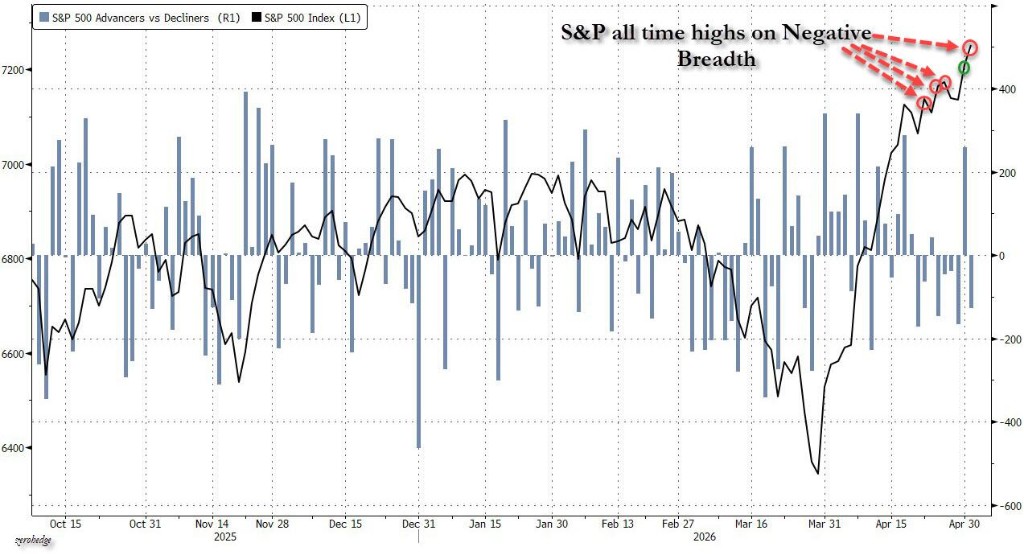
It is worth noting that fundamental long-short hedge funds just recorded their best single-month return on record (+9.1%) in April.
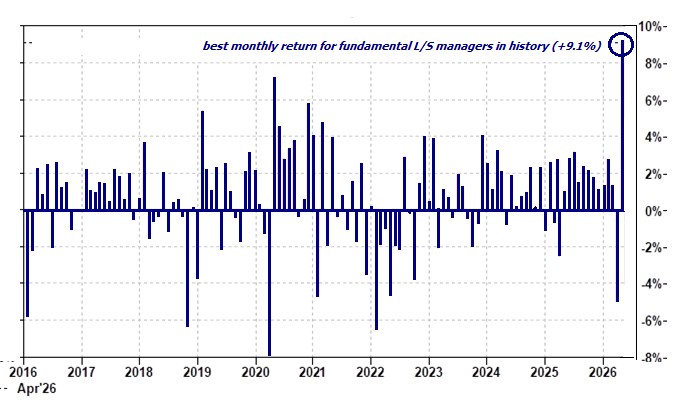
Made the Best Money in History, Yet Running Fastest
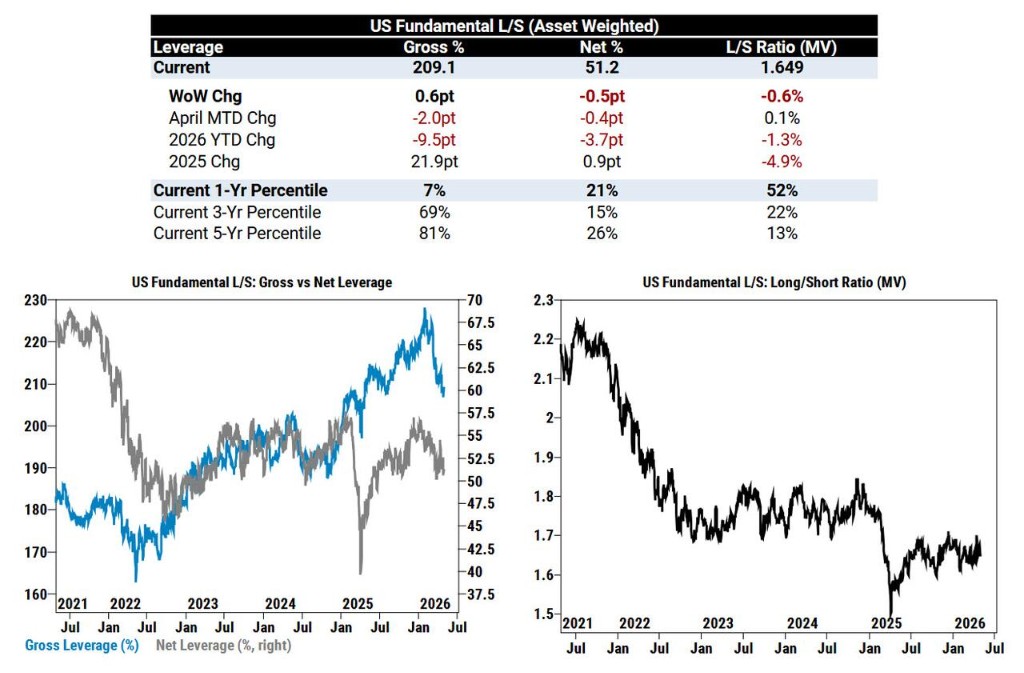
Data from Goldman Sachs Prime Brokerage shows that hedge funds have been reducing their positions in U.S. stocks for three consecutive weeks—selling long holdings and shorting individual stocks, only partially hedged by short covering in macro products. The department described this as "adopting more prudent risk management at historical market highs."
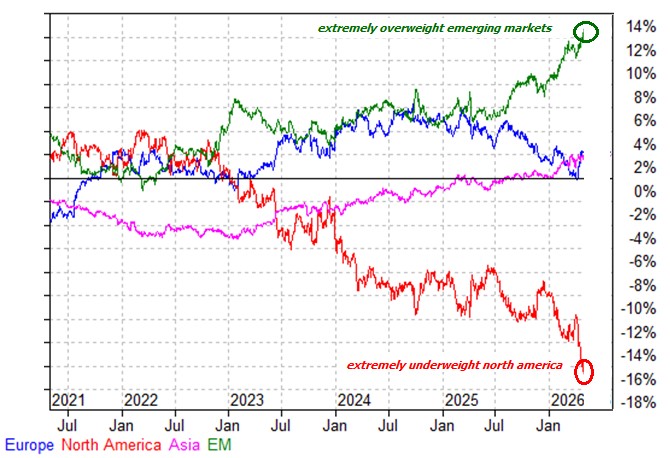
Allocation divergence has reached historical extremes: hedge funds' allocation ratio to North American equities relative to the MSCI ACWI Index has dropped to the lowest level since data collection began, while they are extremely overweight in emerging markets. Garrett himself expressed being "surprised" by this data.
The technology sector is bearing the brunt. The information technology sector saw significant position reductions for two consecutive weeks, with a ratio of long selling to short covering of 1.5:1. Excluding the meme stock frenzy in early 2021, the deleveraging of U.S. tech stocks over the past two weeks was the largest in a decade (-2.7 standard deviations), with most sub-sectors seeing position reductions, led by semiconductors, tech hardware, and software. The Mag 7 saw net selling on 4 out of the last 5 trading days, with long selling intensity exceeding short covering.
Another notable signal comes from the Goldman Sachs cash trading desk: asset management companies are becoming new suppliers of equity supply—is this routine rebalancing or an expression of directional views? It remains unclear. Matt Kaplan of Goldman Sachs observed: "It feels like there is some investor paralysis, and Wall Street is still in digestion mode."
Multiple Cracks Beneath New Highs
The S&P is hitting new highs, but the "quality" of these highs is declining—4 of the last 5 historical ATHs were achieved with negative breadth (more declining stocks than advancing stocks).
The volatility market is also sending contradictory signals. The VIX has fallen significantly, and index implied volatility is at low levels, but individual stock volatility is extremely high—implied correlation has collapsed, and dispersion has surged. Garrett pointed out that the average daily gain over the past month was about 85 basis points, and the average daily loss was about 75 basis points. The traditional meaning of "skew" is being reshaped, and the market is experiencing an "upside flash crash."
Meanwhile, the cost of 1-month at-the-money put options on the S&P has dropped from about 300 basis points in late March to about 150 basis points, making protection cheap. The +9.1% return in April just pulled hedge funds from year-to-date losses into profit—Garrett said he "doesn't blame" clients for locking in downside protection while it's cheap. Last Wednesday was one of the busiest trading days of the year for the Goldman Sachs index trading desk (excluding days when VIX > 20), with investors concentrating on buying downside options expiring on May 15 and 29 to hedge against earnings risks of large tech stocks. On the other hand, July expiry implied volatility at only 12.5 also makes going long attractive—call option volume in the large TMT sector exploded last week.
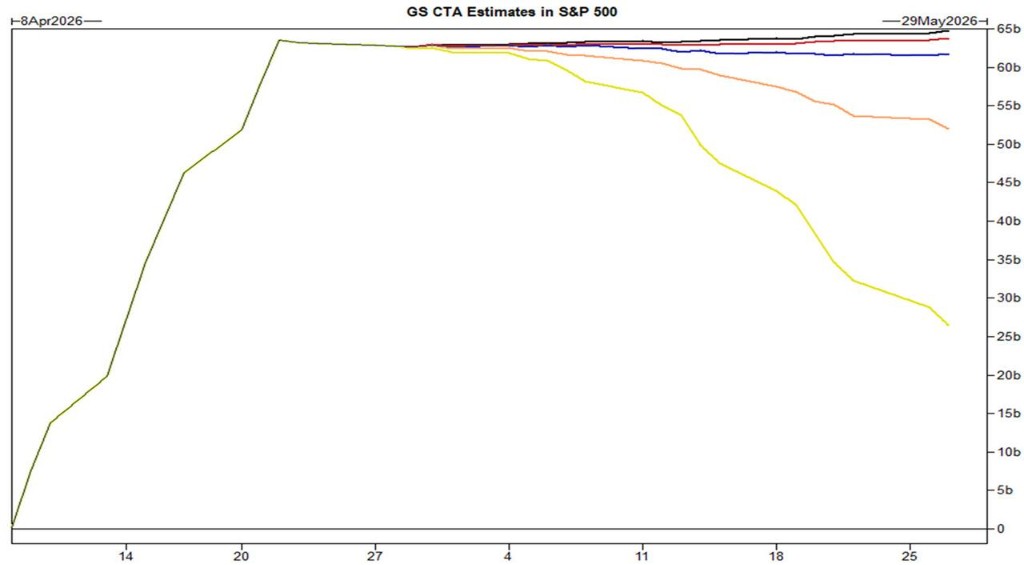
Regarding CTAs, the explosive demand that previously provided the largest incremental buying power to the market has ended, turning into mild selling pressure: in a flat market scenario, about $10 billion awaits selling in the next week, and about $21 billion in a month; the momentum support threshold is at S&P 6800-6900.
In contrast to institutional caution is the influx of passive funds. QQQ saw a net inflow of $10 billion in April, setting the largest single-month record in history; semiconductor ETFs saw a net inflow of about $5 billion, also at a historical level. The trading volume of 3x leveraged semiconductor ETFs even drew market attention last week. Furthermore, high Beta coefficient momentum paired baskets recorded one of the worst single-day performances on record after the Wall Street Journal reported OpenAI-related news. This factor remains crowded, and the Goldman Sachs trading desk has seen clients shift towards limited loss protection strategies.
Goldman Sachs Trading Desk Preferences and Earnings Season Signals
Garrett believes that "the money from simply going long on Beta has already been made," and current favored directions include:
- Going long on gold ("feels like the timing is right");
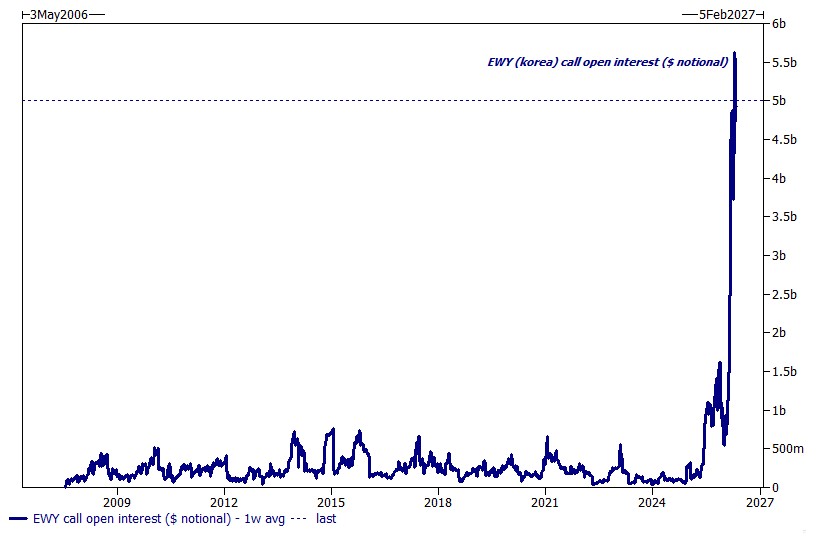
- Going long on emerging market tech stocks, which are cheaper in valuation compared to their U.S. counterparts, with call option open interest in the South Korea ETF (EWY) surging to historical highs;
- Going long on AI infrastructure (U.S. industrial stocks continue to be sold off, providing fuel for a short squeeze);
- Going long on hyperscalers while underweighting semiconductors—Goldman Sachs officially released this strategy last Thursday.
As a "hedge consensus" trade, he is also discussing the possibility of the European SX5E outperforming the Nasdaq—"underweight Europe, long U.S. tech" has become a crowded trade.
Regarding earnings season, according to Goldman Sachs Chief Equity Strategist Ben Snider, 63% of S&P 500 companies have completed Q1 disclosures: 61% of companies exceeded earnings expectations by more than 1 standard deviation, while only 5% missed expectations by more than 1 standard deviation (the lowest miss rate in history excluding the pandemic period). Q1 EPS growth is expected to hit a five-year high. However, the expectation threshold was already extremely low, and stocks beating expectations received almost no reward—excess returns were only about 20 basis points, one of the lowest on record.
This week, another 128 S&P component stocks (accounting for 11% of market cap) will report results, with AMD drawing the most attention, implying a volatility of 7.2%; its stock plummeted 17.3% after the last earnings report.
