


Tech Giants Surge AI Spending, So Why Did NVIDIA Drop?
The market's core concern is that Alphabet has announced the external sale of its self-developed TPU chips, while Amazon's self-developed Trainium chips have achieved annualized revenue exceeding $20 billion. NVIDIA's largest customers are accelerating their transformation into competitors. Analysts warn that this move could "fundamentally disrupt NVIDIA," but some argue that under the explosive growth in AI demand, supply remains the bottleneck
Tech giants have intensively raised their AI capital expenditures, which should be a major positive for NVIDIA, but the market has given a completely opposite response.
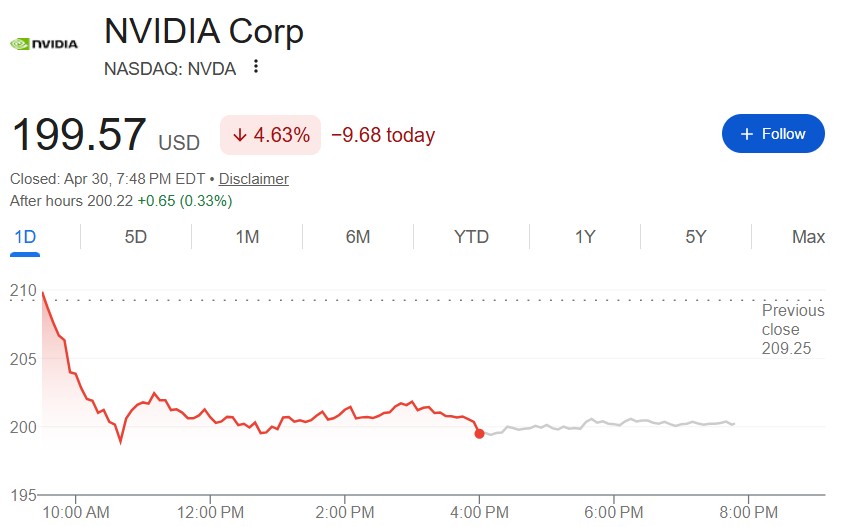
On Thursday, NVIDIA's stock price fell more than 4%, dropping below the $200 mark, with a single-day decline of nearly $10.
The previous night, Meta, Alphabet, Microsoft, and Amazon sequentially reported their earnings. The four hyperscale cloud providers collectively expect to invest up to $725 billion in AI infrastructure construction by 2026.
NVIDIA holds approximately 90% of the AI accelerator chip market. Ordinarily, this investment wave should directly benefit the chip giant. However, investors are concerned that as NVIDIA's most important customers begin large-scale self-development of chips, its market dominance will face challenges.
Previously, Alphabet announced it would sell its self-developed TPU chips to external customers, while Amazon emphasized the rapid growth of its self-developed chip business during its earnings conference call.
Alphabet TPU "Breaks Out," Touching the Market's Most Sensitive Nerve
Alphabet announced that it will sell its self-developed TPU chips to selected external customers, who can deploy them in their own data center infrastructure.
Previously, TPUs served almost exclusively within Google's internal ecosystem. Once commercialized externally, TPUs will evolve from potential competitors to NVIDIA GPUs into market rivals with substantial threat.
Although TPUs are generally considered less flexible than NVIDIA's solutions, they offer prominent cost-effectiveness advantages for specific AI application scenarios.
Amazon also emphasized the expansion momentum of its self-developed chip business during its earnings conference call.
According to Bloomberg, Amazon CEO Andy Jassy stated that the company's chip business has achieved annualized revenue exceeding $20 billion, representing triple-digit year-over-year growth, with its core product being the self-developed Trainium chip.
Wall Street Analysts: Wave of Self-Developed Chips Poses "Significant Risk"
Regarding this competitive landscape, some Wall Street analysts have issued clear warnings.
Jay Goldberg, a semiconductor analyst at Seaport Research, stated bluntly:
This has the potential to fundamentally disrupt NVIDIA, which I believe is a quite significant risk.
Goldberg's logic is based on the scale and capital strength of hyperscale cloud providers. These companies are not only NVIDIA's largest customers but are also continuously investing resources to become its competitors.
Alphabet's cloud revenue in the first fiscal quarter grew 63% year-over-year to $20.03 billion, with its backlog nearly doubling to over $460 billion, a significant portion of which is handled by internal TPUs.
Meta, while raising its 2026 capital expenditure guidance to $125–145 billion, is simultaneously advancing its MTIA self-developed chip project.
However, not all analysts agree with this pessimistic assessment.
Stacy Rasgon from Bernstein Research offered a counterargument, suggesting that "fixating on who wins and who loses is the wrong question." His logic lies in the fact that: the rise of AI agents has led to explosive growth in computing demand, and the key factor currently constraining the industry is supply, not demand.
In this context, all chip manufacturers with credible production capacity, including NVIDIA, can achieve full capacity utilization.
NVIDIA currently holds $95.2 billion in supply commitments, with cooperative customers covering leading institutions such as OpenAI, Anthropic, CoreWeave, and Meta.
