


Mag 7 Earnings Week Arrives: Can $600 Billion in CapEx Sustain the AI Narrative?
This week, tech giants including Alphabet, Microsoft, Amazon, and Meta Platforms will report their Q1 earnings, with market focus on whether their AI capital expenditures can support the current narrative. The combined capex of these four companies is expected to exceed $600 billion in 2026. Goldman Sachs points out that if capex remains flat, it will challenge the AI market narrative. The semiconductor sector has benefited significantly, but valuations have risen to 60 times earnings, worsening the risk-return ratio. The tech industry's race for computing power has led to a "Token Maxing" effect, where companies face career risks for under-spending
One of the most dense earnings weeks in history has arrived as scheduled, with the AI capital expenditure narrative facing a critical stress test.
On Wednesday, Alphabet, Microsoft, Amazon, and Meta Platforms will simultaneously release their Q1 earnings, followed by Apple on Thursday. Current consensus expectations have fully priced in the combined 2026 capital expenditures of over $600 billion for these four companies.
Rich Privorotsky, Head of Delta One at Goldman Sachs, pointed out that the core question for the market is not the strength of demand—which is clearly strong—but whether capital expenditures can increase further. If capex remains flat against a backdrop of rising input costs, this effectively equates to a slowdown, directly challenging the current AI market narrative.
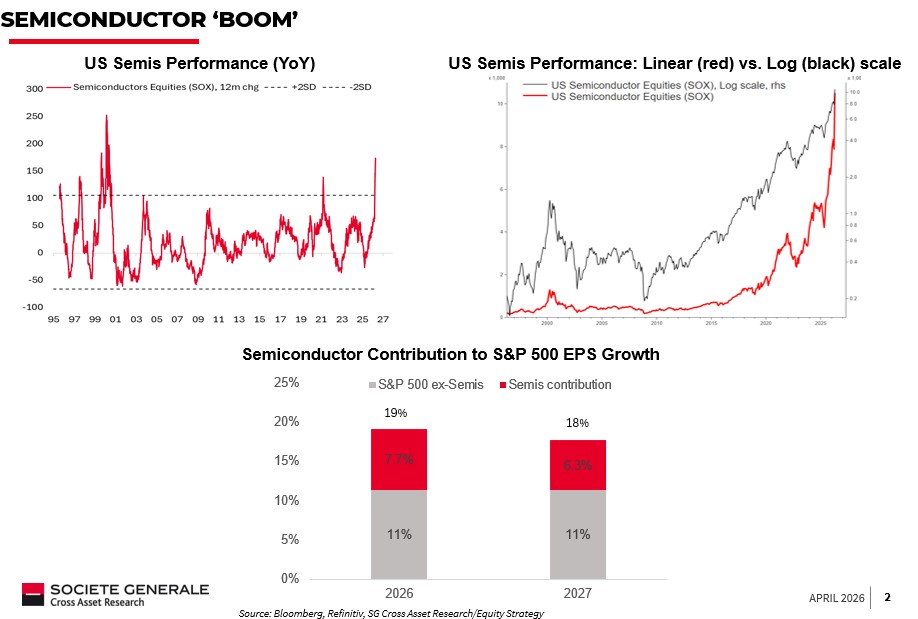
In this market structure dominated by the logic of AI capital expenditures, semiconductors have become the most direct beneficiaries, with the sector soaring 42% year-to-date, far outpacing the Mag 7's overall gain of about 2%; excluding Nvidia, the Mag 7 has risen only about 0.2% year-to-date. However, Goldman Sachs also warns that upward surprises from AI spending are "almost the entire game," with semiconductor valuations rising to a P/E ratio of 60, the risk-return ratio deteriorating, and technicals shifting from tailwinds to headwinds.
CapEx Expectations: Consensus Fully Priced In
The current race for computing power in the tech industry is spawning what Goldman Sachs calls the "Token Maxing" effect: engineering teams at major companies are competing to consume as much computing resource as possible, creating a distorted incentive where "under-spending equals career risk," driving firms to spend aggressively even if inefficiently.
Leading tech stocks have committed to combined AI capital expenditures exceeding $740 billion by 2026. Current consensus expectations have incorporated into their models the combined 2026 capex of over $600 billion for Amazon, Microsoft, Meta Platforms, and Alphabet. Meanwhile, constraints have spread across multiple links: shortages of electricity, CPUs, GPUs, copper, and even engineering talent.
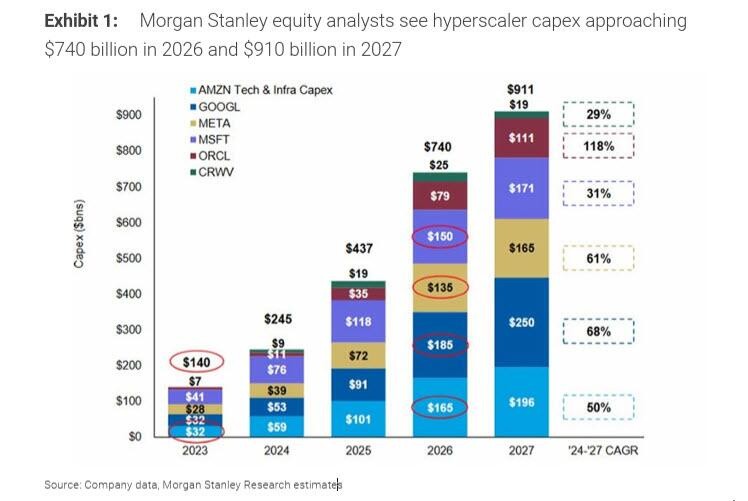
Goldman Sachs stated that, regarding current fundamentals, it is indeed hard to argue: "Supply is constrained in multiple verticals, EPS growth is accelerating, and the market narrative (right or wrong) is that we are on the verge of the most important technological breakthrough in decades." However, the market is indefinitely extrapolating upside potential forward—more computing power, higher intelligence, until Artificial General Intelligence (AGI) is finally achieved—this week's earnings will provide important reference for this expectation.
Semiconductors: Rally Reaches Critical Zone
The rally in the semiconductor sector has evolved into a self-reinforcing cycle: expectations and prices drive each other, with the trend evolving from "fundamental support" to "self-fulfilling." The sector's P/E ratio has risen to 60, and panic-driven chasing continues to accumulate. Goldman Sachs believes this is an area where "convexity risks begin to emerge"—parabolic rises always have an end.
Within the sector, the leading drivers have quietly shifted. CPUs and analog chips have become the main pullers, while GPUs, which usually lead the rally, will lag relatively. Goldman Sachs judges that the current breakout "looks like an upward breakout, but trading characteristics resemble a short squeeze more"—positions, capital flows, and forced buying are jointly driving the market to chase right-tail risk.
In terms of earnings contribution, Micron Technology alone accounted for more than half of the recent total upward revisions to S&P 500 EPS, with its quarterly results and guidance far exceeding consensus expectations. Market expectations for the "infinite extension" of demand for AI memory chips have pushed consensus valuations nearly double. The breadth of earnings revisions for the S&P 500 is narrowing, with consensus expectations for median companies hardly changing; the extreme concentration of earnings momentum is an indisputable fact.
Hyperscalers: Divergence in Shareholder Logic
Semiconductor stocks and hyperscaler stocks are showing markedly different market reactions to the same wave of capital expenditures, with the misalignment of interests between the two types of investors coming to the surface. Rich Privorotsky stated bluntly that semiconductor stocks have strong enthusiasm for capex growth—after all, these expenditures flow directly into their pockets; but shareholders of hyperscalers have historically not seen returns from increased capital expenditures.
"Last week we heard from the suppliers (semiconductor companies), and this week it's the turn of the spenders (hyperscalers) to take the stage, whose narrative is more complex," Rich Privorotsky expressed.
This divergence is clearly reflected in this year's market performance: the Mag 7 has risen only about 2% overall, nearly flat excluding Nvidia, forming a sharp contrast with the semiconductor sector's 42% gain. Hyperscalers bear substantial capital investments in the AI era, but there remains significant uncertainty in the market regarding when and how these investments will translate into shareholder returns.
Corporate Buybacks: Structural Demand Provides Bottom Support
As market sentiment faces tests, stock buybacks by US companies are providing a structural buffer for the stock market. Buyback authorizations are at record levels, with quiet periods ending sequentially, and total corporate buyback demand this year is expected to exceed $1 trillion.
This buying pressure is price-insensitive, belonging to pure structural demand—companies are repurchasing heavily at historical highs, continuously shrinking the floating share count, and mechanically boosting earnings per share. For the stock market currently running at high levels, this is a passive support force that cannot be ignored.
Market Landscape: Either in the AI Supply Chain or an Outsider
Rich Privorotsky's judgment on the overall market risk-return ratio has become cautious: "It is hard not to respect the strength of AI capital, but the speed of this rally is already extreme. Relative to expectations, the upward surprise comes almost entirely from AI spending—that is the entire game."
Outside the main AI narrative thread, crude oil and refined product prices are consuming market attention, European stocks are lagging relatively, and market differentiation is becoming extreme. Goldman Sachs summarized: "You are either in the AI supply chain, or you are not participating in this rally. From current positions, the risk-return ratio has worsened, and technicals are turning from tailwinds to headwinds."
This concentration trend also extends to emerging markets: earnings growth driven by semiconductors is reshaping the entire structure of emerging markets, with EM becoming more concentrated rather than diversified. For global investors, regardless of the market they are in, the distinction between being inside or outside the AI supply chain is increasingly becoming the most critical boundary determining returns.
Risk Disclosure and Disclaimer
The market carries risks; investment requires caution. This article does not constitute personal investment advice, nor does it take into account the specific investment objectives, financial status, or needs of individual users. Users should consider whether any opinions, views, or conclusions in this article align with their specific circumstances. Investment based on this content is at your own risk.
