


Soaring 358% This Year! Global AI Chips Strangled by Helium Shortage!
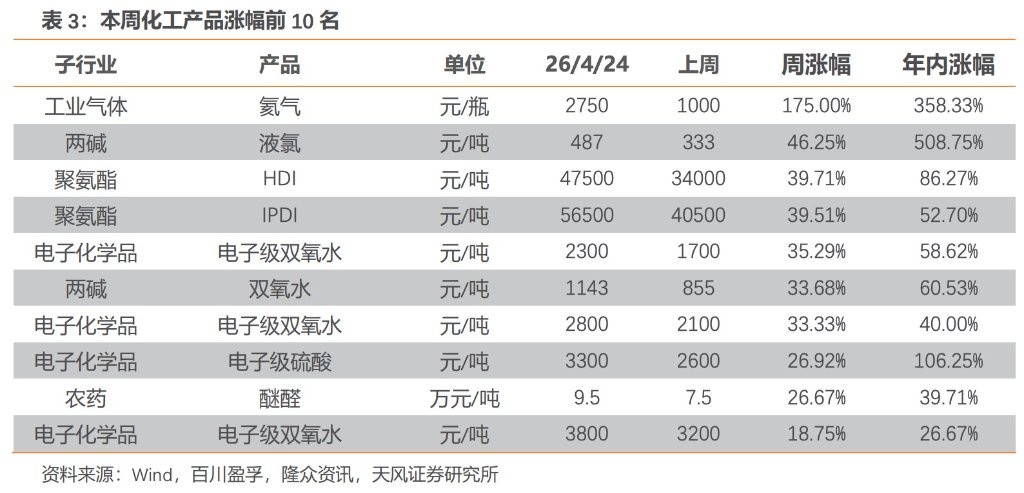
Tightening global helium supplies continue to drive up spot prices. The destruction of facilities in Qatar and Russian export controls have cut off approximately 40% of the world's helium supply within six weeks. Domestic spot prices surged 175% in a single week, bringing the year-to-date cumulative increase to 358%. Helium is an irreplaceable cooling medium for EUV lithography, with advanced nodes below 7nm highly dependent on it. The shortage has raised chip production costs and is invisibly eroding yields at advanced nodes. If the crisis persists, capacity for advanced processes and the AI chip supply chain will face further shocks
Helium, this colorless and odorless inert gas, is becoming the most unexpected fatal bottleneck for the global AI chip industry.
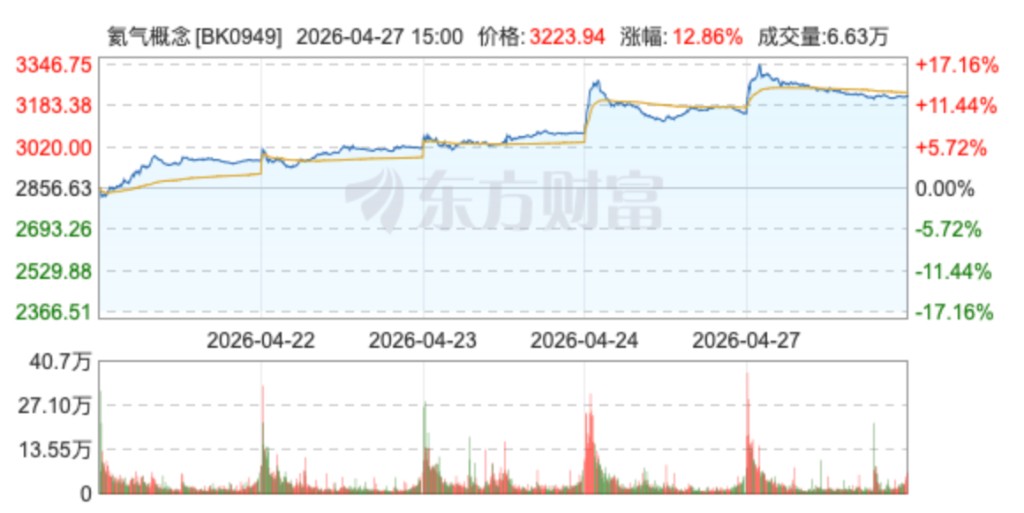
In the A-share market, the helium theme has rapidly heated up, with related concept sectors rising nearly 13% cumulatively over the past five trading days. On April 27, helium concept stocks surged collectively, with Jin Hong Gas rising more than 20% at one point, Guanggang Gas rising more than 14%, while Zhongtai Shares and Jiufeng Energy followed suit.
Behind the market rally is the continuous soaring of helium prices. In the past week, helium price increases led all chemical products, with domestic spot prices surging 175% in a single week, bringing the year-to-date cumulative increase to 358.33%.
The direct trigger for this price hike stems from a dual supply shock. First, core facilities in Ras Laffan Industrial City, Qatar, were attacked and damaged, causing tension in about 30% of global helium supplies, with an indefinite timeline for resumption of production. Second, Russia announced temporary export controls on helium on April 14, with measures lasting until the end of 2027. According to Tianfeng Securities, after Russia suspended exports, both long-term contract and spot import users in China were affected. Importers' reluctance to sell strengthened, causing a sharp decrease in market circulation volume and further pushing prices higher.
A crisis originally seen as a localized increase in chemical prices is evolving into a systemic shock to AI chips, advanced semiconductors, and data center infrastructure.
Helium is an irreplaceable cooling medium for the EUV lithography process. Supply shortages have increased production costs for chip companies and substantially suppressed capacity at some factories. Analysts warn that if the crisis continues, yields at advanced nodes for foundries like TSMC and Samsung will be the first to come under pressure, while the supply chain stability for NVIDIA GPUs and AI ASIC chips faces tests.
Dual Shock: 40% of Global Helium Supply Cut Off Within Six Weeks
The root cause of this surge in helium prices lies in two systemic shocks occurring almost simultaneously on the supply side.
The first shock comes from the Middle East, where core facilities in Ras Laffan Industrial City, Qatar, were attacked and damaged. In March this year, the facility was attacked, and the assessment for resuming production deteriorated from "weeks for repair" to "3 to 5 years for reconstruction," resulting in the sudden loss of about 30% of global helium supply. CITIC Securities pointed out that more than 60% of China's helium imports in 2024 came from Qatar, so every deterioration in the Middle East situation directly impacts the security of the domestic industrial chain.
The second shock comes from Russia, which announced temporary export controls on helium. On April 14, 2026, the Russian government introduced these measures, lasting until the end of 2027. All exports require personal approval from the Prime Minister and are exempt only for member countries of the Eurasian Economic Union (EEU). As a major global helium producer, this move effectively froze about 8% to 9% of global floating capacity.
Combined, approximately 40% of global helium supply was substantively cut off or frozen within just six weeks. Guojin Securities analysis suggests that the main global helium resource countries are the United States, Qatar, Russia, and Algeria. With multiple points damaged simultaneously, the tight supply-demand pattern far exceeds that during the 2022 Russia-Ukraine conflict. Meanwhile, extended maintenance at Australian factories and the Red Sea shipping crisis caused a 35% plummet in arrivals, driving global commercial inventories to their lowest levels since 2008, with obvious reluctance to sell among upstream suppliers.
From Yield to Capacity: How Helium Shortage "Strangles" AI Chips
The reason helium can tug at the nerves of the global AI chip industry lies in its irreplaceable core status in advanced semiconductor manufacturing.
Helium is a core cooling medium in the EUV (Extreme Ultraviolet Lithography) process and is widely used in dry etching processes. Advanced nodes of 7nm and below—especially AI semiconductors, HBM (High Bandwidth Memory), and advanced DRAM products at 5nm, 3nm, and 2nm nodes—are highly dependent on helium. In contrast, mature process nodes of 28nm and above have relatively lower dependence and possess a certain ability to withstand supply shocks.
In terms of impact mechanism, helium shortage first manifests as a decline in yield. Dry etching processes highly depend on the quality margin of helium. Once supply is restricted, the impact on yields at cutting-edge nodes becomes more significant—this loss does not directly appear in production output data but continuously erodes capacity in an "invisible" manner. If yields at TSMC's 3nm/2nm production lines drop by a few percentage points, the supply of core products such as NVIDIA GPUs, Broadcom AI ASICs, and Apple mobile SoCs will come under direct pressure.
According to industry analysis, EUV-specific helium (6N/99.9999% purity) is currently in a state of global hard shortage, with some chip factories' inventories hitting rock bottom, forcing capacity contraction. Every stage of new semiconductor factory construction, including equipment installation, process certification, and mass production ramp-up, consumes large amounts of special gases. The startup windows for multiple advanced production lines, such as Rapidus's Chitose factory, TSMC's Arizona factory, and Kumamoto Factory No. 2, coincide with the peak of the current supply crisis, making the potential risk of delays impossible to ignore.
Analysts point out that with continued tension in the Middle East and slow recovery of overseas capacity, concerns about global helium supply are unlikely to dissipate in the short term, and prices are expected to remain high and volatile. For the downstream semiconductor and AI computing power industries, the cost pressures and potential capacity risks brought by exposed supply chain vulnerabilities remain core variables that cannot be avoided in the near term.
