DeepSeek 'Shocks' Knowledge Atlas and MINIMAX-W, but JPMorgan Argues: V4 Breaks Compute Constraints, Boosting the Industry
Analysts believe the recent decline in Knowledge Atlas and MINIMAX-W represents an overreaction. V4 has verified that Huawei Ascend chips can support frontier model inference with 1.6 trillion parameters; as Ascend chips accelerate adoption and compute supply continues to expand, LLM companies will see significant reductions in service costs, effectively unlocking the monetization path from token demand to real income
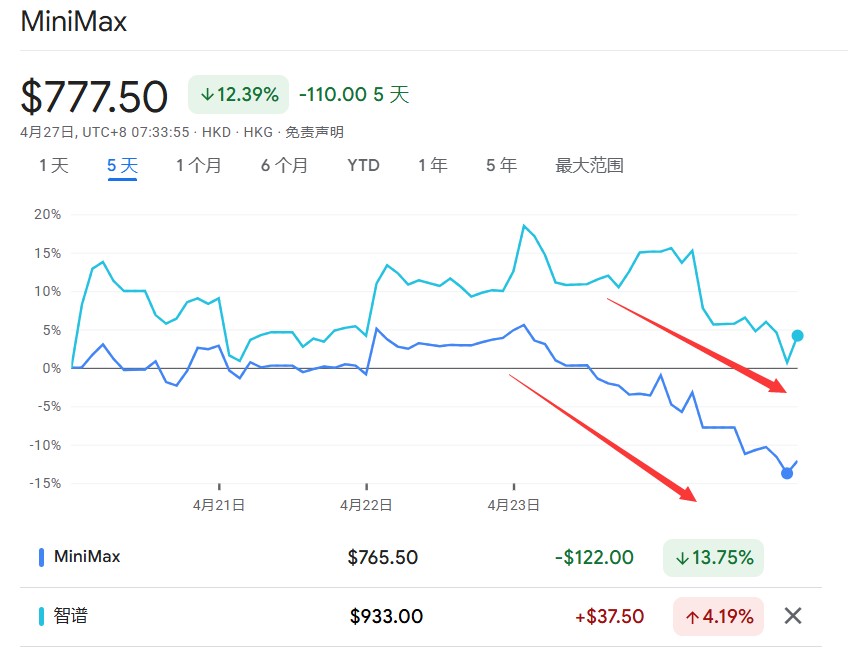
On April 24, DeepSeek released a preview version of V4, causing the domestic AI large model sector to plunge—was this a market release of concentrated fears regarding a "potential threat," or a genuine reshaping of the competitive landscape?
According to Zhongfeng Trading Desk, J.P. Morgan Securities (China) released a research report on April 26 offering a starkly different assessment of the market reaction: The launch of V4 is a positive for the industry, not a zero-sum shock.
What Did the Market Misread Behind the 9% Stock Plunge?
On the day DeepSeek V4's preview went live, both Knowledge Atlas and MINIMAX-W stocks fell by 9%, while the Hang Seng Index rose 0.2% on the same day.
The market logic was straightforward: DeepSeek launched another new model, intensifying competition and compressing the survival space for pure Large Language Model (LLM) companies.
However, these analysts argue this is an overreaction.
Their core judgment is that the launch of V4 actually reinforced three key pillars supporting China's LLM industry—release of compute supply, pricing discipline, and compression of structural cost curves. The only dimension where competition intensified was relative competitive positioning, but this represents "intense competition" rather than "rebalancing of the landscape."
More importantly, V4 had previously been the single largest negative competitive catalyst tracked by analysts in the April-May event calendar. With V4 now launched and digested by the market, this uncertainty has officially cleared.
Compute Bottlenecks Loosen: This Is V4's Greatest Industry Significance
Analysts point out that the area with the greatest "price and interpretation gap" between the market and their research framework is precisely compute.
DeepSeek V4 adapts to Huawei Ascend chips, successfully supporting frontier model inference at a scale of 1.6 trillion parameters. This is a critical validation: domestic chips are not only technically feasible but may also possess cost competitiveness compared to international chips.
In the past, compute constraints were an invisible ceiling for Chinese LLM companies—they had token demand but struggled to convert it into recognized revenue (ARR). DeepSeek has explicitly stated that as the Ascend 950 super-node enters mass production in the second half of 2026, the inference cost for V4 Pro will decrease further.
Analysts believe this is direct good news for Knowledge Atlas and MINIMAX-W: expansion of compute supply means these companies can provide services at lower costs, thereby unlocking the conversion path from token demand to recognized revenue.
We believe this is a key positive for the entire Chinese LLM industry, including Knowledge Atlas and MINIMAX-W, as it alleviates compute supply constraints—one of the main obstacles hindering these companies from fully scaling operations. DeepSeek indicated that with broader adoption and optimization of Ascend chips, the inference cost curve will improve, opening new paths for Knowledge Atlas and MINIMAX-W to convert token demand into recognized revenue.
12-Fold Price Gap: DeepSeek Itself Negates the "Commoditization" Narrative
Another market concern is whether DeepSeek's low-price strategy will drag the entire industry toward commoditization, crushing everyone's pricing power.
Data does not support this judgment.
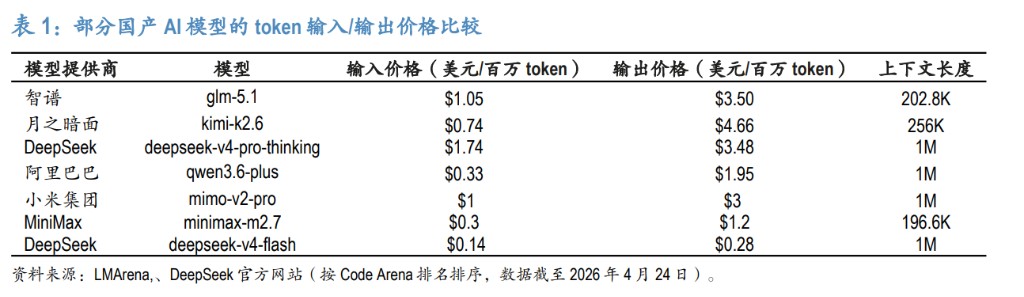
According to pricing data cited in the report (as of April 24, 2026):
-
DeepSeek V4 Pro version: Input/Output price of $1.74/$3.48 per million tokens
-
DeepSeek V4 Flash version: Input/Output price of $0.14/$0.28 per million tokens
The output prices differ by approximately 12 times. DeepSeek's own product line has already established a tiered pricing system based on task complexity: high pricing for advanced coding and agent workflows, low pricing for simple high-throughput tasks.
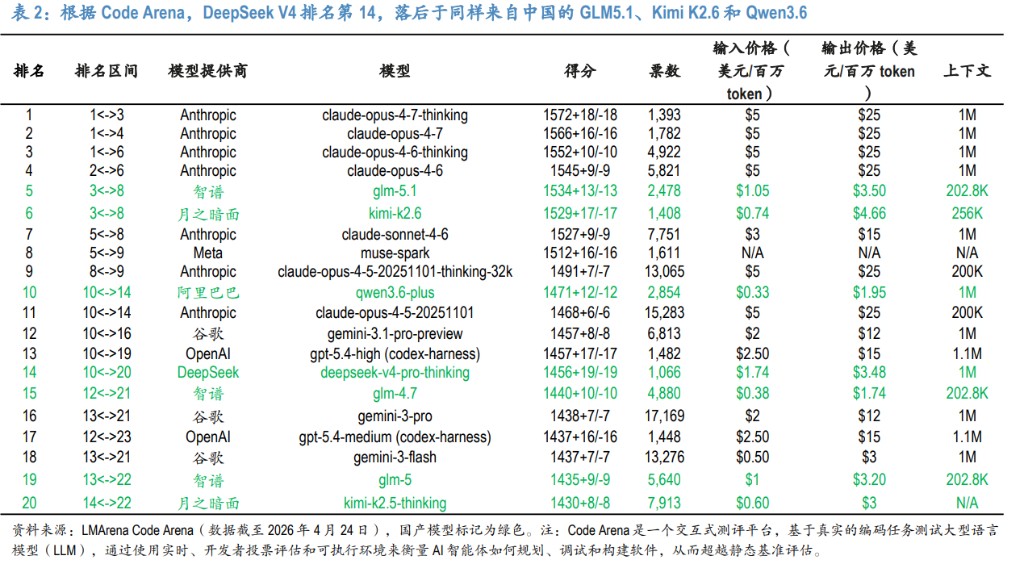
This aligns perfectly with the monetization logic promoted by Knowledge Atlas and MINIMAX-W. Analysts note that in comparison, GLM-5.1's output pricing is $3.50 per million tokens, nearly matching V4 Pro's $3.48—the pessimistic narrative that "DeepSeek's pricing crushes everything" contradicts actual data.
V4 Technologically Advanced, But Does Not Suppress Competitors in Core B2B Scenarios
V4 indeed shows technical progress. Citing official DeepSeek data, the report states that compared to V3.2, V4 reduced inference FLOPS by 3.7 to 9.8 times, shrank KV cache size by 9.5 to 13.7 times, and significantly improved long-context processing efficiency.
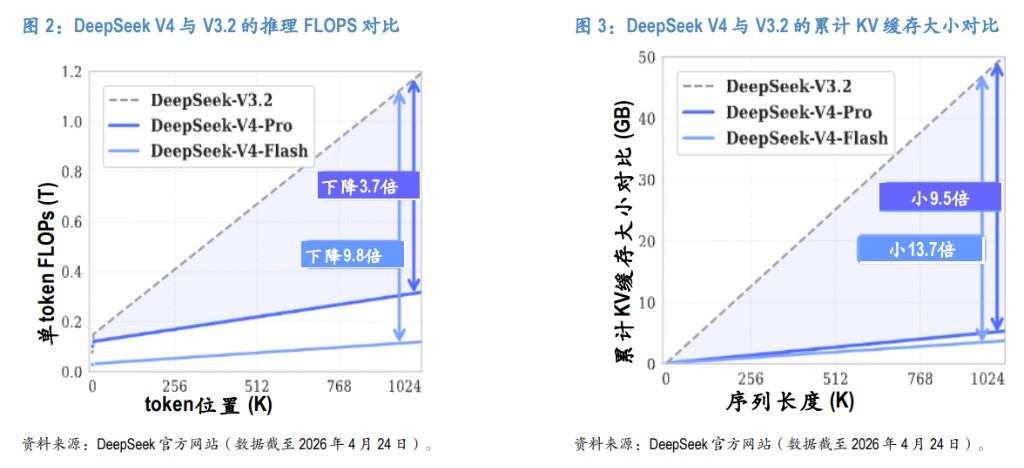
However, in the core B2B scenarios investors care about most—coding and agent workflows—V4 has not formed a suppressive advantage.
According to LMArena Code Arena rankings (as of April 24, 2026):
-
GLM-5.1: 5th place, score 1534
-
Kimi K2.6: 6th place, score 1529
-
DeepSeek V4 Pro: 14th place, score 1456
Analysts point out that this ranking reflects normal industry patterns: every new version launch brings ranking rotation. Knowledge Atlas and MINIMAX-W are expected to release GLM-5.5 and MiniMax M3 around June, at which time rankings may be refreshed again.
Additionally, V4's token compression and DeepSeek Sparse Attention (DSA) architecture are open-source releases, not moats. Historically, the MoE routing mechanism during the V3 period was absorbed by Qwen, GLM, and Kimi within approximately 4-6 months. These technological innovations will eventually become industry-standard configurations, lowering the overall cost curve and benefiting all players.
Next Two Months: Negative Catalysts Cleared, Positive Catalysts Concentrated
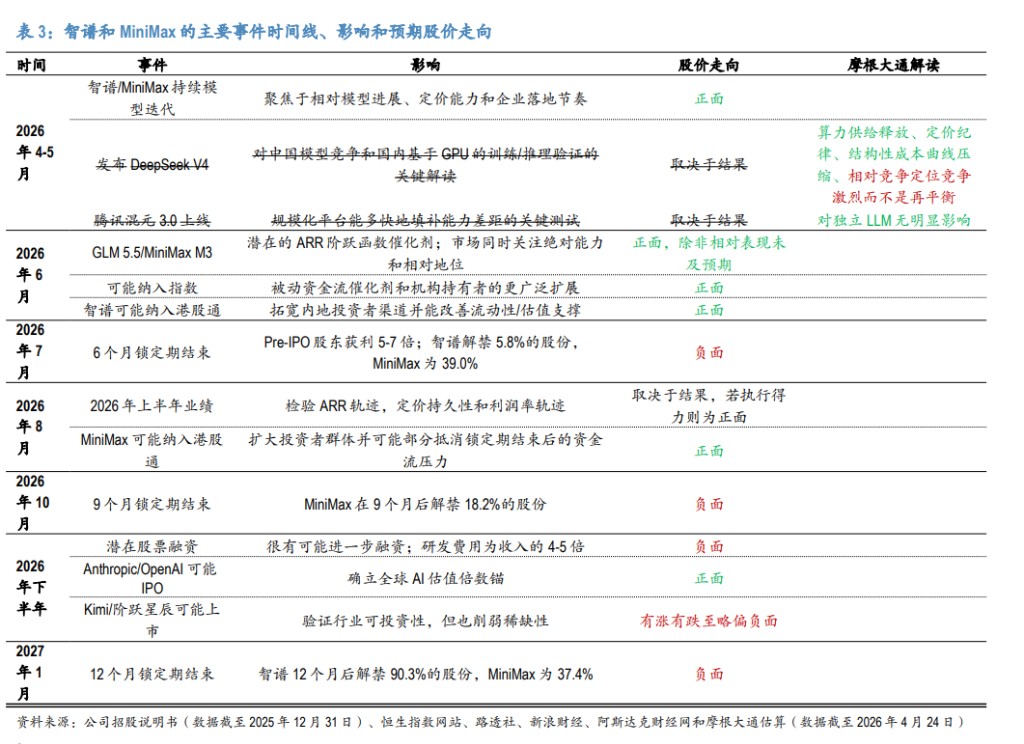
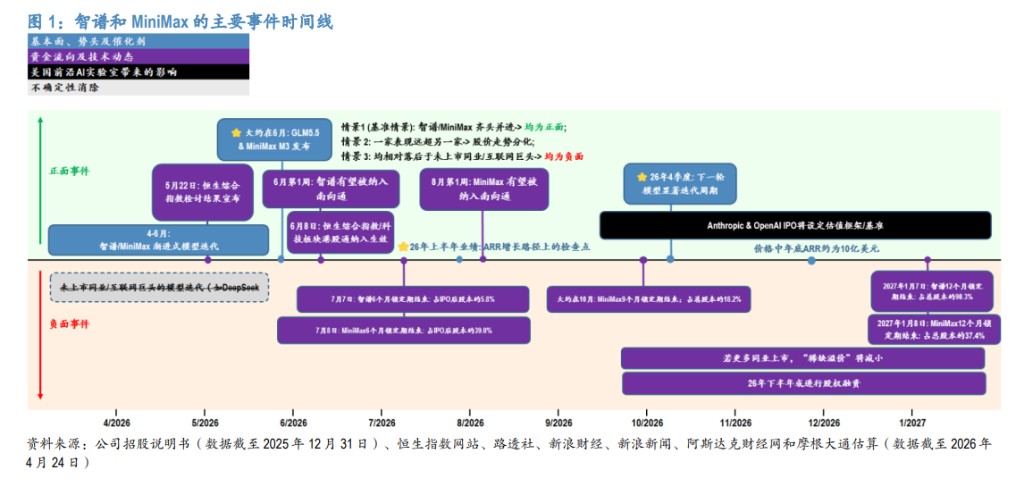
Analysts characterize the current time window as an "asymmetrically positive landscape."
With V4 now launched, the largest short-term competitive uncertainty has been eliminated. Before restricted shares unlock in July, the catalyst path for the next two months is as follows:
-
May: Index inclusion review (effective June), bringing passive capital inflows
-
Early June: Knowledge Atlas included in Stock Connect, opening channels for mainland investors
-
Around June: Launch of GLM-5.5 and MiniMax M3, potentially driving step-function increases in ARR
Risk nodes to watch: July, when the 6-month lock-up period for Knowledge Atlas expires, unlocking 5.8% of shares; MINIMAX-W faces a higher unlock ratio of 39.0%. In January 2027, the 12-month lock-up period for Knowledge Atlas expires, unlocking 90.3% of shares.
Analysts maintain a "Overweight" rating for both companies:
-
Knowledge Atlas (2513.HK): Target price HKD 950 (as of December 2026), based on 30x 2030 expected P/E, WACC 15%. 2030 expected revenue RMB 98.832 billion, expected adjusted net profit RMB 20.36 billion
-
MINIMAX-W (0100.HK): Target price HKD 1100 (as of December 2026), also based on 30x 2030 expected P/E, WACC 15%. 2030 expected revenue USD 9.136 billion, expected adjusted net profit USD 2.322 billion
Both companies expect compound annual growth rates exceeding 100% for 2026-2030 revenue, which is the core rationale for granting valuation premiums.