


New Round of Iran Negotiations, But the Stock Market Is Indifferent, Focusing Entirely on AI Bottlenecks Like CPUs and Optical Communications
Goldman Sachs believes that the current AI narrative is dominating U.S. stock market pricing, with the focus shifting from GPUs to CPUs and optical communications. However, there has been no substantive improvement in the situation at the Strait of Hormuz; the ceasefire remains fragile, and finished product inventories are depleting at an accelerating pace. U.S. stock technicals and position signals are becoming fragile, with asymmetry turning downward. Goldman Sachs maintains a cautious stance on the current positioning
Goldman Sachs believes that behind the U.S. stock market's continuous record highs, risks are quietly accumulating.
On April 24, Goldman Sachs' Delta One trading desk warned that despite the market's consecutive rebounds and the S&P 500 index touching new historical highs, the situation in the Strait of Hormuz has seen no substantive improvement.
Rich Privorotsky, head of the Goldman Sachs trading desk, pointed out that negotiations themselves are easy to launch, but solving problems is far more difficult. Today, crude oil prices continue to rise and inventories are depleting at an accelerating pace, yet the stock market seems to ignore all of this.
(Since April, the U.S. stock market has embarked on an independent upward trend)
Goldman Sachs believes that the current market is directing all its attention to the AI-driven demand narrative, while the focus is extending upstream from GPUs. CPUs and optical communications are emerging as new supply bottlenecks, echoing shortages heard across the supply chain in areas such as DRAM, packaging, power, and cooling.
The Strait of Hormuz: Fragile Ceasefire, Inventories Running Low
According to analysis by Goldman Sachs' Delta One trading desk, the actual situation in the Strait of Hormuz has not improved substantially.
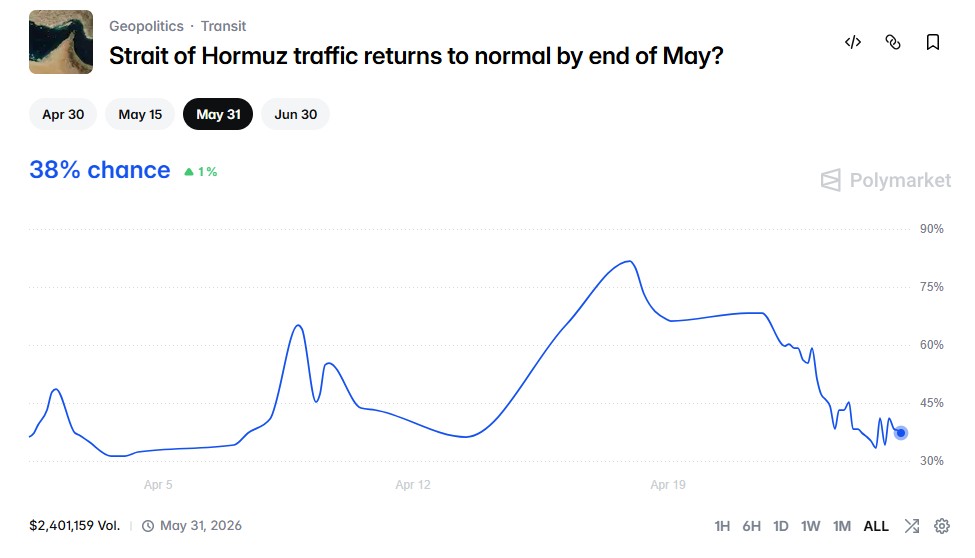
The current ceasefire status remains fragile, and the predictive market also holds a bearish view on the Strait of Hormuz situation, estimating less than a 40% probability of resolving the issue before the end of May.
More realistic pressure comes from the inventory side. Privorotsky noted that inventories are being depleted rapidly, and every additional day without reopening exacerbates the compounding effect of the problem.
The finished product market has sent clear signals: gasoline, heating oil, and diesel prices are all hitting new highs. He emphasized that current tanker misalignments, refining capacity constraints, and tight finished product markets mean that even if positive news emerges, its actual impact will continue to ferment.
From a trading perspective, Goldman Sachs believes that going long on December 2026 Brent crude oil futures remains the best expression of the current view.
AI Narrative Takes Over Pricing, From GPUs to CPUs and Optical Communications
The reason the stock market remains immune to energy risks lies partly in the outstanding performance of technology companies in the first quarter.
Privorotsky pointed out that AI-driven demand remains the market focus, with Siemens Energy's surprise orders and Intel's strong earnings further reinforcing the narrative of "more compute, more power, more infrastructure."
Notably, the main thread of this story is evolving: gradually extending from GPUs to memory and broader AI "scaffolding" areas, namely CPUs plus optical interconnects.
Bottleneck signs have appeared across all links of the supply chain—DRAM, packaging, power, and heat dissipation—becoming new structural tension points.
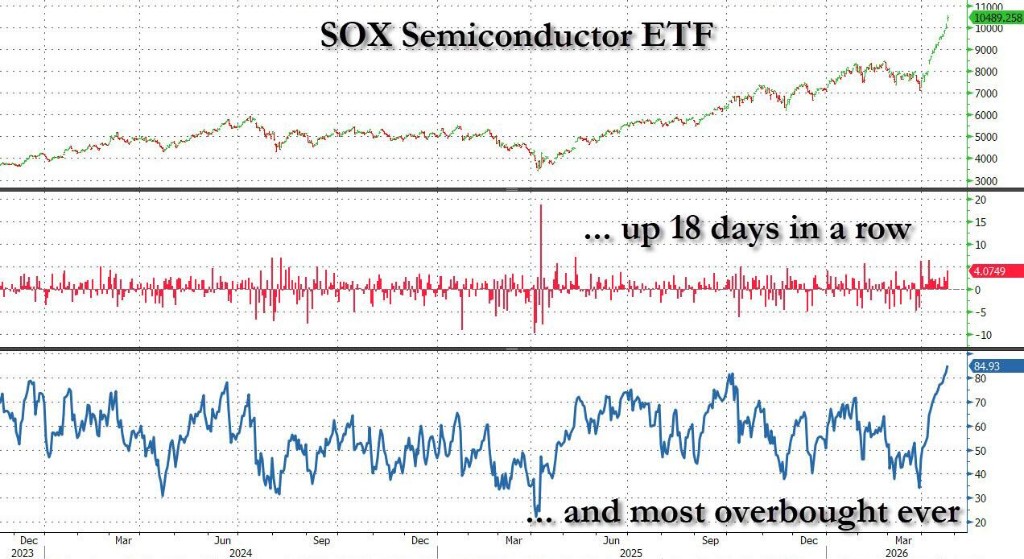
The Philadelphia Semiconductor ETF has closed higher for 18 consecutive trading days, setting a historical record, with significant expectations already priced in.
Technicals and Position Signals Becoming Fragile, Asymmetry Begins to Reverse
Technically, Privorotsky noted that the current U.S. stock market movement is largely reflexively linked to energy prices.
His model indicates that the market is currently in a phase of "tightening at the end of the cycle"—one of the worst quadrants for risk asset performance, characterized by a flattening yield curve and rising long-term interest rates.
A divergence still exists between short-term interest rates and the stock market; if energy prices fall, this divergence may narrow; if energy prices remain high, the divergence will further intensify.
Regarding volatility, European markets exhibit "short gamma" characteristics, while the U.S. market may return to the "long gamma" zone after a rapid rebound.
Regarding position data, the NAAIM (National Association of Active Investment Managers) exposure index has risen to 94, pointing together with multiple indicators to a sharp increase in investor risk appetite.
At the same time, with month-end approaching, the U.S. stock market faces one of the largest month-end rebalancing selling pressures on record.
Privorotsky judged that over a longer time horizon, the technical drivers for buying are significantly weakening, and asymmetry is beginning to turn downward. He stated:
From a more macro perspective, the technical buying momentum here is weakening, and asymmetry is beginning to tilt in another direction. I have remained and will continue to remain cautious at the current level.
