


Philadelphia Semiconductor Index Surges Again, Records 18 Consecutive Days of Gains. A Single Article to See How Overbought It Is
On Friday, buoyed by Intel's earnings beating expectations, the Philadelphia Semiconductor Index surged more than 4.3% in a single day, further fueling an already stretched trend. However, financial blog Zerohedge points out that behind the explosive rise in the U.S. semiconductor sector, internal leadership is crumbling; this rally is driven by second-tier AI stocks and high-beta names, while the MAG7 has largely stagnated over recent days, with NVIDIA also lagging—signs of late-cycle behavior
On Friday, buoyed by Intel's earnings beating expectations, SOX (the Philadelphia Semiconductor Index) surged more than 4.3% in a single day, further fueling an already stretched trend. By now, SOX has risen for 18 consecutive trading days, moving in a near-vertical trajectory.
However, financial blog Zerohedge analysis points out that behind the explosive rise in the U.S. semiconductor sector, internal leadership is crumbling; this rally is driven by second-tier AI stocks and high-beta names, while the MAG7 (the Tech Seven Giants) has largely stagnated over recent days, with NVIDIA also lagging. This is late-cycle behavior:
When "generals" stop leading the charge and the market begins chasing everything, trades tend to be closer to exhaustion than expansion. There is still room for short squeezes above, but the landscape is shifting. This is where good trades become crowded trades. Short squeezes do not die from bad news; they die when there is no one left to squeeze.
The parabolic surge in SOX is nothing short of epic; prices have long left the 200-day moving average far behind and are now pressing against the main upper trendline formed since last summer. Zerohedge notes that the latest leg of the rally has taken on a parabolic shape, a pattern that rarely ends well.
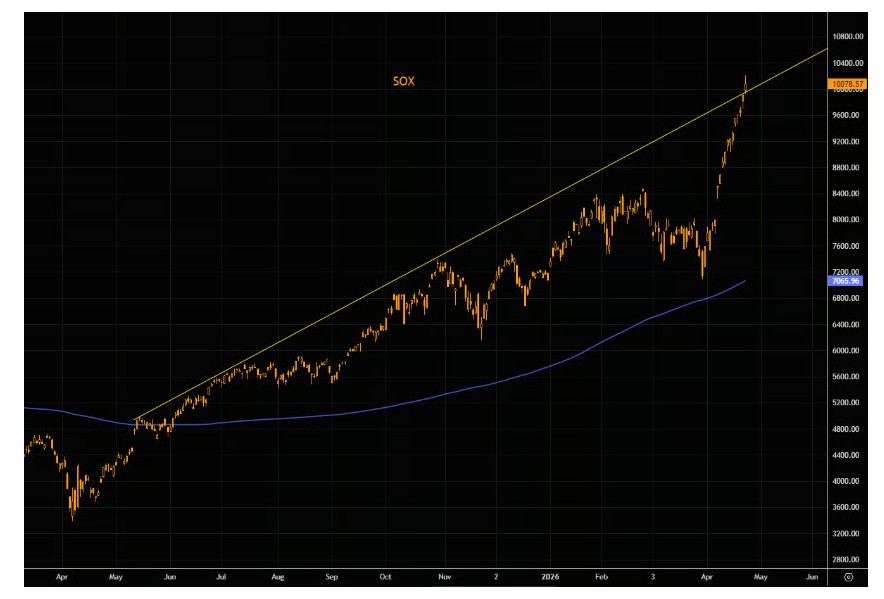
SOX has risen for 18 consecutive trading days, during which market capitalization increased by at least $2.4 trillion, with numerous individual stocks posting historic gains (CRDO +95%, MXL +92%, ALAB +78%, MRVL +65%, SITM +60%, ON/AMD +50%). According to Goldman Sachs analysts, market focus has clearly shifted from geopolitics to AI (and the token economy), with key earnings reports approaching (STX, WDC, AMD). The bar is getting higher, yet under the current market style, even if earnings fail to meet the private expectations of the market, they will still be bought—as long as the long-term structural bull case remains intact.
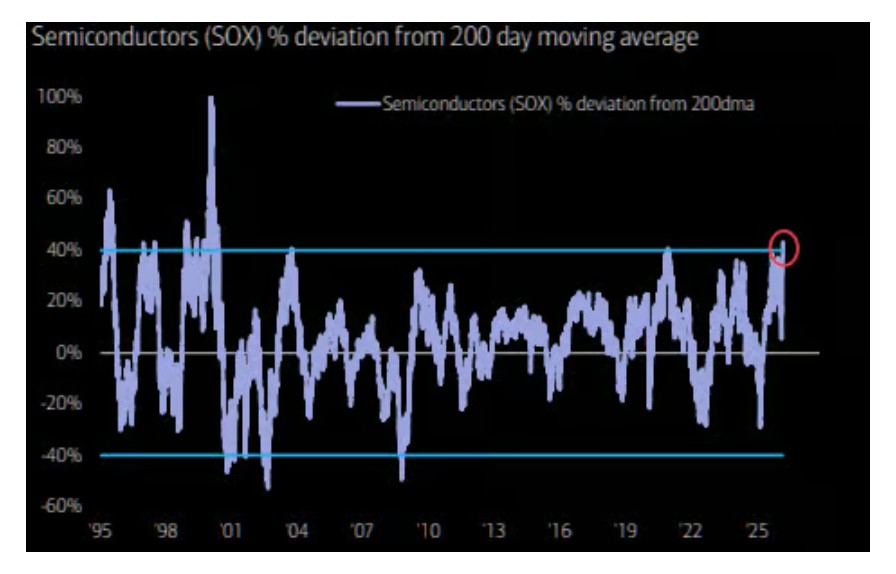
Currently, SOX has reached extreme overbought levels: the deviation of semiconductor stocks relative to their 200-day moving average is the highest since June 2000. Zerohedge states that this is the moment we should stop chasing Delta and start thinking about convexity. In other words, it is time to abandon the momentum-chasing Delta mindset and instead protect ourselves with Convexity logic—trading limited cost for asymmetric survival space.
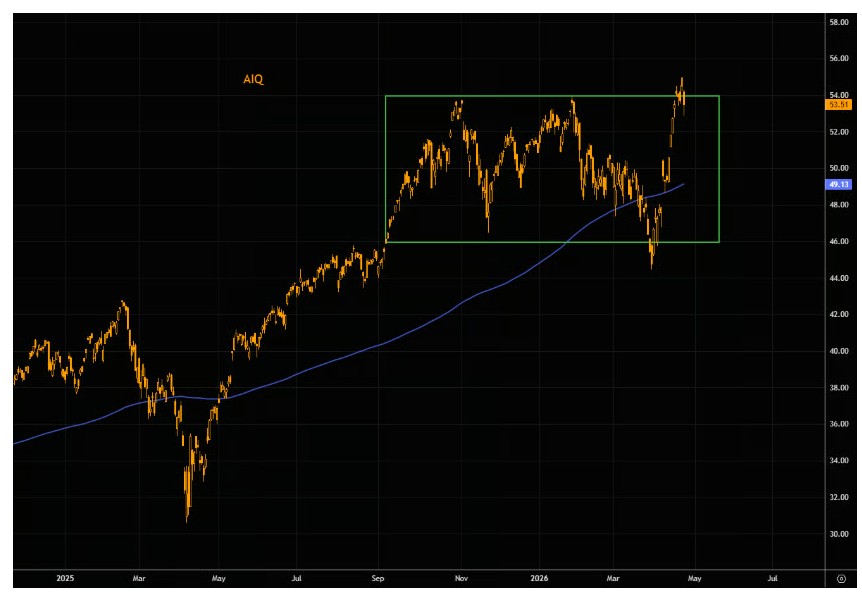
Despite Friday's rise, on Thursday prior, AIQ (the AI-themed ETF) recorded its largest single-day drop since the onset of this parabolic surge. Analysts suggest that if this turns out to be a false breakout, it could mirror the earlier low-point phase of the market—where extreme selling was subsequently punished by a short-squeeze rebound. Now, chasing longs at elevated levels carries similar risks; if the trend reverses, the outcome could be equally dire. With the 200-day moving average hanging lower, chasing momentum breakouts at the edge of the range is, in the long run, a losing game.
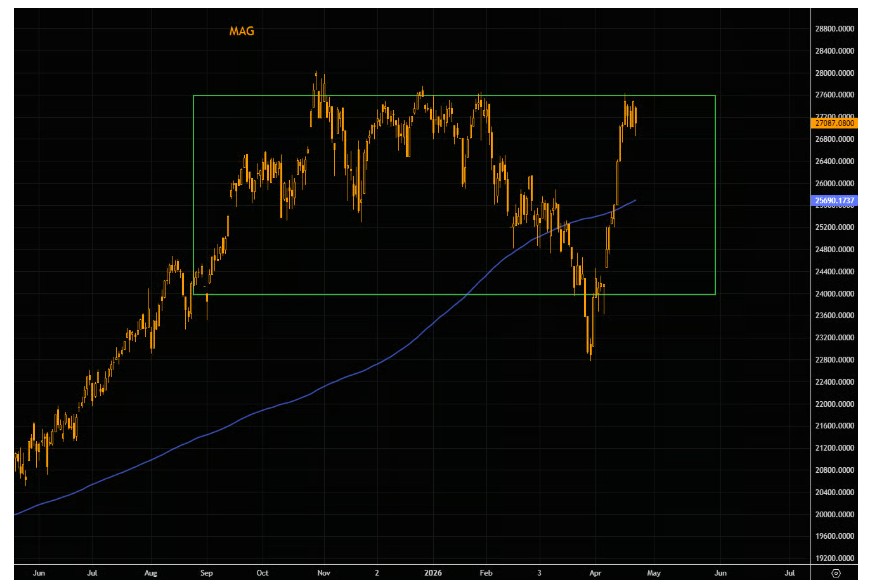
Despite bullish market sentiment, the MAG7 has done nothing over the past few trading days. Our current trading price level remains unchanged from six days ago. The MAG7 remains trapped within a massive consolidation range. Since September last year, going long at the range highs has always been wrong. Will this time be different?
Year-to-date and since the recent lows, the Russell 2000 has significantly outperformed the Nasdaq-100. The scramble for low-quality stocks has played out in full. Is this healthy market diffusion or a warning signal of the cycle's end?
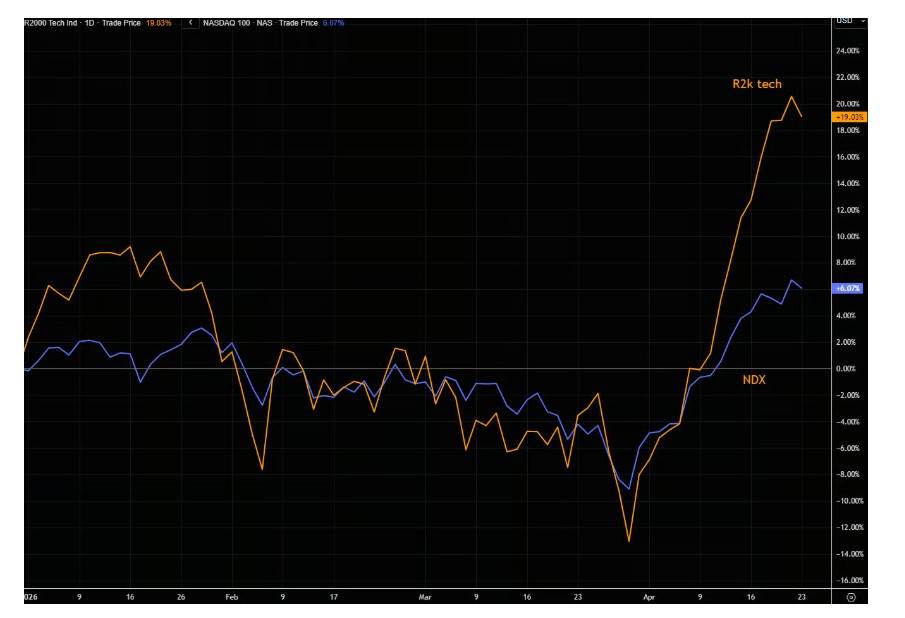
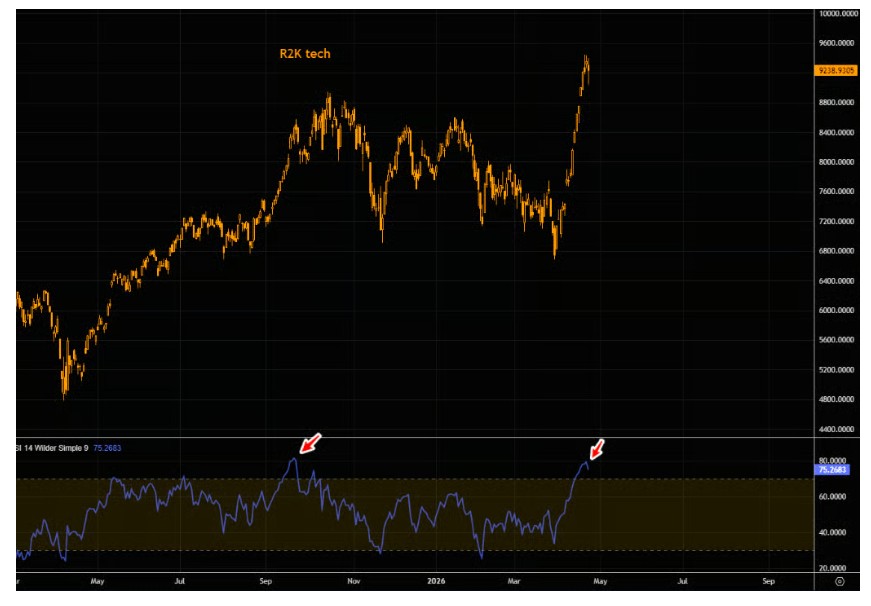
The rally in Russell 2000 technology stocks has reached extreme levels. The reversal pattern in RSI is beginning to resemble the situation during the last period of similarly overbought conditions, but this time the advance from the lows has been more aggressive, making the current setup even more stretched—and potentially more fragile.
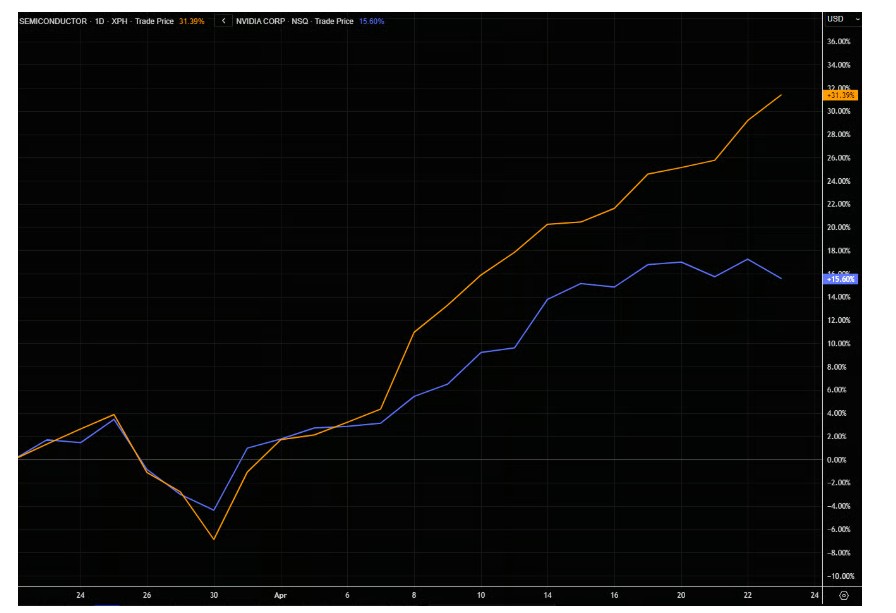
This month, NVIDIA has underperformed SOX by approximately 18 percentage points (NVIDIA +15%, SOX +33%), marking one of its largest monthly underperformance records in over two decades. According to Goldman Sachs statistics, this ranks as the third-largest monthly underperformance in history. While other stocks experience short squeezes, NVIDIA lagging is not confirmation—it is a warning.
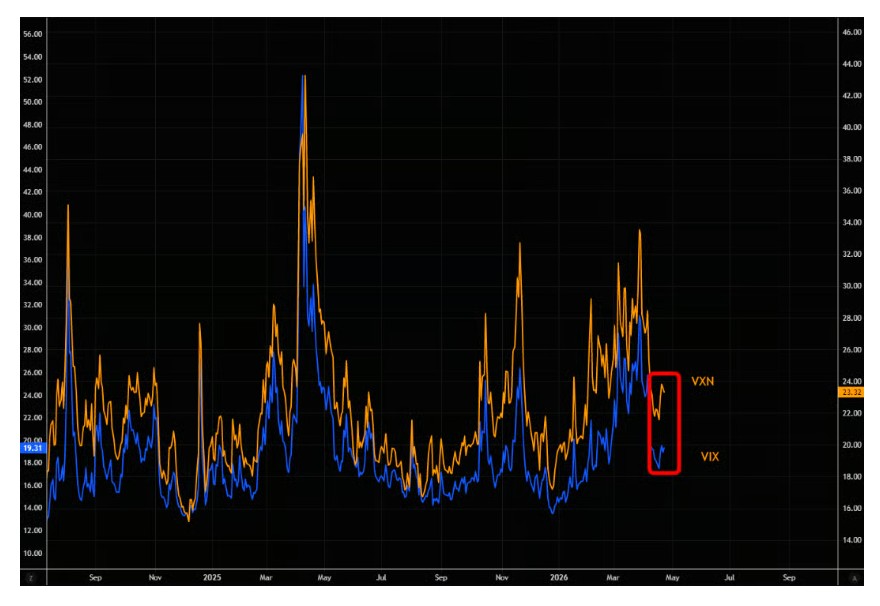
Early last week, even as the market continued to rise, volatility began climbing strongly. The pattern of "spot rising alongside volatility" has persisted to date. Elevated volatility creates a dilemma: with VIX and VXN at current levels and the market nearly touching historical highs, hedging costs appear prohibitively expensive, leading investors to stand aside and ultimately swim naked.
Zerohedge concludes that this is no longer a pure AI bull market, but rather a liquidity-driven AI chase game—the higher the price, the more forced buying occurs, yet the leadership structure is fracturing, and risks are quietly accumulating beneath the surface.
