


U.S. Stock Market Outlook | The three major stock index futures are mixed, U.S.-Iran negotiations are "highly likely" to achieve a breakthrough, and Intel's earnings report ignites tech stocks
On April 24th, U.S. stock index futures were mixed, with Dow futures down 0.04%, S&P 500 futures up 0.46%, and NASDAQ 100 futures up 1.40%. Market news indicates that U.S.-Iran negotiations are "highly likely" to achieve a breakthrough, with the Iranian Foreign Minister arriving in Pakistan tonight. The Trump administration has extended the shipping waiver for 90 days to address supply disruptions caused by the war with Iran
- As of April 24 (Friday) before the US stock market opens, the three major US stock index futures are mixed, with Dow futures down 0.04%, S&P 500 futures up 0.46%, and NASDAQ 100 futures up 1.40%.

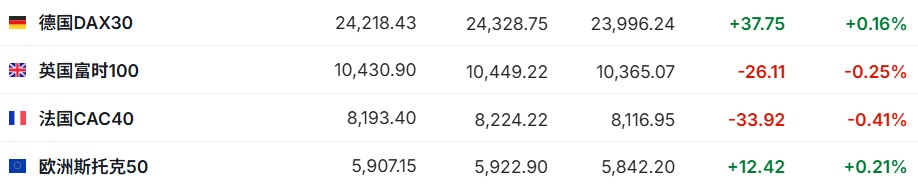
- As of the time of writing, the German DAX index is up 0.16%, the UK FTSE 100 index is down 0.25%, the French CAC 40 index is down 0.41%, and the Euro Stoxx 50 index is up 0.21%.
- As of the time of writing, WTI crude oil is down 0.91%, priced at $94.98 per barrel. Brent crude oil is down 0.45%, priced at $104.60 per barrel.

Market News
Sources: Iranian Foreign Minister expected to arrive in Islamabad tonight, US-Iran negotiations "very likely" to achieve breakthroughs. Government sources confirmed that the talks between the US and Iran in Islamabad are "very likely" to achieve breakthroughs, with a delegation led by Iranian Foreign Minister Amir-Abdollahian expected to arrive in the Pakistani capital tonight. Earlier today, the Iranian Foreign Minister had a phone conversation with the Pakistani Deputy Prime Minister and Foreign Minister, both confirming this news. The Pakistani Foreign Ministry stated that both sides exchanged views on regional developments, ceasefire, and ongoing diplomatic efforts in the context of US-Iran contacts. Several media outlets, including Pakistan's ARY News Channel, reported on the 24th that the US negotiating delegation may arrive in Islamabad tomorrow.
To hedge against wartime supply inflation, the Trump administration extends shipping waivers. The Trump administration has extended a shipping waiver for 90 days. This waiver aims to simplify the transportation of oil, fuel, and fertilizers within the United States, marking the White House's latest effort to address supply disruptions caused by the war in Iran. This decision extends the existing waiver, originally set to expire on May 17, by about three months, allowing foreign vessels to transport goods between US ports until mid-August. Trump's waiver temporarily lifts the aforementioned restrictions on coal, crude oil, refined oil, natural gas, liquefied natural gas, fertilizers, and other energy derivatives. The original waiver applied to approximately 659 specific products identified by the US Customs and Border Protection (CBP), and the extension does not reduce the scope of covered goods.
US maritime blockade restricts crude oil exports, Iran continues to load supertankers to maintain production capacity. Despite the US blockade on Iranian shipping, Iran continues to load millions of barrels of crude oil onto supertankers, but this operation will become increasingly difficult as the US blockade persists The images captured by the EU's "Sentinel-1" satellite on Monday show a very large crude carrier (VLCC) docked at Hark Island, capable of carrying approximately 2 million barrels of crude oil. Early images taken last Saturday indicated that there were no vessels docked at Hark Island at that time. There is currently no evidence to suggest that a large amount of crude oil is bypassing the U.S. blockade, so the crude oil that has been loaded is likely filling the tankers available to Iran in the region. Monday's images show 13 vessels (most of which are very large crude carriers) docked on the eastern side of the island; images from the day before the blockade began (April 13) indicated that the number of vessels docked at that time was about half of the current count.
Has the U.S. stock market rebound been achieved? Fidelity warns: If oil prices don't fall, the pullback won't stop. Julian Timmer, Fidelity's global macro director, pointed out that the longer oil prices remain high, the longer the recent adjustments in the U.S. stock market will last. Given that current oil prices are dominating stock market trends, Timmer reviewed historical oil price shocks to assess potential future market directions. Timmer stated, "The Gulf War in 1990 pushed oil prices from $41 to $100 (in today's dollars), but this shock was short-lived, only causing a brief 19% pullback in price-to-earnings ratios." He noted that the market is currently pricing in a similar outcome, and since the rebound has been completed, "we need to see this narrative continue to unfold for the current gains to be supported." He also compared it to the inflation surge period after the pandemic in 2022, when oil prices rose from $79 to $136 (in today's dollars).
Individual Stock News
Performance exceeds expectations, CPU strategic value validated! Intel (INTC.US) under the leadership of Pat Gelsinger initiates a reversal from "survival" to "expansion." Intel reported first-quarter results and second-quarter guidance that far exceeded market expectations, indicating that this long-troubled chip manufacturer is benefiting from the massive wave of AI construction. Intel's first-quarter revenue grew 7% year-over-year to $13.6 billion, significantly higher than the average analyst expectation of $12.4 billion. Non-GAAP net profit was $1.5 billion, a 156% year-over-year increase; adjusted earnings per share were $0.29, a 123% year-over-year increase, also significantly above the average analyst expectation of $0.01. The gross margin was 41.0%, compared to 39.2% in the same period last year. The Client Computing Group (CCG) business revenue was $7.7 billion, a 1% year-over-year increase; the Data Center and AI (DCAI) business revenue was $5.1 billion, a 22% year-over-year increase; and the foundry business achieved revenue of $5.4 billion, a 16% year-over-year increase. The stock rose over 25% in pre-market trading, driving up tech stocks.
Newmont Corporation (NEM.US) Q1 performance relies on high gold prices to "cover up," with alarms raised for double whammy on production costs. Newmont Corporation's first-quarter profits exceeded Wall Street expectations, with record gold prices helping to offset the impact of declining production. According to data compiled by LSEG, the company's adjusted earnings per share for the quarter ending March 31 was $2.90, while the average analyst expectation was $2.18 per share. Q1 revenue reached $7.31 billion, a year-over-year increase of 45.9%, significantly exceeding the market expectation of approximately $6.36 billion The company's free cash flow set a historical record of $3.1 billion, soaring 161% year-on-year. Adjusted EBITDA was $5.2 billion. CEO Natascha Viljoen stated that this is "one of the strongest quarters in Newman Mining's history." "We have doubled the scale of our stock repurchase program, with an additional $6 billion authorized," Viljoen said.
Business AI-driven SAP (SAP.US) Q1 performance exceeded expectations, with cloud business transformation accelerating to achieve a 25% growth, maintaining a strong guidance for the year. SAP's Q1 total revenue was €9.56 billion, a year-on-year increase of 12%, surpassing market average expectations. GAAP earnings per share were $1.94, and adjusted earnings per share were $2.01, both exceeding analyst expectations. Thanks to the deep integration of business AI into its cloud product portfolio, the company's cloud business and operating profit both exceeded market expectations, with the current cloud backlog growing strongly by 25% at constant exchange rates. In terms of core performance (non-IFRS), the current cloud backlog was €21.93 billion, a year-on-year increase of 25%; cloud business revenue was €5.96 billion, a year-on-year increase of 27%, of which cloud ERP suite revenue was €5.21 billion, a year-on-year increase of 30%. The company's Q1 operating profit was €2.87 billion, a year-on-year increase of 24%, with an operating profit margin of 30.0%, up 2.8% year-on-year.
Nomura Holdings (NMR.US) achieves record profits for two consecutive years! Core business flourishes in multiple areas, with annual profits reaching ¥362.1 billion. In the three months ending March 31, Nomura Holdings' net profit grew by 2.7% year-on-year to ¥73.9 billion. This figure fell short of the average estimate of ¥98.9 billion from four analysts. The annual profit set a historical high of ¥362.1 billion. Q4 revenue was ¥577.2 billion, a year-on-year increase of 27%; total annual revenue was ¥2.17 trillion, a year-on-year increase of 15%. Benefiting from the recovery of the Japanese financial market, Nomura achieved record profits for the second consecutive year, although its Q4 performance did not meet analyst expectations. Nomura Securities' stock trading revenue grew by 26%, marking the 12th consecutive quarter of growth, keeping pace with Wall Street firms that also recorded double-digit growth. Fixed income business revenue grew by 18%, marking the first growth in five quarters.
Procter & Gamble (PG.US) withstands the impact of Middle Eastern conflicts with its brands! Organic growth reaches a new high in over a year, maintaining full-year performance outlook. Procter & Gamble reported the latest performance data that was stronger than market consensus expectations, primarily driven by strong growth in its beauty product line; at the same time, the company significantly raised its overall cost expectations associated with commodities for the current fiscal year. The overall organic sales for Procter & Gamble's third fiscal quarter, ending March 31, achieved a year-on-year growth of 3%, exceeding the most optimistic forecasts from Wall Street analysts. This is the strongest organic growth data in over a year. The core earnings per share (EPS) for the third quarter was $1.59, higher than the market consensus expectation of approximately $1.56 and the $1.54 from the same period last year In the third quarter, operating profit was approximately $4.576 billion, significantly higher than market consensus expectations and roughly in line with strong profit data from the same period last year.
Meta (META.US) partners with Amazon: investing billions in AI infrastructure. Meta has reached a multi-year agreement worth billions of dollars with Amazon (AWS) to lease tens of millions of Amazon's self-developed Graviton5 CPU chips. This deal positions Meta as one of the top five global customers for Graviton. Although NVIDIA GPUs remain central to training, the rise of "agent AI" has led to a surge in demand for high-performance CPUs for multi-step task orchestration and real-time inference. This move is a key step in Zuckerberg's "multi-vendor strategy," aimed at reducing reliance on a single supplier by collaborating with AMD, leasing Google TPUs, and utilizing Amazon chips to meet the massive computing power gap. Meanwhile, Meta is implementing structural layoffs to offset AI infrastructure expenditures that could reach hundreds of billions.
From NVIDIA's AI error correction to Cisco (CSCO.US) targeting "quantum interconnect," the quantum wave is making huge waves again! Tech giants are competing for the commercialization of quantum computing. Cisco, one of the largest manufacturers of computer networks and internet devices globally, showcased a high-performance switching chip for the quantum computing field to global investors on Thursday, Eastern Time. Dubbed a "founder of the internet era," Cisco emphasized in a statement that this switch chip will be able to connect different types of quantum computers. As the quantum craze sweeps the globe, this move represents another key step for this leading computer hardware manufacturer in the forefront of technology—ultimately aiming to connect large networks composed of super quantum computing machines, just as its devices connect to existing internet systems.
Tesla (TSLA.US) starts Cybercab production! Musk's "physical AI super blueprint" takes a crucial step. Musk stated in a post on X on Friday that Tesla has begun production of its Robotaxi model—the highly anticipated fully autonomous taxi named "Cybercab." As the U.S.-based electric vehicle leader faces a continuous decline in global electric vehicle sales, Musk is fulfilling his long-term commitment to large-scale production of Cybercab since 2024. From Tesla's latest financial report and over $25 billion in capital expenditure plans, Musk is elevating AI, Robotaxi, humanoid robots, and space AI data centers to higher priorities. The latest production updates on Robotaxi are undoubtedly a key force in the realization phase of Musk's "physical AI super blueprint."
Important Economic Data and Event Forecasts
Beijing time 22:00: Final value of the University of Michigan Consumer Confidence Index for April in the U.S.
The next day, Beijing time 01:00: Total number of U.S. drilling rigs for the week ending April 24 The next day at 03:30 Beijing time: CFTC releases the weekly positions report
