


The US stock education sector has "changed"! AI "eliminates" white-collar workers, capital shifts to favor blue-collar workers
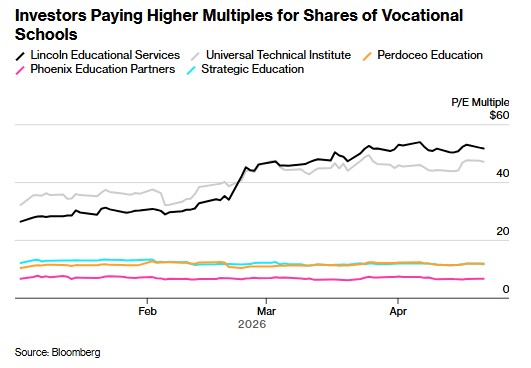
As concerns grow over artificial intelligence (AI) replacing white-collar jobs, vocational school concept stocks have become popular in the capital market. Lincoln Educational Services' stock price rose by 71%, while Global Technical College increased by 7%. On the other hand, Phoenix Education Partners, Perdoceo Education, and Strategic Education saw an average decline of 17%. Analysts point out that the proliferation of generative AI has led to a divergence in the education sector, with blue-collar skill positions being more resistant to replacement, and vocational education receiving policy support, resulting in significant revenue growth
According to Zhitong Finance APP, as concerns about white-collar jobs being largely replaced by artificial intelligence (AI) continue to rise, previously unpopular and sluggish vocational school concept stocks have now become hot targets in the capital market.
In the past six months, Lincoln Educational Services (LINC.US) has seen its stock price soar by 71%, while its competitor Universal Technical Institute (UTI.US) has risen by 7% during the same period. In contrast, the three major mainstream degree education institutions—Phoenix Education Partners (PXED.US), Perdoceo Education (PRDO.US), and Strategic Education (STRA.US)—have seen their stock prices decline by an average of 17%, indicating a significant industry divergence.
Analysts point out that the for-profit education sector is experiencing a polarized trend, primarily due to the rapid adoption of generative AI in the workplace. From programmers to legal assistants, many white-collar jobs face the risk of technological replacement, while practical blue-collar skill jobs, such as HVAC installation and welding, are relatively less impacted by AI and have stronger resistance to replacement.
Alexander Paris, an analyst at Barrington Research Associates Inc., stated, "For the past half-century, American parents have generally advised their children not to pursue technical jobs like automotive repair and to go to college for a degree. But now, this entrenched belief has been completely reversed."
The policies of the Trump administration have further provided additional support for the vocational education sector. The administration promised to promote the return of manufacturing jobs and strongly support vocational skills education—through a series of significant measures, including reallocating special funds from Ivy League schools to specifically assist the development of the vocational education industry.
Independent education analyst Ariel Sokol mentioned in a research newsletter that as society's recognition of skilled trades continues to rise, vocational technical schools are expanding their campuses and increasing enrollment, leading to strong revenue growth.
Data shows that Lincoln Educational Services' revenue surged by 18% last year, while Universal Technical Institute's revenue grew by 14% year-on-year. Currently, the price-to-earnings ratios of these two vocational education companies are significantly higher than those of traditional degree education peers.
"I can't say for sure whether the job I am doing now will still exist in ten years," Sokol candidly remarked, "but you will still need HVAC repair personnel."
