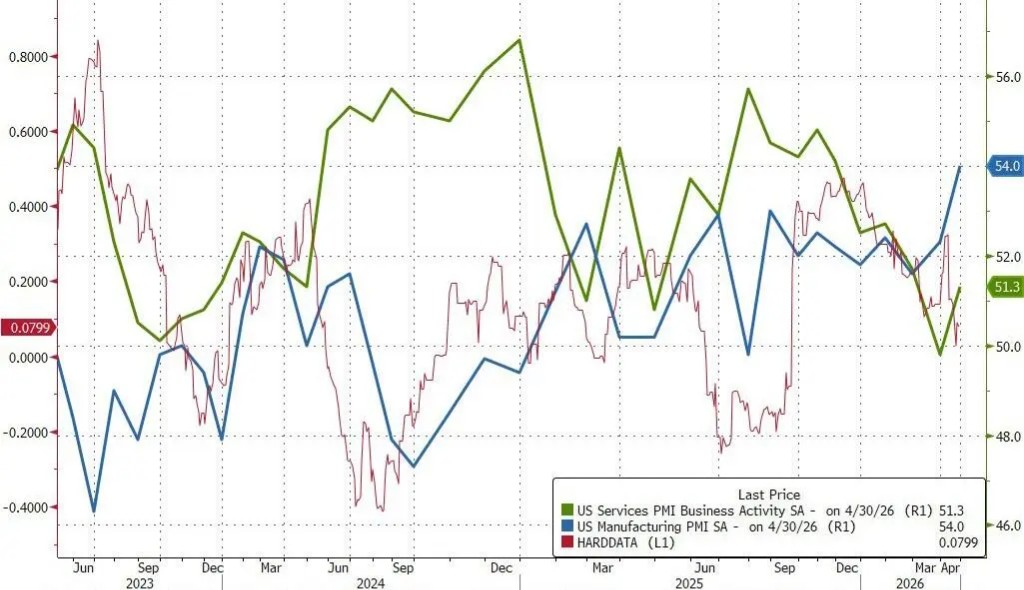
US April Manufacturing PMI Initial Value Hits Near Four-Year High; Stockpiling Driven by Tariffs Fails to Mask Weak Demand, Inflation Rebound Puts Fed in a Dilemma

Wallstreetcn
2026.04.23 14:36

The US April Composite PMI initial value rose to 52, reaching a three-month high and indicating moderate economic growth. The Manufacturing PMI recorded 54, its highest in 47 months, with growth partly driven by tariff-induced precautionary stockpiling rather than genuine demand; the Services PMI climbed to 51.3 but remains low, reflecting weak demand. Price increases for goods and services posted their largest rise since July 2022, intensifying inflation pressures. Economist Chris Williamson warns that with sluggish growth and rising inflation, the Federal Reserve's threshold for rate cuts has significantly increased

US April PMI initial values indicate moderate economic growth, though inflation pressures are intensifying.

Preliminary data released by S&P Global on April 23 showed that the US April Composite PMI initial value rose to 52.0, up from 50.3 previously, marking a three-month high and signaling a recovery in business activity following March's slump. Meanwhile, the average price increase for goods and services reached its largest single-month rise since July 2022, making the inflation outlook a focal point for markets.

Breakdown of data:

  • The Manufacturing PMI initial value stood at 54.0, exceeding expectations of 52.5 and the previous reading of 52.3, hitting a 47-month high with a significant rebound in sentiment;
  • The Services PMI initial value was 51.3, above the expected 50.6 and a notable improvement from the prior 49.8, returning to expansion territory and reaching a two-month high;
  • The Composite PMI initial value came in at 52.0, surpassing expectations of 50.6 and the previous 50.3, setting a three-month high.

Notably, the strong performance in manufacturing was partly driven by precautionary stockpiling by companies rather than substantive improvement in end-user demand; service sector demand remained weak.

Chris Williamson, Chief Business Economist at S&P Global, stated that the April PMI data generally aligns with an annualized US economic growth rate slightly above 1%, with services acting as the main drag. He warned that if inflation continues to rise along the path indicated by the PMI, amid only moderate economic growth, the Federal Reserve will find it increasingly difficult to justify rate cuts.

Weak Demand Coupled with Inflation Pressures: Services PMI Rises But Remains Low

The US April Services PMI saw a slight uptick but remained at a low level, with weak demand and inflation suppressing consumer willingness. Data shows that the US April Services PMI Business Activity Index rose to 51.3, recovering somewhat from March's low, yet still representing the second-lowest level over the past year.

Demand-side performance was lackluster. New order growth nearly stagnated, posting the slowest pace in nearly two years, while export business continued to decline. Survey respondents generally attributed weak sales to uncertainty triggered by the Middle East situation, impacts from other government policies, and constrained purchasing power. Multiple service sectors, including tourism and financial products, showed clear hesitation among both household and corporate clients.

Chris Williamson noted that rapid price increases and expectations of further rises in borrowing costs added additional suppression to service demand.

On employment, service sector jobs grew only marginally. Companies faced structural constraints due to labor supply shortages while also actively controlling labor costs amid unclear demand prospects and high input expenses.

Manufacturing PMI Reaches Near Four-Year High, But Stockpiling Masks Real Demand

US manufacturing activity expanded significantly in April, with the Manufacturing PMI initial value climbing to 54.0, the highest since May 2022; the output index reached 55.7, its highest in 48 months, and new order growth recorded the fastest pace since May 2022. Factory business conditions have improved for eight consecutive months.

However, Chris Williamson issued a warning regarding this trend. He pointed out that output and order growth were largely driven by customers' "pre-stockpiling" behavior. Frequent mentions of "panic" and "emergency" purchasing in surveys reflected concerns among enterprises about rising prices and supply shortages, a phenomenon reminiscent of supply chain chaos during the pandemic.

At the same time, manufacturing export sales accelerated their decline, indicating that external demand does not support the current expansion momentum. On the employment front, manufacturing jobs fell for the first time in nine months, partially undermining the positive signals from other indicators.

Supply Chain Pressures Mount, Price Pressures Intensify

US supply chain pressures intensified significantly in April, emerging as the most concerning risk signal in this month's PMI report.

Data reveals that delays in factory supplier delivery times in April were the most severe since August 2022, a deterioration trend that has persisted for eight months. Beyond shipping disruptions caused by geopolitical conflicts, additional procurement by companies to build safety stocks further exacerbated supply tightness. The pace of procurement activity was the second-fastest in nearly four years, trailing only the surge following tariff announcements last spring.

Price pressures rose in tandem. The average price increase for goods and services in April was the largest since July 2022. Among them, manufacturing product price inflation hit a ten-month high, while service sector price increases reached a 45-month peak. Input price inflation touched an 11-month high, the second-highest in over three years. Aside from rising energy prices, commodities, various raw materials, and labor costs all saw increases.

Corporate Confidence Improves Slightly But Remains Low; Fed Faces Dilemma Between Growth and Inflation

US corporate expectations for output over the next year improved in April, but overall confidence levels remain at historical lows. Market concerns focus on the impact of geopolitical conflicts on price and supply stability, compounded by rising living costs and existing uncertainties regarding government policies.

By sector, service sector confidence remains particularly depressed, showing only a slight rebound from March; manufacturing confidence rose to its highest since February 2025, primarily driven by recent order recoveries, increased marketing investments, and expectations of manufacturing reshoring spurred by tariff policies.

For the Federal Reserve, the current situation is becoming increasingly tricky. Chris Williamson stated that with sluggish economic growth, the inflation signals reflected in the PMI continue to strengthen, making the necessary conditions for rate cuts ever harder to satisfy. Policymakers face a dilemma between slowing growth and rising inflation, rather than the relatively clear path for rate cuts previously anticipated.