TSMC Says Prices Are Too High, ASML Shares Tumble as Analysts Rush to Calm the Market

Wallstreetcn
2026.04.23 13:10

Analysts broadly agree that TSMC's stance was not surprising and should not be overinterpreted as a warning signal for ASML's long-term demand outlook. ASML's monopoly position in lithography equipment remains solid, while Intel and Samsung are significantly more positive regarding high numerical aperture EUV

TSMC's statement that ASML's latest high-end lithography machines are "too expensive" triggered brief market volatility, but multiple analysts quickly stepped in to reassure investors, characterizing it as a timing issue rather than a structural shift in industry demand.

Kevin Zhang, Co-Chief Operating Officer of TSMC, told reporters on Wednesday that the company currently has no plans to purchase ASML's latest generation of High Numerical Aperture Extreme Ultraviolet (High NA EUV) lithography machines, citing a price exceeding $400 million per unit.

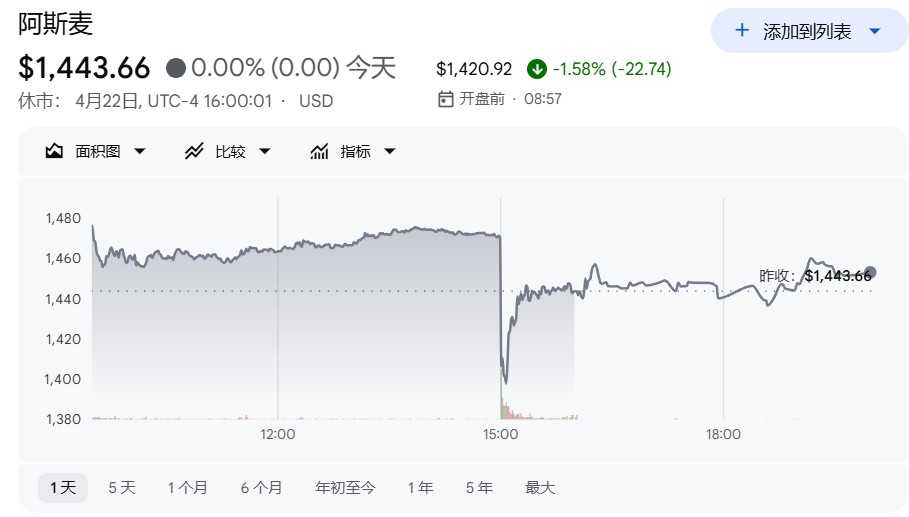
This statement immediately caused ASML American Depositary Receipts (ADRs) to plummet from $1,470 to below $1,400. Although most losses were recovered shortly after, the stock closed down approximately 1% for the day, with an additional 2% drop in pre-market trading the following day.

TSMC Sets a Price Red Line

Kevin Zhang's comments served as the direct trigger for the recent market fluctuation.

As the primary foundry for the world's most advanced chips, TSMC is one of ASML's very limited pool of high-end customers; its procurement decisions have a significant impact on ASML's revenue expectations.

High NA EUV is ASML's most advanced lithography equipment to date, with a single unit priced above $400 million, far higher than the previous generation of EUV models. Kevin Zhang explicitly stated that TSMC has no current procurement plans, a remark that sparked doubts in the market regarding the product's commercialization timeline.

Analysts: A Timing Issue, Not a Structural One

Faced with market panic, analysts from multiple institutions quickly spoke out to quell sentiment.

UBS analyst Francois-Xavier Bouvignies characterized TSMC's stance as "resistance at a specific point in time" rather than a structural change. He noted that UBS previously forecasted High NA EUV could account for 15% to 20% of ASML's total lithography system sales by the end of this decade, emphasizing that ASML still holds a "unique monopoly position" and continues to gain market share in the wafer fab equipment sector.

A team of analysts led by Andrew Gardiner at Citigroup, in a report titled "Deja EUV all over again," pointed out that Kevin Zhang has consistently maintained a cautious attitude toward purchasing this product over the past few years, making this latest statement nothing new. The Citigroup team also noted that they had not expected significant volume increases for High NA EUV before 2028, with mass production targets set for 2029 and beyond.

Intel and Samsung Show More Positive Stances

In contrast to TSMC's conservative position, ASML's other two major clients, Intel and Samsung, have expressed significantly more positive views on High NA EUV. Andrew Gardiner noted that both companies have voiced relatively optimistic perspectives on the technology's capabilities and procurement prospects, which has partially alleviated concerns about overall demand.

This implies that TSMC's absence does not equate to a comprehensive contraction in High NA EUV market demand; rather, it reflects differences among clients regarding technology roadmaps and cost considerations, suggesting that commercialization timelines may vary by customer.