IBM Q1 Revenue and Earnings Beat Expectations, Software Growth Lags, Stock Plunges After Hours | Earnings Insights
The earnings report showed IBM's first-quarter revenue reached $15.9 billion, a 9% year-over-year increase, beating expectations; adjusted EPS was $1.91, also surpassing forecasts. Infrastructure business surged 15%, with mainframe growth of 51%. However, software business growth only met expectations, while consulting business grew just 1% in constant currency, raising market concerns about AI disrupting traditional businesses, causing the after-hours stock price to drop over 7%
IBM released a first-quarter earnings report showing both revenue and profits exceeded Wall Street expectations, with AI demand continuing to support its business. However, the software business, which serves as the company's core growth engine, failed to surpass analyst expectations. Coupled with the consulting business remaining almost stagnant in constant currency, investors remain concerned that AI may disrupt their traditional operations.

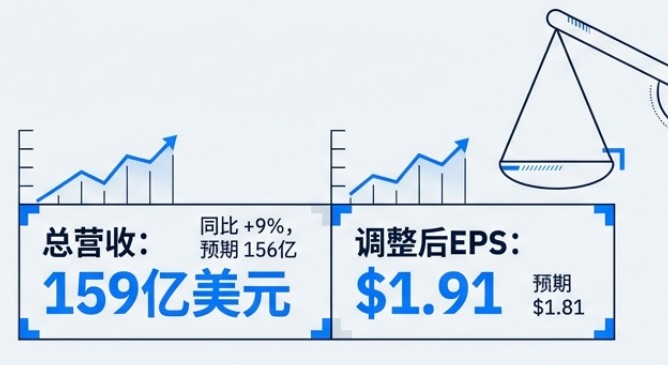
On April 22, the latest earnings report revealed that IBM's total revenue for the first quarter reached $15.9 billion, a 9% year-over-year increase, higher than the average analyst estimate of $15.6 billion. Adjusted earnings per share (EPS) recorded $1.91, also exceeding Wall Street expectations of $1.81.

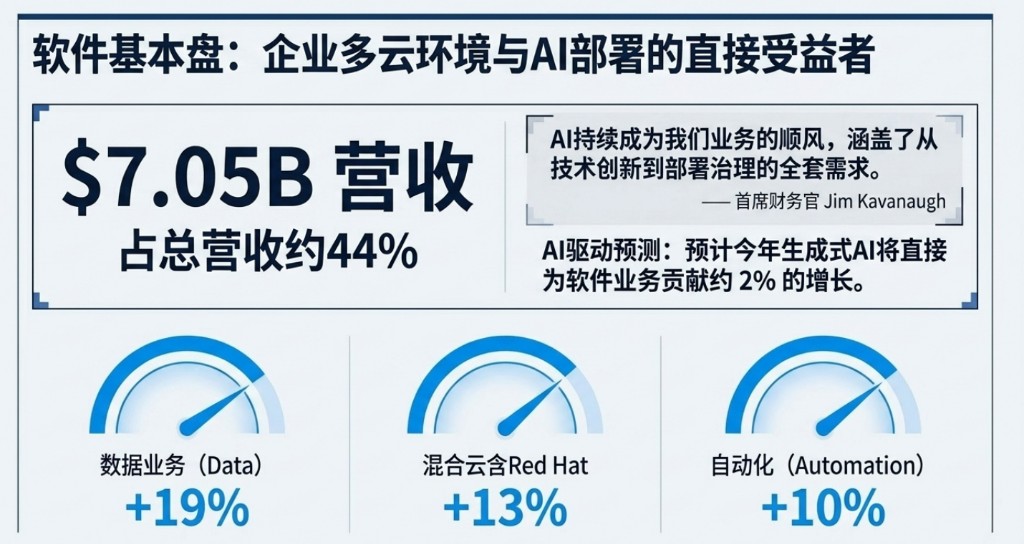
Chief Financial Officer Jim Kavanaugh stated, "AI continues to be a tailwind for our business, whether it is the demand for technology and innovation around AI or the service demand for helping enterprises deploy, govern, and scale AI."
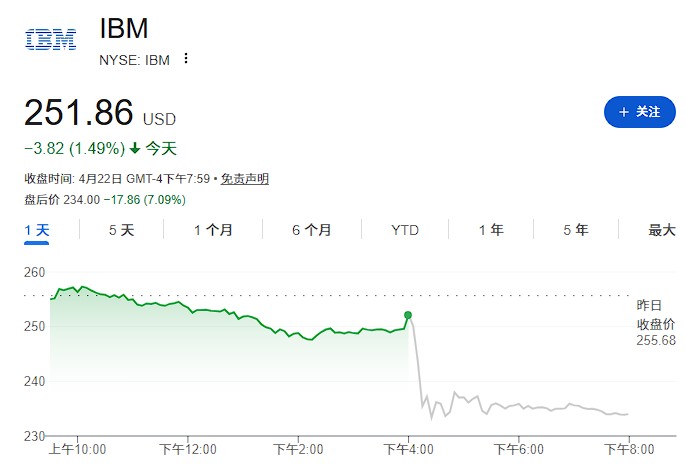
Despite robust fundamental data, IBM's stock fell more than 7% in after-hours trading to around $234, marking a year-to-date decline of nearly 15%. Jefferies analyst Brent Thill noted that investors had expected stronger performance from the software business, and Wall Street might question whether customers are waiting for new tools from AI vendors before making procurement decisions regarding IBM.

Software and Infrastructure Drive Performance, Mainframe Business Shines
Software and infrastructure were the core drivers of this quarter's results.
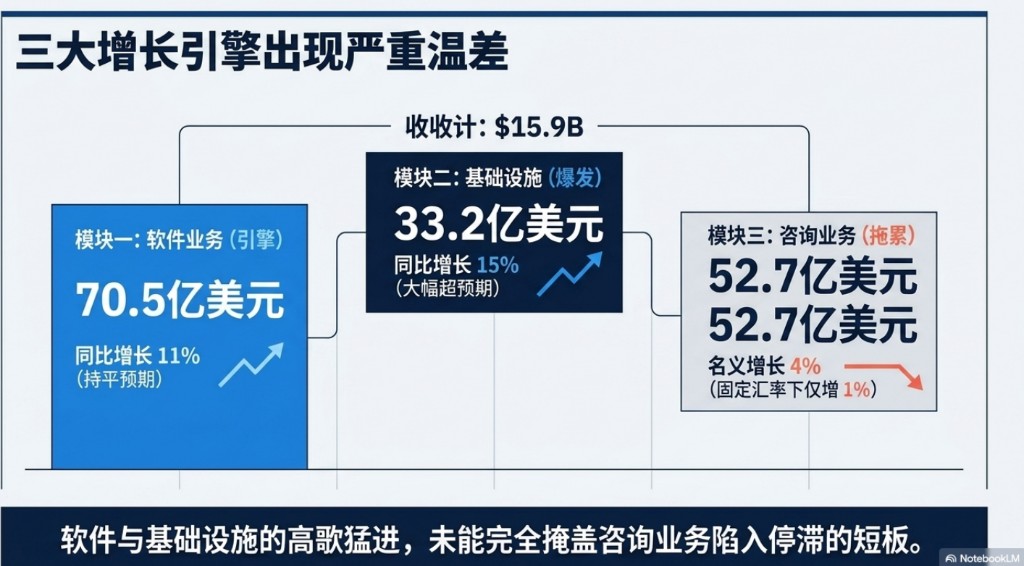
The earnings report showed software revenue reached $7.05 billion, an 11% year-over-year increase, roughly in line with analyst expectations. In detail, data business grew 19% year-over-year, hybrid cloud (including Red Hat) grew 13%, and automation business grew 10%, reflecting sustained demand from enterprises for data management and automated deployment in multi-cloud environments.

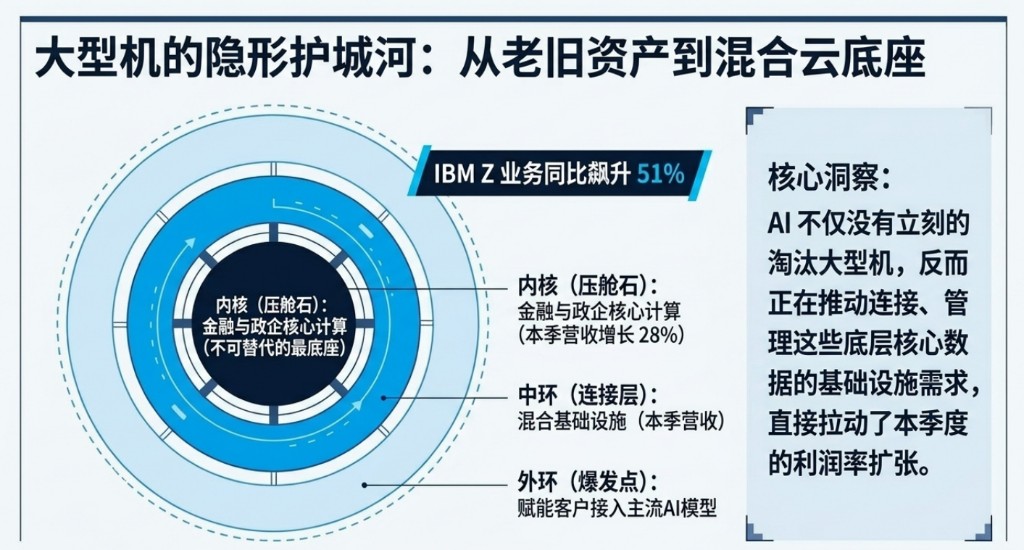
The infrastructure business performed exceptionally well, with revenue reaching $3.32 billion, a 15% year-over-year increase, exceeding analyst expectations. Among them, IBM Z mainframe business grew 51% year-over-year, and hybrid infrastructure business grew 28%, confirming the irreplaceability of mainframes in core computing fields such as finance and government-enterprise sectors, and providing strong support for overall profit margin expansion this quarter.

Kavanaugh stated that AI-related work is driving increased demand for IBM infrastructure software, enabling customers to access mainstream AI models. The company expects that generative AI-related work will contribute approximately 2 percentage points of growth to the software business this year.
Consulting Business Growth Weakness Becomes Market's Biggest Concern
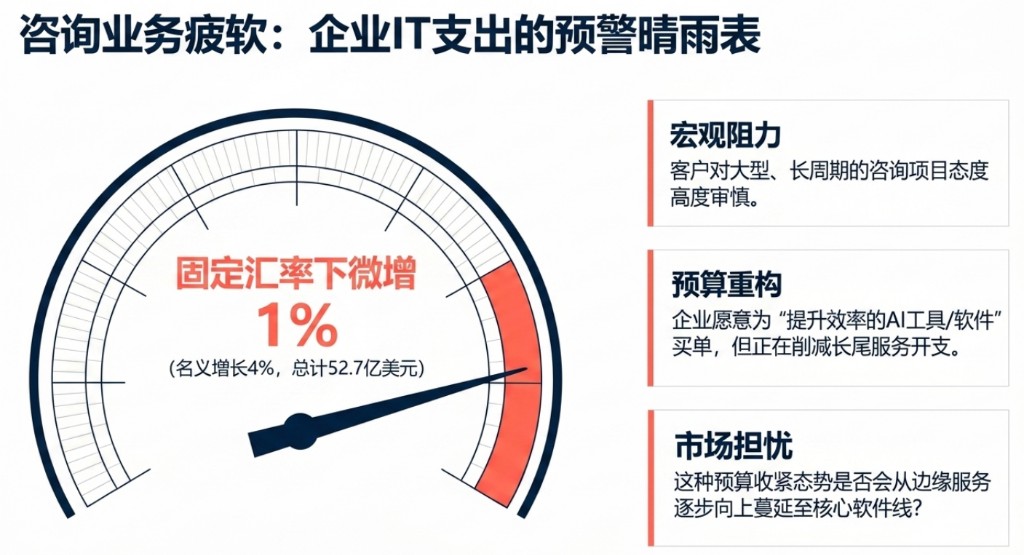
While software and infrastructure are surging, the relative sluggishness of the consulting business has become the most obvious shortcoming in this earnings report. Consulting business revenue for the first quarter was $5.27 billion, a nominal year-over-year increase of 4%, but excluding exchange rate impacts, it grew only 1% in constant currency.

Consulting business is often seen as a barometer of corporate IT spending willingness. In the current macroeconomic environment, while enterprises are willing to pay for AI tools and software infrastructure to improve efficiency, customer attitudes toward large, long-cycle consulting projects remain cautious. The market worries that if macro pressure persists, this tightening of IT budgets could gradually spread to other business lines.
Notably, in February this year, AI startup Anthropic released a tool allegedly capable of helping modernize legacy programming languages running on IBM mainframes, triggering the largest single-day drop in IBM's stock price in decades, further intensifying market concerns about AI disrupting IBM's existing business.
Margins Expand Across the Board, Strong Cash Flow Supports M&A and Dividends
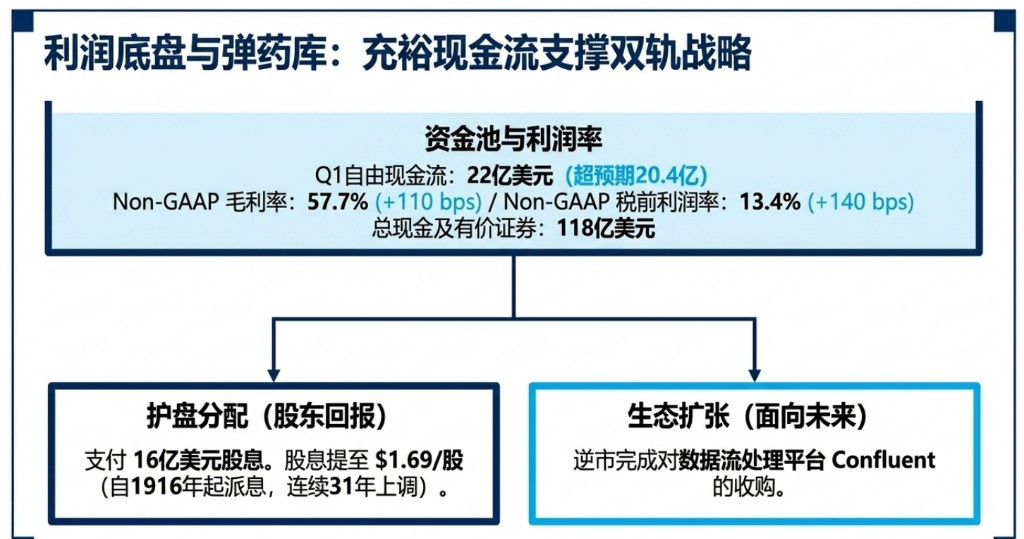
Setting aside local business concerns, IBM's financial health in this quarter remains at a relatively high level. Non-GAAP gross margin reached 57.7%, up 110 basis points year-over-year; GAAP gross margin rose to 56.2%, up 100 basis points year-over-year; Non-GAAP pre-tax profit margin reached 13.4%, a significant increase of 140 basis points year-over-year.
Regarding cash flow, free cash flow for the first quarter reached $2.2 billion, an increase of approximately $300 million year-over-year, exceeding analyst expectations of $2.04 billion. Ample cash flow allowed IBM to return $1.6 billion in dividends to shareholders while still completing the acquisition of data stream processing platform Confluent, further refining its AI ecosystem layout. As of the end of the first quarter, the company held cash and marketable securities totaling $11.8 billion.

IBM's board also announced an increase in the quarterly dividend to $1.69 per share, a slight rise from the previous $1.68. This marks the 31st consecutive year of dividend increases for IBM, continuing its uninterrupted dividend payment record since 1916. Dividends will be paid on June 10 to shareholders registered on May 8.
Full-Year Guidance Maintained, Whether AI Can Continuously Translate into Incremental Growth Remains Key
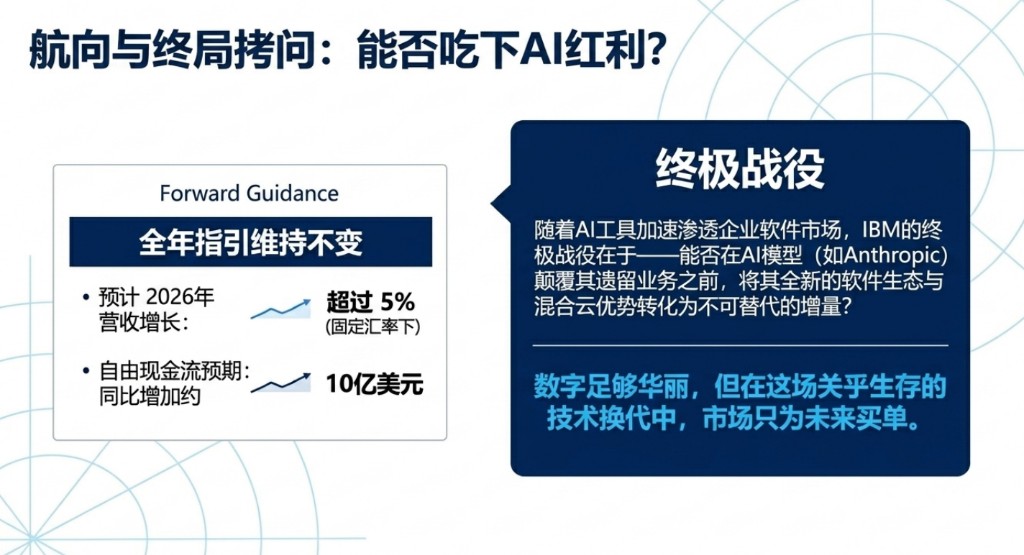
Looking ahead to the full year, IBM maintained its previous guidance unchanged, forecasting revenue growth of over 5% in constant currency for 2026, and free cash flow increasing by approximately $1 billion year-over-year. Kavanaugh stated that this represents IBM's strongest quarterly revenue growth performance in recent years.

However, the core question from the market remains unresolved: As AI tools accelerate penetration into the enterprise software market, whether IBM can continuously translate its AI strategy into quantifiable performance increments while retaining its existing customer base will be the key variable determining its full-year performance.
Analysts point out that IBM has reshaped itself into a high-growth enterprise centered on software, having completed major acquisitions including Red Hat, HashiCorp, and Confluent. However, this transformation path has also made it a focal point for concerns about AI disruption.