Soaring 5-8 Times Upon Listing: Are KNOWLEDGE ATLAS and MiniMax Too Expensive Now?

Wallstreetcn
2026.04.23 04:04

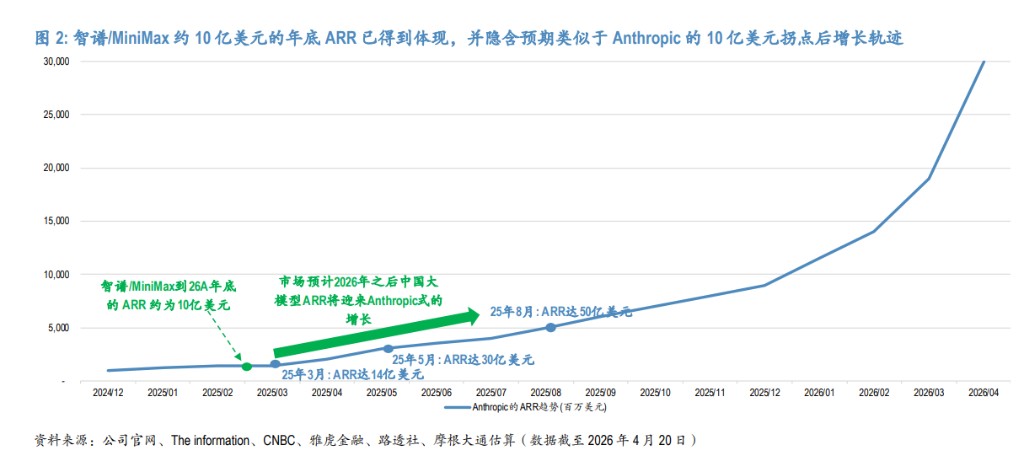
JPMorgan Chase believes that current valuations not only reflect a path for both companies to achieve approximately $1 billion in year-end ARR (Annual Recurring Revenue), but also implicitly bet on them replicating Anthropic's growth miracle of 'scaling ARR from $1 billion to $5 billion in six months'. In the more competitive Chinese market, this expectation is not low

A stock rises 5-7 times within three months of listing; would you ask: Can I still buy it? JPMorgan's answer is — yes, but first you must understand what has already been priced into the stock.

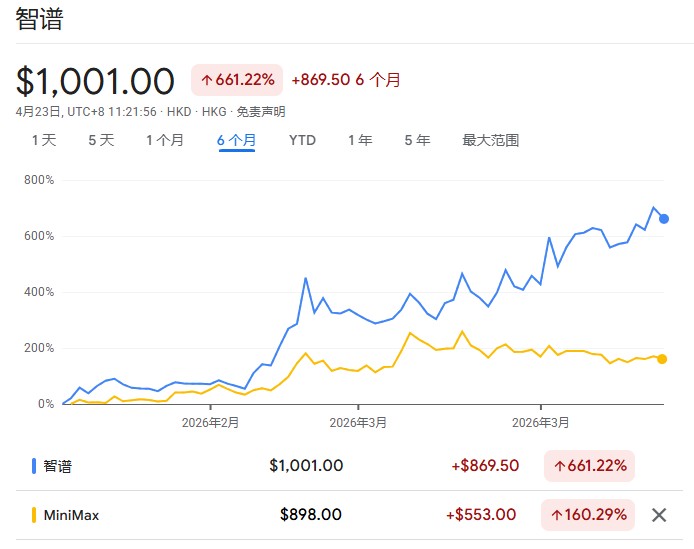
KNOWLEDGE ATLAS and MiniMax listed on the Hong Kong Stock Exchange in January 2026, with share prices surging thereafter. As of April 23, cumulative gains reached approximately 5-8 times. Specifically, KNOWLEDGE ATLAS rose from an IPO price of HK$116.20 to HK$1,001. They are currently the only two pure frontier AI large model companies listed globally; scarcity itself commands a premium.

According to Zhongfeng Trading Desk, JPMorgan maintained "Overweight" ratings for both companies in a research report released on April 22, setting target prices of HK$950 for KNOWLEDGE ATLAS and HK$1,100 for MiniMax. However, the report's focus was not on whether to "buy or not," but rather on systematically answering a harder question: What has this rally already digested, what could drive further gains, and what could cause a decline?

An Anthropic-Style Myth Hidden in the Stock Price

The combined market capitalization of the two companies is currently between $40 billion and $55 billion. What does this number signify?

JPMorgan's calculation indicates that the market has already implied KNOWLEDGE ATLAS will reach approximately $1 billion in ARR by the end of 2026, while MiniMax will reach about $700 million.

This is only the first layer. More critically, the second layer of implicit expectations is: The market is not just betting they will hit $1 billion, but also that after surpassing that threshold, they will follow an Anthropic-style growth curve.

The reference point for Anthropic is as follows: In March 2025, ARR was approximately $1.4 billion with a valuation of roughly $61.5 billion; by August 2025, ARR had surpassed $5 billion—a growth of about 3.5 times in six months.

Following this logic, the pricing for KNOWLEDGE ATLAS and MiniMax already presupposes that once they cross the $1 billion hurdle, they can roughly replicate this curve.

JPMorgan directly pointed out: "In the more competitive Chinese market, such an expectation is high."

When Anthropic surged from $1 billion to $5 billion, direct competition was limited. The situation in China is entirely different—Alibaba, ByteDance, and Tencent are all ramping up B2B efforts. Tencent launched WorkBuddy, while Alibaba and ByteDance are expanding the scale of Qoder and TRAE respectively, and ByteDance has bundled Doubao into enterprise suites. If the same growth opportunities are distributed among 6-8 companies, each company's growth rate will naturally be slower.

ARR Is Not Linear; It Is a Step Function

Despite high expectations, JPMorgan maintains a structurally optimistic stance, one reason being: Current ARR (Annual Recurring Revenue) may understate true demand.

KNOWLEDGE ATLAS disclosed that as of March 31, 2026, API ARR had surpassed $250 million, representing a 60-fold year-over-year increase and a 6.4-fold increase since the beginning of the year. Every time a new GLM version was released (4.5 → 4.6 → 4.7 → 5 → 5.1), ARR experienced jump-like growth; after GLM-5 went live, the growth curve became "almost vertical." A similar pattern emerged after MiniMax released its M2.2 to M2.7 series.

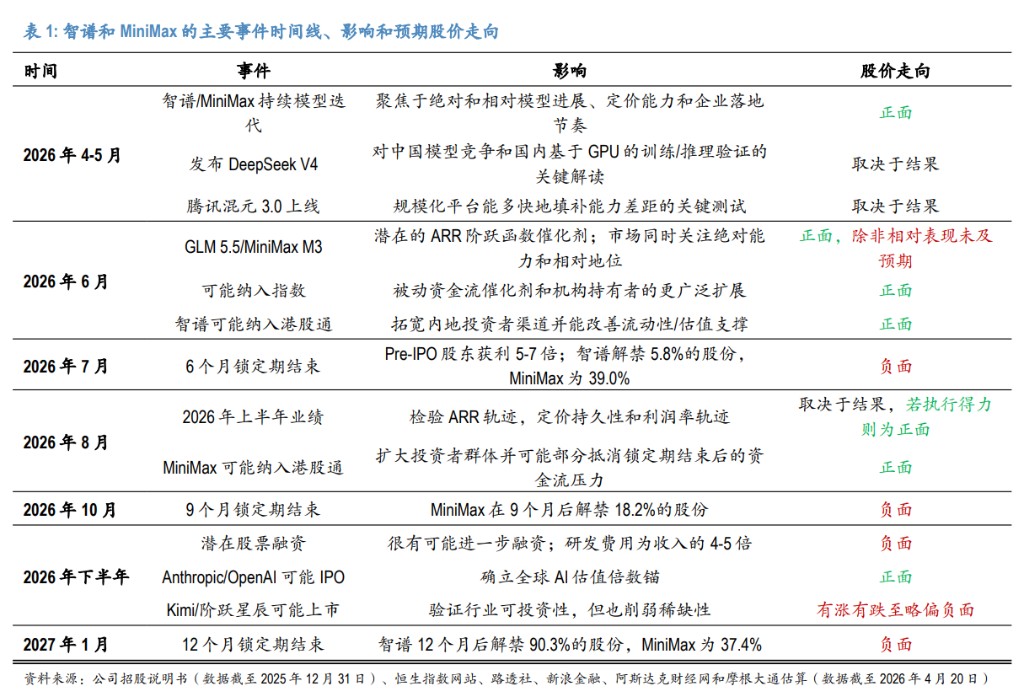
This means ARR growth is not a steady climb but a step function tied to model iterations. The next node—the anticipated release of GLM 5.5 and MiniMax M3 around June—is the single most predictable ARR catalyst at present.

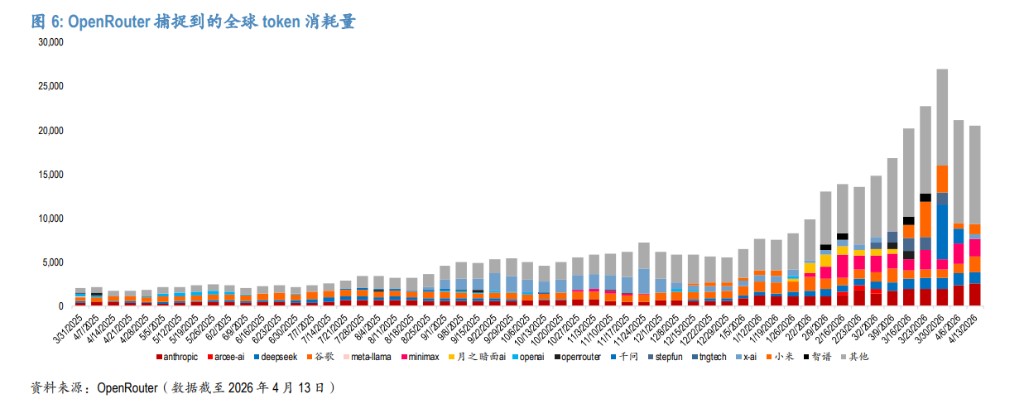
Demand-side support is equally strong. According to data from the People's Daily, daily token usage in China exceeded 140 trillion in March 2026, compared to 100 billion at the start of 2024 and 100 trillion by the end of 2025—the slope of demand acceleration is extremely steep.

The issue lies in computing power. All major LLM suppliers in China have stated that inference computing cannot keep up with token demand growth. This leads to an counter-intuitive conclusion: The currently observed ARR growth rate is a floor, not a ceiling. Once the computing bottleneck is lifted, suppressed demand can be directly converted into recognized revenue.

Alibaba Cloud announced on April 18 that AI computing prices were raised by 34%, while KNOWLEDGE ATLAS's API prices nearly doubled since the beginning of the year. Despite the price hikes, demand remains robust, and the pricing environment is becoming "significantly more stable."

Pricing Improvements Involve More Than Just Price Hikes; Three Mechanisms Are Working Simultaneously

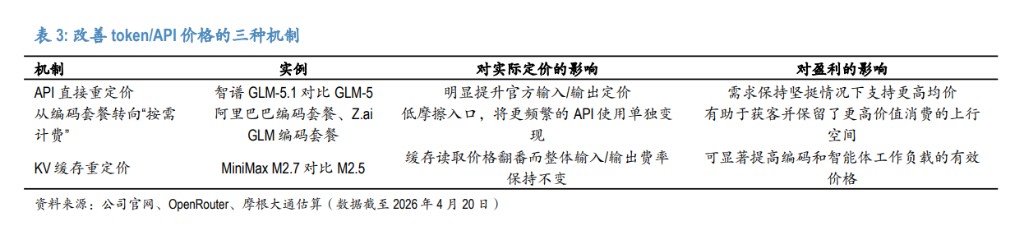
Pricing improvement is one of the most significant industry changes in 2026. JPMorgan outlined three mechanisms working in the same direction:

First, direct repricing centered on model upgrades. From GLM-4.7 to GLM-5 and then to GLM-5.1, KNOWLEDGE ATLAS significantly increased its API pricing, with actual token prices nearly doubling since the start of the year. The fact that demand did not noticeably shrink despite price hikes indicates that corporate willingness to pay is rising.

Second, migration from subsidized packages to pay-as-you-go models. Alibaba Cloud stopped accepting new users for its Lite coding package starting March 20, making the Pro version the primary entry point; KNOWLEDGE ATLAS adopted a similar separation strategy—coding package quotas can only be used within their coding tools, while API calls are billed separately. Discounted packages serve to reduce implementation friction, while the real revenue opportunity comes from customer consumption beyond bundled content.

Third, KV cache repricing. This is the most easily overlooked mechanism. Compared to M2.5, MiniMax's M2.7 maintained overall input/output pricing, but the price for reading prompt cache increased from $0.03 per million tokens to $0.06. In coding and agent workloads, the billing weight for cached tokens is high. JPMorgan estimates that the effective price of M2.7 is over 30% higher than M2.5—even though the surface pricing remained unchanged.

Next Risks: In July, 39% of MiniMax Shares Will Be Unlocked

Beyond fundamentals, liquidity conditions represent the most direct technical pressure for the second half of 2026.

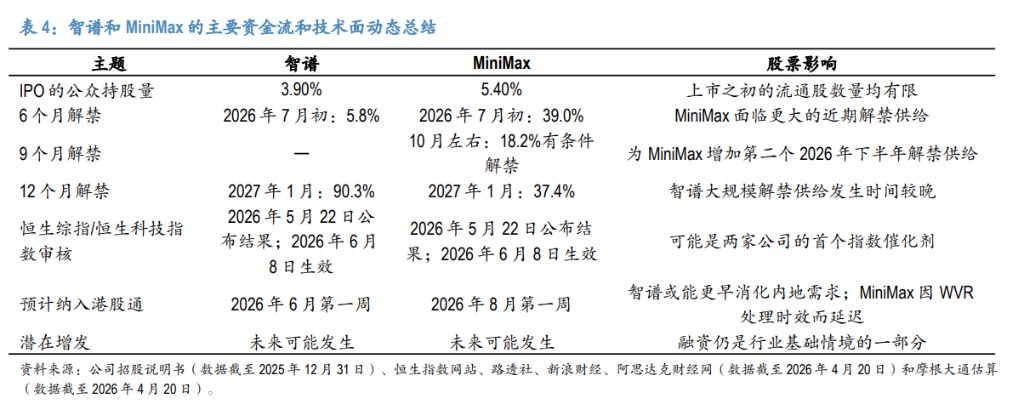
Both companies had very few tradable shares at IPO: approximately 3.9% for KNOWLEDGE ATLAS and 5.4% for MiniMax. Restricted shares will be released in batches:

KNOWLEDGE ATLAS: 5.8% unlocks in early July, and 90.3% unlocks in January 2027. Near-term pressure is relatively moderate.

MiniMax: 39.0% unlocks in early July, followed by another 18.2% around October, and 37.4% in January 2027. Supply pressure in the second half of 2026 is significantly heavier.

Pre-IPO shareholders hold costs at extremely low levels, with paper profits of 5-7 times; the pressure for profit-taking after unlocking cannot be ignored.

JPMorgan referenced the unlocking history of Kuaishou, SenseTime, and Horizon Robotics: Kuaishou's stock price fell from HK$250 to HK$120 during its six-month unlocking period, and SenseTime saw a sharp decline post-unlocking. However, there are differences—KNOWLEDGE ATLAS and MiniMax currently have average daily trading volumes of approximately HK$1.2-1.5 billion, indicating significantly better liquidity than the aforementioned cases, along with higher turnover rates prior to unlocking and stronger market absorption capacity.

More importantly, the unlocking window overlaps heavily with the model release cycle in June. If GLM 5.5 and MiniMax M3 deliver strong results, some pressure can be hedged; if model performance is mediocre, stock prices will be more vulnerable to supply expansion shocks.

Hedging factors: On June 8, KNOWLEDGE ATLAS and MiniMax are expected to be included in the Hang Seng Composite Index and Hang Seng Tech Index, bringing passive fund inflows; KNOWLEDGE ATLAS is expected to be included in the Stock Connect program in the first week of June, while MiniMax, due to its different share rights structure, is expected to be included in the first week of August.

Scarcity Premium Has a Window Period of Approximately 6-12 Months

KNOWLEDGE ATLAS and MiniMax are currently the only two pure frontier AI large model companies listed globally; scarcity is a key source of valuation premiums. However, this window will not remain open forever.

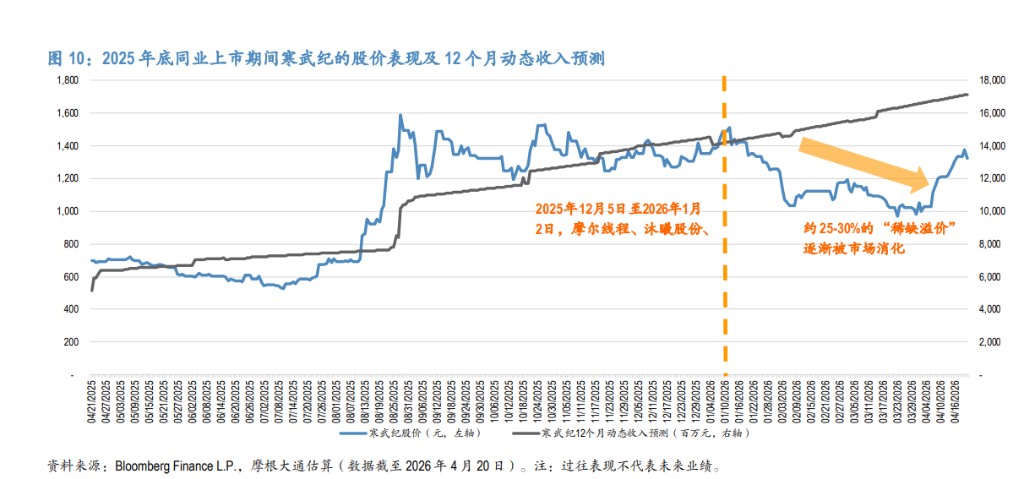
JPMorgan cited a direct precedent: Cambricon was once the only pure AI chip company listed on the A-share market, with a stock price of approximately RMB 1,500 at the end of November 2025. Subsequently, Moore Threads, MetaX, and Biren Technology listed between December 2025 and January 2026. Despite Cambricon's 12-month dynamic revenue forecast being revised up by 17% and earnings forecasts revised up by 26%, its stock price fell approximately 2% since the beginning of the year, and its valuation multiple contracted by about 25-30%.

If Kimi (Moonshot AI) and StepFun were to list, the impact on KNOWLEDGE ATLAS and MiniMax would be similar. Short-term IPO activity brings capital inflows and boosts sector sentiment; however, the scarcity premium for each company will structurally decline. JPMorgan judges that the window for "the only path to invest in Chinese AI" has approximately 6-12 months remaining.

In the US: Anthropic and OpenAI IPOs Could Change the Valuation Framework

Anthropic's ARR surpassed $30 billion on April 6, up from $9 billion at the end of 2025—a 3.3-fold increase in about 3.5 months; OpenAI is expected to generate revenue of approximately $29 billion in 2026. Combined, their ARR exceeds $59 billion.

This has two implications for Chinese LLM companies:

Positive aspect: The realization scale of US frontier models continues to refresh the market's perception of potential market ceilings. Chinese token consumption is also exploding; if adoption curves in China catch up, KNOWLEDGE ATLAS's year-end target of $1 billion might be conservative. Currently, the combined market cap of KNOWLEDGE ATLAS and MiniMax is approximately $80 billion, accounting for about 5% of US peer valuations—the relative discount is actually widening.

Risk aspect: Once Anthropic or OpenAI lists, the valuation framework may shift from "ARR multiples" to a public market logic focusing more on gross margin, operating leverage, and free cash flow. At that time, companies with strong revenue growth but lower mid-term earnings visibility will face greater valuation pressure.

Red Lines Drawn by JPMorgan

While maintaining an "Overweight" rating, JPMorgan also clearly listed five signals that could lead to a cautious stance:

Including losing relative model leadership in coding, agents, and enterprise workloads; internet or cloud giants establishing clear technological advantages that weaken the premium pricing ability of independent model suppliers; renewed API price competition compressing the link between "better models" and "higher pricing"; a widening gap in model capabilities between China and the US again; and strong usage growth coupled with persistently weakening ARR conversion.

"As long as these conditions remain favorable, technical pullbacks should be viewed as buying windows."

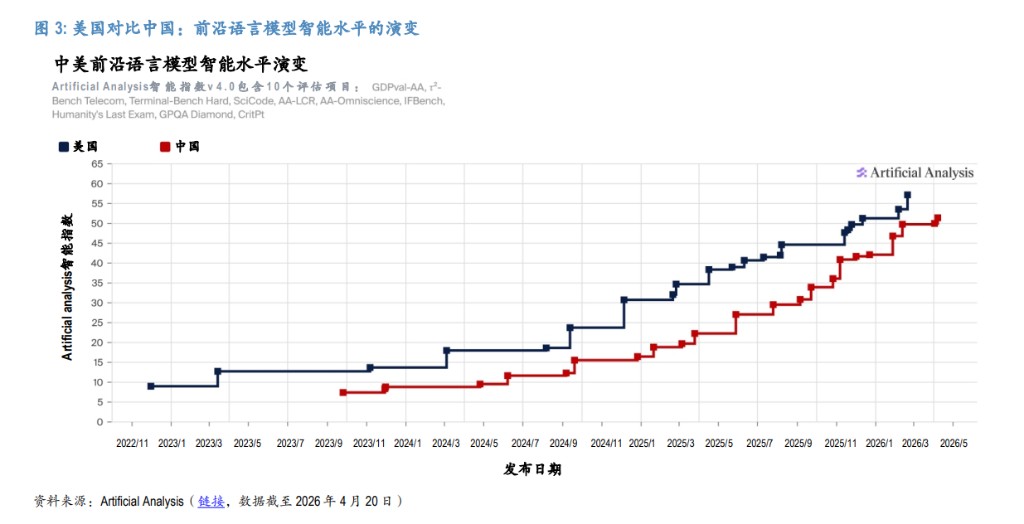
Currently, JPMorgan estimates the gap in frontier model capabilities between China and the US is about 9-12 months, and China is catching up rapidly. This is one of the core supporting assumptions for current valuations.