Volkswagen Reveals Its "Arsenal"

Wallstreetcn
2026.04.23 03:44

The arrow is on the string

Author | Chai Xuchen

Editor | Zhou Zhiyu

After enduring the pressure test in China's "gym," that familiar German giant seems to have returned with enhanced strength.

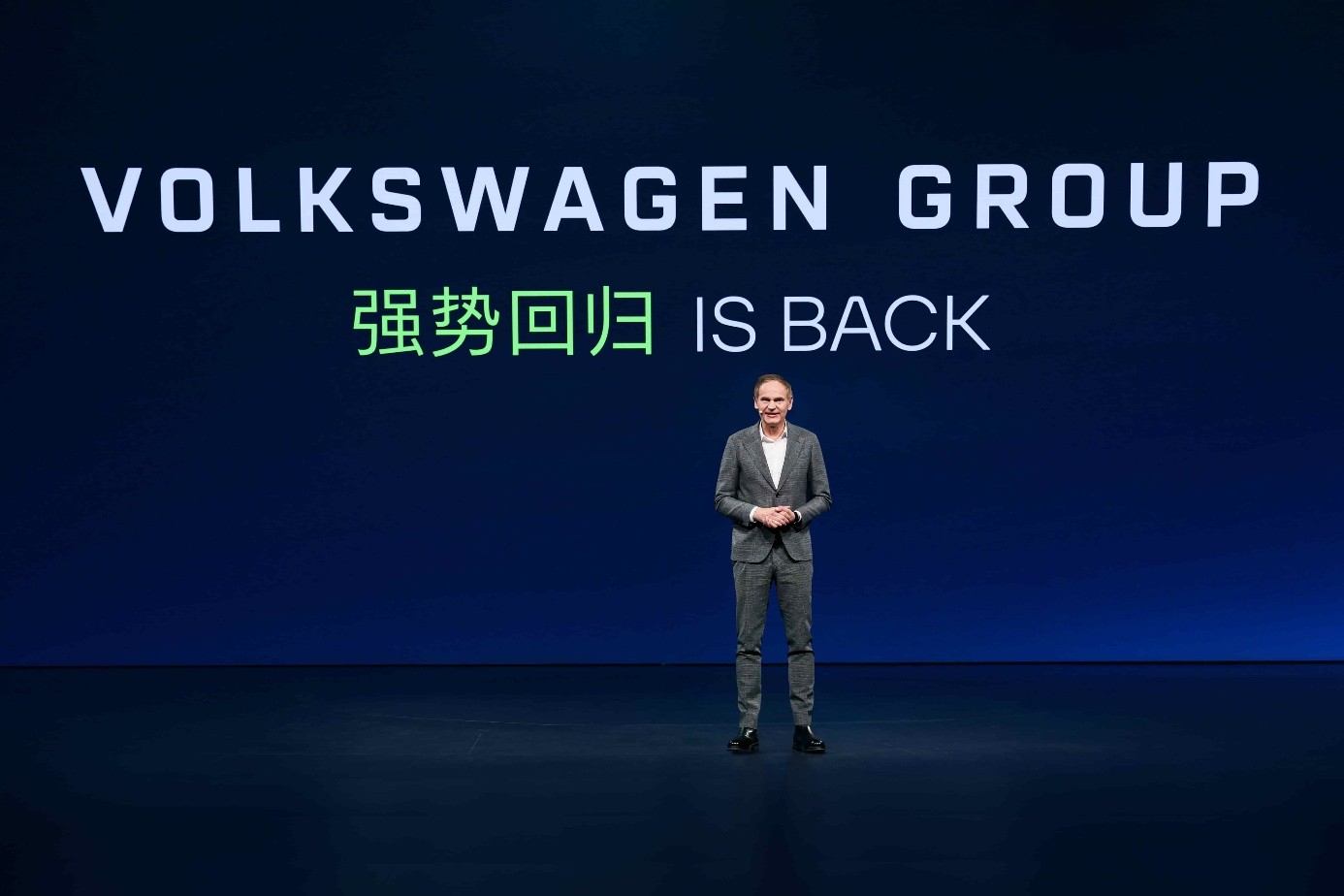
Following three years of "silent transformation," on April 21, 2026, just before the Beijing Auto Show, Volkswagen AG prepared a concentrated "parade." Unlike previous events where high-end luxury brands like Audi, Porsche, and Bentley took the lead, this time the Volkswagen brand, Audi, AUDI, and even the rebranded Jetta brand all showcased their respective electric vehicles on stage.

Electrification transformation has been fully integrated into Volkswagen Group's core strategy, targeting the volume-driven mainstream market.

This is merely the tip of the iceberg. Oliver Blume, Chairman of the Management Board of Volkswagen Group, stated that what follows will be Volkswagen's largest product offensive in China to date, with approximately 30 electric vehicles to be launched by 2027, rising to 50 by 2030.

Such an intensive product rollout is unprecedented among multinational automakers.

Volkswagen has unveiled its long-accumulated "arsenal," ready to face off against new players. However, the more critical battle lies in AI. Volkswagen has brought "Agentic AI for All" into the spotlight, preparing to secure a ticket to the final destination of intelligence.

This multinational giant, which has deeply cultivated the Chinese market for over forty years and accumulated tens of millions of users, is no longer satisfied with holding onto the basic foundation of the internal combustion engine era. Instead, it has decided to launch a truly comprehensive counterattack in China's new energy and intelligence tracks.

In recent years, the elimination race in the Chinese market has accelerated, with many players cleared from the table and market share continuing to concentrate among top enterprises. Foreign brands are generally in a state of waiting and adjustment, while Volkswagen chose to unsheathe its sword at this moment. Behind this move is the German giant's clear understanding of its own situation: if it does not accelerate further, it may lose the entry ticket for the next round of competition.

Only by reclaiming the Chinese market can Volkswagen have the opportunity to break out of its global passive situation and return to the throne of the world's number one manufacturer six years after being overtaken by Toyota.

Fighting with Chinese Speed

Compared to previous editions focusing on product display, Volkswagen Night this year clearly proclaimed a "strong return" with a specific intent: to fight in China using China's rhythm.

That night, Volkswagen Group launched four vehicles simultaneously, covering everything from entry-level to luxury, including a pure electric mid-size SUV, a large pure electric sedan, an entry-level pure electric concept car, and a luxury pure electric SUV.

AUDI's second mass-produced model, the E7X, aims to enter the large luxury SUV market and plans to equip L3-level driving assistance functions in the future. This will mark the first introduction of this technology globally and in the Chinese market for Audi.

The ID. UNYX 09 from Volkswagen Anhui is a 5-meter-long pure electric sedan nearing mass production, targeting the mid-to-large new energy sedan market. The new vehicle is equipped with an enhanced Level 2 advanced driver assistance system, a high-performance computing platform, and an AI intelligent assistant.

ID. AURA T6 brought by FAW-Volkswagen is the first model of the new ID. AURA series, built on the CEA architecture, officially entering the most competitive pure electric mid-size SUV market. Its core capabilities include enhanced Level 2 assisted driving and continuous OTA upgrades.

Jetta's first pure electric concept car, JETTA X, will target the entry-level intelligent connected car market, representing Volkswagen's penetration into price-sensitive new energy users. Volkswagen plans to launch four new energy models under the Jetta brand by 2028, with the first product hitting the market this year.

If new forces excel at building recognition through single-point hit products, then Volkswagen clearly takes another path: relying on multiple brands, multiple price points, multiple powertrain routes, and multiple market segments to form systematic suppression. This is very much Volkswagen. In the fuel era, Volkswagen became a global hegemon through platformization and matrix strategies; in the new energy era, it attempts to reorganize the war in the same way.

Oliver Blume admitted that three years ago, Volkswagen initiated a thorough transformation for China, the most dynamic automotive market globally. "No place has such rapid technological iteration, such fierce competition, and such rapid changes in user demand as China. China is like a gym for the automotive industry."

Volkswagen's choice is to rebuild muscle in this "gym."

It should be noted that the most constraining factor for Volkswagen in the Chinese market in recent years was not a lack of technology or capital, but insufficient speed. While Chinese brands have entered a rhythm of quarterly model updates, monthly OTAs, and annual platform iterations, traditional multinational automakers remain trapped in lengthy global R&D processes, cross-regional coordination mechanisms, and multi-layered approval systems. Often, by the time products are released, the market has already changed.

In the new R&D architecture, the Chinese team no longer needs to wait for layered approvals from Wolfsburg. They have been granted technical decision-making authority and verification capabilities to independently advance all tasks at Chinese speed.

On the other hand, Volkswagen has also lowered its posture. An insider familiar with Volkswagen revealed to Wall Street Journal that the cooperation between Volkswagen and XPeng on the CEA architecture is not a client-contractor relationship. Volkswagen deployed an entire team to XPeng to learn how to build a new software architecture from scratch.

Tao Hailong, General Manager of SAIC Volkswagen, also confirmed to Wall Street Journal that "Volkswagen has indeed made huge changes for China to ensure it remains at the table."

After partnering with XPeng, by the end of 2025, its regionally controlled electronic and electrical architecture (CEA) developed locally in China was completed from concept proposal to mass production in just 18 months. In contrast, Volkswagen typically requires 3 to 5 years for traditional electronic and electrical architecture development, and this speed even exceeds the 24-month cycle targets usually set by Chinese local new forces.

Furthermore, under the new architecture, the R&D cycle is shortened by 30%, and platform development costs are reduced by up to 50%. The advantages of efficiency and cost give Volkswagen the confidence for batch output. Looking back, the core reason Volkswagen became a global automotive giant was platform-based manufacturing. Now facing the new battlefield of smart cars, it is evident that Volkswagen continues to employ its most skilled approach.

The Real Protagonist is AI

If we only look at the new cars, this launch event is still just a strong return. But the real protagonist Volkswagen wants to highlight is not the models, but the technology roadmap. For the first time, Volkswagen has elevated AI to the core of its group-level strategic narrative, launching "Agentic AI for All."

In recent years, amidst calls to "redo every industry with AI," the automotive industry has undoubtedly been the most radical. From intelligent upgrades in voice interaction to immersive experiences in smart cockpits, and breakthroughs in intelligent driving, the acceleration button for AI integration has been pressed.

However, most efforts still remain at the cockpit level, such as voice assistant upgrades, chat interactions, and entertainment recommendations. Industry insiders believe that the essence of a car is safely and efficiently moving from point A to point B. If AI cannot participate in this core function, it will always remain mere icing on the cake. What Volkswagen wants to do is make AI more proactive, becoming an essential necessity that car owners cannot live without.

This time, Volkswagen proposed the "Agentic AI for All" roadmap, which will serve as the brain for its future models.

"All-domain" means covering all core vehicle systems—intelligent driving, cockpit, chassis, and powertrain—without fragmentation. "Agent" means AI will no longer passively wait for instructions but will proactively understand user intentions and dispatch whole-vehicle resources to execute tasks.

For example, when a user says, "I'm tired today and want to get home early," a traditional infotainment system might play music or turn on massage seats. The AI defined by Volkswagen, however, should simultaneously plan the fastest route, switch to a comfortable driving mode, pre-adjust the cabin temperature, utilize assisted driving capabilities, and plan charging paths based on battery levels.

This capability of proactive understanding and service is what Volkswagen believes AI integration should achieve. The more critical second step tests the automaker's ability to scale implementation.

Hans Schreiter, Executive Vice President of Volkswagen Group, told Wall Street Journal that the Chinese market defines the competitive rhythm of the global new energy vehicle industry. "In this AI-driven automotive industry revolution, whoever can achieve scaled implementation of intelligence at the lowest cost will define the rules of the second half of the game."

Volkswagen has prepared a major weapon for this.

First is the CEA architecture jointly developed by Volkswagen and XPeng, which integrates intelligent driving control and cockpit control onto a central computing platform, achieving a unified driving-cockpit experience. According to Volkswagen's plan, starting from the second half of 2026, all new models built on the CEA electronic and electrical architecture will be fully equipped with this onboard agent AI.

In this way, Volkswagen's AI capabilities can be "one-click copied" to new models across its group brands, becoming a standard selling point.

The second territory comes from intelligent driving—CARIZON. As a local intelligent driving capability center established as a joint venture between Volkswagen and Horizon Robotics, CARIZON delivered its first-generation Level 2 advanced driver assistance system by the end of 2025. In the second half of this year, the enhanced Level 2 system will further expand to urban roads, realizing a "point-to-point" assisted driving experience.

For technology fields requiring rapid iteration like AI, the speed of R&D efficiency itself will be the absolute decisive factor. This explains why Volkswagen emphasizes its desire to become the first multinational automaker to scale-agently apply agent AI to all models in China. For Volkswagen, technology only generates true value when it is popularized.

There Is No Way Back

Volkswagen's high-profile move to unsheathe its sword is precisely because the pressure is already immense, solidifying its determination to transform.

In 2025, Volkswagen Group delivered over 2.69 million new vehicles in China, a year-on-year decline of 8%. In the more profitable internal combustion engine market, Volkswagen still delivered over 2.57 million vehicles, holding a market share of over 22% and securing its basic foundation.

However, Volkswagen's sales of new energy vehicles in China were only 120,000 units, a 40% drop compared to 200,000 units in 2024, accounting for just 4.5% of total sales. This figure is far below the group's global average of 10.9% and has even reverted to 2021 levels.

China remains Volkswagen's largest single market, and its performance directly determines its global landscape. In 2025, Volkswagen Group's global sales reached 8.98 million units, trailing Toyota for the sixth consecutive year and ranking second globally.

Therefore, the significance of the Chinese market to Volkswagen goes far beyond profit sources. Volkswagen needs breakthroughs in this largest single market more than ever before to leverage a reshuffling of the global competitive landscape.

Without a thorough transformation, the former king will completely become a supporting character.

On one hand, the penetration rate of new energy vehicles is rapidly increasing, the internal combustion engine market continues to shrink, and Chinese brands are exerting pressure on the new energy track. BYD, Geely, Huawei, and a batch of new forces occupy user minds and growth dividends, establishing themselves firmly in their respective market segments and forming a diversified competitive landscape.

On the other hand, under the offensive of independent brands, joint ventures shouting about deep cultivation of the Chinese market and active self-rescue are not limited to Volkswagen.

Toyota, known for efficiency, has begun a counterattack by leveraging GAC to create the Baimi series; the old luxury brands BBA have chosen to collaborate with Chinese supply chains to develop intelligent solutions to quickly catch up; American brand Buick, with the help of SAIC, is also creating its own new energy brand to change market perceptions.

However, keeping up with the pace of the new era is not easy for a nearly century-old global brand. Industry insiders believe that what Volkswagen Group seeks is not radical innovation, but steady progress. A comprehensive and thorough transformation means having to adjust organizational structures, reorganize supplier relationships, etc., all of which are necessary pains.

But once an elephant starts turning around, its massive inertia will push it to become a new anomaly in the market.

According to the latest plan, in 2026, Volkswagen Group will launch over 20 new energy vehicle models in China; by 2027, the cumulative total will reach about 30 models; by 2030, it will reach about 50 models, including approximately 30 pure electric models. New energy vehicles will account for 80% of Volkswagen's sales in China.

Oliver Blume stated plainly: "This year, we launch a new product almost every two weeks."

It is worth noting that Volkswagen chose to launch its offensive during this window of subsidy withdrawal and survival of the fittest, precisely using the receding tide as an entry ticket. Because when the market shifts from policy-driven to value-driven, consumers no longer look solely at subsidies but begin to re-evaluate quality, brand, reliability, long-term usage costs, and system service capabilities. These are exactly the areas where Volkswagen excels.

Oliver Blume exclaimed: "Volkswagen Group, we are back—stronger, more confident, and with clearer goals." Many people interpret Volkswagen's recent moves as a "joint venture counterattack." This is only half true.

What Volkswagen truly wants to compete for is not just the share of China's new energy market, but the discourse power of the next round of the global automotive industry.

China has become the world's largest new energy vehicle market and the most intense training ground for smart cars. Whoever completes product validation, supply chain optimization, and intelligent implementation in China will have a better chance to replicate this system globally.

In the past, Germany defined Volkswagen, and China bought Volkswagen. In the future, Volkswagen wants China to define the next generation of Volkswagen, which Volkswagen will then sell to the world. Now, this century-old giant sets off again.