


Wash's bold bet: using AI productivity to hedge against inflation, the Federal Reserve moves towards a framework reconstruction
Kevin Warsh believes that the success of the Federal Reserve lies in the fact that people are no longer talking about inflation. The challenge he faces is to curb inflation while meeting Trump's expectations. Warsh emphasized the independence of the Federal Reserve during a congressional hearing and refused to commit to interest rates. He proposed restructuring the operational framework of the Federal Reserve, shrinking the balance sheet, and using interest rate tools to support the real economy and AI-driven productivity improvements. However, achieving the goal of price stability by the end of the year presents a daunting task for him
According to the Zhitong Finance APP, an increasing number of senior macroeconomists on Wall Street believe that Federal Reserve Chairman nominee Kevin Warsh faces an almost impossible task—both to curb inflation and to please the U.S. President Donald Trump who nominated him. Kevin Warsh, the next Federal Reserve Chairman candidate nominated by Trump, believes that an important sign of the Federal Reserve's success in monetary policy is that no one is talking about inflation anymore. However, to achieve this, the Federal Reserve Chairman nominee is likely unable to please the president who appointed him in the short term.
Just over an hour before Kevin Warsh began attending his confirmation hearing in Congress on Tuesday, U.S. President Donald Trump reiterated his stance on interest rates—he told reporters that he would be very disappointed if the new Federal Reserve Chairman did not immediately lower the benchmark borrowing costs upon taking office.
During a two-hour routine questioning session in the Senate Banking Committee, Warsh was very direct in defending the independence of the Federal Reserve and insisted that President Trump did not ask him to make any commitments regarding interest rate decisions—even if Trump made such a request, he would not agree.
What Kevin Warsh really wants to do may not be a traditional "dovish/hawkish shift," but rather a reconstruction of the Federal Reserve's operational framework: on one hand, compressing the balance sheet, weakening the normalization of QE and quasi-fiscal functions, while on the other hand, when conditions allow, reusing interest rate tools more to support the U.S. real economy and the significant improvements in productivity driven by the AI wave.
Although Warsh lists radical reform statements, data surveys, and a re-examination of the Federal Reserve's massive balance sheet as part of his reform proposals for the U.S. central bank system, he faces an extremely challenging task to achieve his profound definition of price stability by the end of this year.
Echoing former Federal Reserve Chairman Alan Greenspan's views on inflation targets, Warsh defines price stability—one of the two responsibilities authorized to the central bank by the U.S. Congress—as a rate of price change "that no one is talking about."
In other words, this is the moment when price changes no longer affect the decision-making of American households or businesses—this level is precisely what Greenspan envisioned when he set the long-term inflation target at 2%.
Regarding another responsibility of the Federal Reserve—prosperity in the labor market, Warsh stated that the U.S. economy is very close to "full employment for the people."
However, to completely quell the concerns of businesses and households about rising prices, it will take many months or even years. Currently, the oil price shock has pushed overall U.S. inflation to near a two-year high, exceeding the Federal Reserve's 2% target by more than a full percentage point.
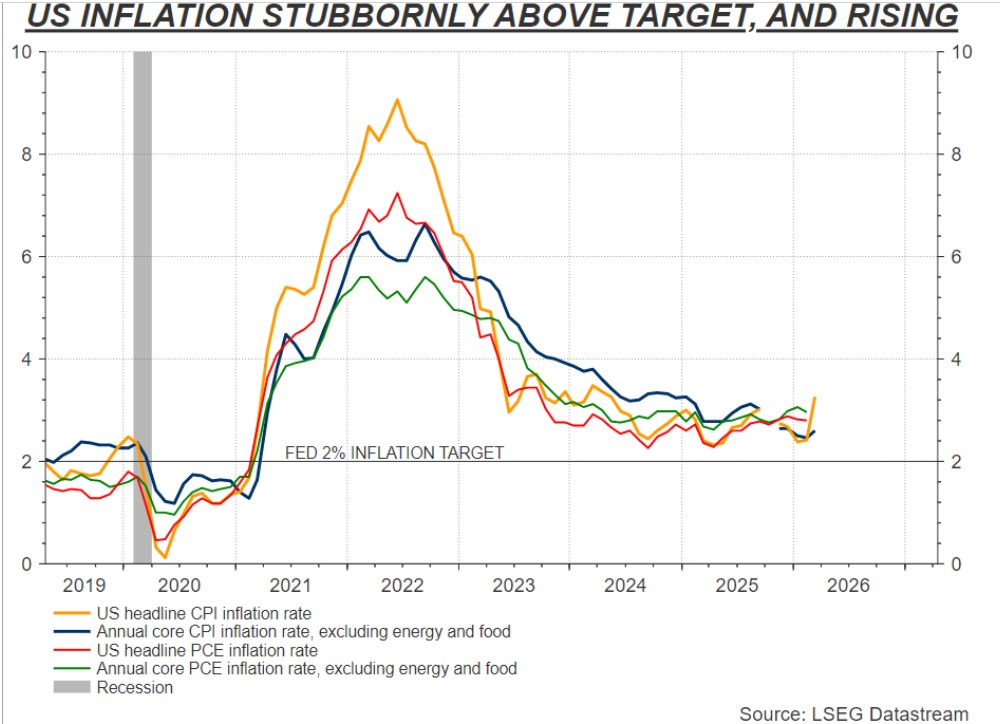 As shown in the above image, U.S. inflation remains stubbornly above the 2% target and is still rising.
Before the outbreak of the war in Iran, the core inflation indicator tracked by the Federal Reserve was already 1 percentage point above the target. For many months to come, few Americans will stop talking about inflation—or stop taking action because of it.
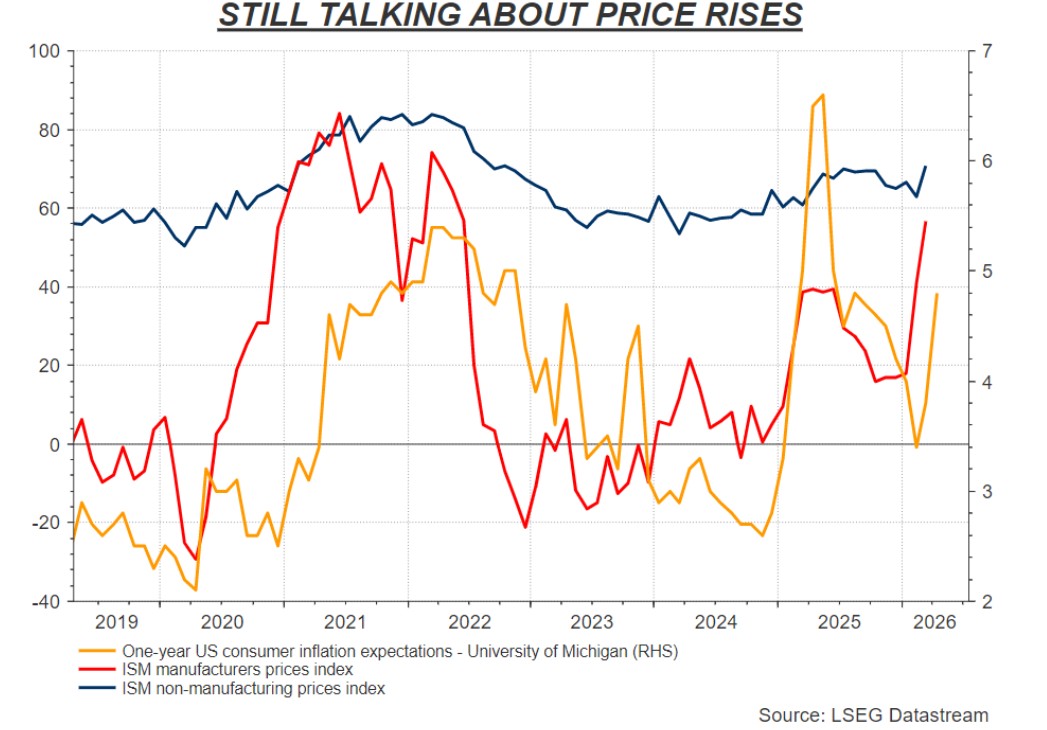
According to a recent consumer survey report from the University of Michigan, consumers' expectations for U.S. inflation over the next year surged by a full percentage point this month to 4.8%, marking the highest inflation expectation level in seven months. Meanwhile, a recent survey by ISM showed that the overall input prices recorded by U.S. businesses last month were at the highest level since the inflation surge in 2022.
According to Ipsos rolling poll data, Trump's approval rating on handling the cost of living issue this month is only 26%, marking his lowest polling statistic. The latest polling chart below shows how Donald Trump's approval rating on economic issues has changed over time according to the Reuters/Ipsos poll.
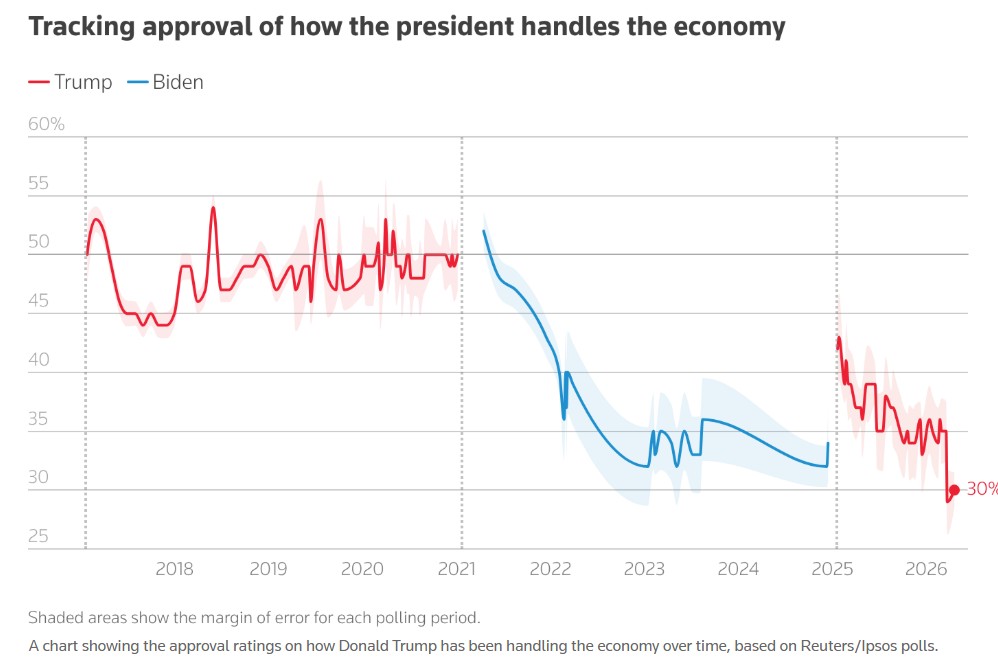
By any measure, the U.S. has not achieved price stability. And if the goal is "no one talks about it," then the Federal Reserve is undoubtedly far from that point.
Stop the Talking About Inflation
Of course, Waller's statement may have been somewhat off-the-cuff, and his broader testimony provides a more original and analytical perspective on how he views the U.S. economy and how to reform the Federal Reserve's monetary policy framework—perhaps leaving his position more room for maneuver than the straightforward wording suggests.
If confirmed, the new chair of the Federal Reserve, who will lead for at least the next four years, will take over from Jerome Powell next month. He also mentioned the need to examine issues in inflation data collection, the potential wave of productivity from artificial intelligence, forward-looking monetary policy formulation, and gradually reducing the Federal Reserve's massive balance sheet, which could create more room for the long-awaited interest rate cuts that Trump desires.
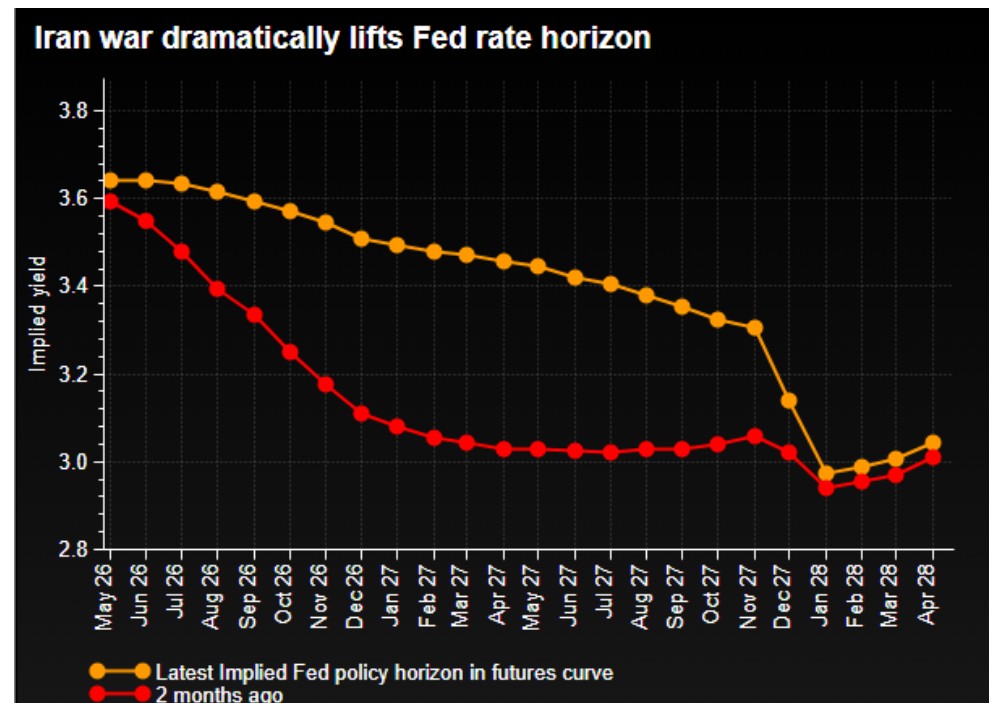
Even if all of this ultimately establishes a core rationale for further easing of the Federal Reserve's monetary policy, the clamor from workers and businesses regarding price issues makes it seem illogical for him to start his term with interest rate cuts, contrary to his own policy stance The market is very aware of this—at least after the recent sharp shock to oil prices. The latest pricing in the interest rate futures market shows that the probability of the Federal Reserve cutting rates this year is less than 50%, and further rate cut expectations have not yet been priced in by the interest rate futures market, at least for the next 12 months.
Data released on Tuesday showed that U.S. retail sales in March unexpectedly recorded the largest increase in a year, primarily driven by soaring gas station revenues amid high oil prices catalyzed by geopolitical conflicts in the Middle East, as well as significantly stronger consumer spending in other categories than economists generally expected. This highlights that despite the surge in gasoline prices due to the Iran war, consumers continue to maintain a strong consumption posture across various goods, with consumer spending data, which accounts for nearly 70% of U.S. GDP, proving to be remarkably resilient and still gaining momentum.
As a result, following the release of the latest retail sales data, interest rate futures traders have further weakened their bets on the Federal Reserve restarting the rate cut cycle this year. The "CME FedWatch Tool" indicates that the vast majority of traders are betting that the Federal Reserve will keep current rates unchanged this year—prior to the retail data release, the market leaned towards betting on one rate cut.
Previously released inflation data showed that the U.S. CPI in March rose year-on-year to 3.3%, with core CPI year-on-year at 2.6%, and the overall CPI rising by 0.9% month-on-month; in terms of PPI data, final demand increased by 0.5% month-on-month and 4.0% year-on-year in March, with final demand energy prices surging by 8.5% month-on-month.
Combined with a series of retail sales data that exceeded expectations, all of this means that the Federal Reserve is facing a typical "short-term growth remains resilient, but inflation is re-emerging" stagflation-like pessimistic combination. In this environment, the most natural response for the Federal Reserve is not to cut rates quickly, but to continue waiting for more evidence to confirm whether the oil price shock will spread from energy to broader core prices and inflation expectations. This is also the core logic behind Deutsche Bank's firm expectation that the Federal Reserve will not cut rates throughout 2026.
For those betting that the new Federal Reserve Chair nominated by Trump will fulfill the White House's desire for rate cuts, the situation has become even gloomier. Additionally, Waller's extensive remarks on reducing the balance sheet during the hearing have marginally tightened this optimistic outlook.
Based on all of this, Trump is likely to feel very disappointed—especially in an election year.
As for the issue of direct political pressure, even if such pressure is not explicitly stated, Waller's latest view is: "Inflation is a choice, and the Federal Reserve must take responsibility for it." He also added that the government has the right to express its views. "The independence of the Federal Reserve largely depends on the Federal Reserve itself." However, not everyone agrees with this, especially in the context of the legal case against current Federal Reserve Chairman Jerome Powell. Powell himself has stated that the case is merely an "excuse" for President Trump to pressure him into further interest rate cuts.
Former Federal Reserve economist Claudia Sahm made a more straightforward statement on Tuesday, writing: "The clichés from Warsh ignore the current reality. The pressure Trump exerts on the Federal Reserve goes far beyond mere words."
She wrote: "Central bank officials opposing Trump's views on interest rates not only need to be 'strong enough to listen without complying' — they also need to be wealthy enough to cover the legal fees incurred when facing lawsuits due to retaliation."
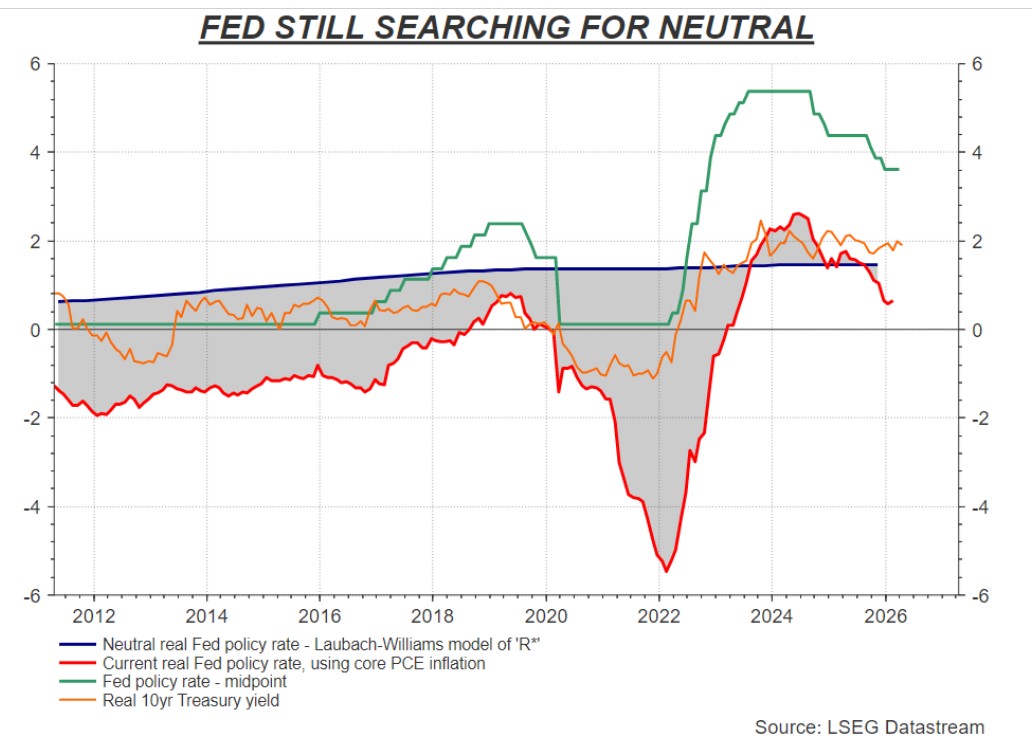
If Warsh cannot persuade his colleagues on the Federal Open Market Committee (FOMC) to accept his grand new vision for the central bank, or cannot stop Americans from discussing inflation, then the market's honeymoon period with his monetary policy may not last long.
Not just interest rate cuts and balance sheet reduction! Kevin Warsh bets on AI productivity dividends, aiming for a structural overhaul of the Federal Reserve
The so-called "old framework of Federal Reserve policy" simply refers to the operational paradigm of the Federal Reserve that was established after the 2008 financial crisis and further reinforced during the pandemic — viewing an oversized balance sheet as the norm, gradually transforming quantitative easing (QE) and long-term asset holdings from crisis tools into semi-regular tools, managing market expectations through ample reserves, forward guidance, and dot plots, while assuming that the Federal Reserve can intervene deeply in the Treasury and mortgage bond markets for the long term.
What Warsh explicitly criticized in the hearing was this "normalization of balance sheet expansion" — he believes it is more about supporting Wall Street asset prices, distorting market pricing, and increasingly entangling the Federal Reserve in quasi-fiscal functions and political controversies. The current size of the Federal Reserve's assets is about $6.7 trillion, which, although down from the peak of about $9 trillion in 2022, is still far above pre-financial crisis levels.
Warsh's proposed new framework essentially repositions interest rates back to the primary tool, relegating the balance sheet to a supportive or even unconventional tool. In other words — QE should only be used at the zero lower bound or during major crises, while gradually reducing the balance sheet, decreasing long-term asset holdings, and weakening the Federal Reserve's quasi-fiscal role; at the same time, it should rebuild the inflation analysis framework, reduce reliance on dot plots and excessive forward guidance, and emphasize structural factors such as price stability credibility, data quality, productivity, and AI.
What Kevin Warsh truly wants to do may not be the traditional notion of "dovish or hawkish monetary policy," but rather a reconstruction of the Federal Reserve's operational framework: compressing the balance sheet, weakening the normalization of QE and quasi-fiscal functions, while, when conditions allow, using interest rate tools more to support the real economy and improve productivity In other words, what he wants is not simply a "large-scale monetary easing" like during the COVID-19 pandemic, but to pull the Federal Reserve back from the policy framework that has heavily relied on its balance sheet for over a decade, towards a framework that emphasizes credibility, price stability, and a stronger focus on "monetary sovereignty." This is also why he repeatedly emphasized the need to reform communication mechanisms, reshape the inflation framework, reduce forward guidance, and tends to describe large-scale asset holdings as arrangements more aligned with "Wall Street" rather than "Main Street" during the hearings.
What Walsh sees is not merely a cyclical fluctuation, but the end of the old low-inflation world after de-globalization, the fragility of supply chains, and the normalization of energy shocks. In this context, his criticism of the uncontrolled inflation of 2021-2022, his firm stance that "the inflation framework needs to be rewritten," and his high regard for the productivity dividends of AI are all part of the same line of thought: he bets that the future methods to lower inflation will no longer rely on continuing to expand the balance sheet to support assets and boost the market, but rather on technological advancements, productivity improvements, and a more restrained central bank balance sheet to rebuild monetary credibility.
However, the problem is that his latest logic has consistency in direction, but there remains significant uncertainty in its implementation, especially regarding whether AI can generate deflationary productivity dividends quickly enough; this currently resembles a strategic hypothesis rather than a validated growth reality.
This also explains why Wall Street macroeconomists and strategists have shown a clear divide in their recent comments on Walsh: medium-term views lean towards "very creative and unique ideas," while short-term trading perspectives lean towards "difficult to realize." On one hand, a "technical route" around a narrower balance sheet has begun to emerge, including easing some liquidity regulations, reducing the banking system's demand for reserves, and adjusting interest rate control tools, thereby creating space for lower short-term interest rates; from this perspective, Walsh's advocacy for "balance sheet reduction + interest rate cuts" is not theoretically contradictory.
On the other hand, the reality constraints are very rigid: oil price shocks have pushed overall inflation in the U.S. to nearly a two-year high, core inflation was already about 1 percentage point above target before the Iran war, and a University of Michigan survey shows that inflation expectations for the next year rose to 4.8% this month, while market futures pricing indicates that the probability of any rate cut this year is less than 50%. This means that even if Walsh takes office, it will be difficult in the short term to satisfy Trump's political demand for "immediate rate cuts" while also meeting his own standard of "making no one talk about inflation" for price stability.
Walsh's latest policy framework highlights that he may not be the "rate-cutting chairman" that Trump has long anticipated, but rather a "systemic reformist" attempting to exchange a tighter liquidity framework for greater policy maneuverability in the future. His core monetary policy ambition is not to make the Federal Reserve's balance sheet more accommodative, but to transform the Fed from an "asset balance sheet-dominated central bank" into a "credibility and rules-dominated central bank"; rate cuts are merely a potential outcome within this new framework, not the starting point.
For the financial markets, this means that if Walsh ultimately pushes for reform, the first thing to be re-priced will be the long-standing assumption of excessive dollar liquidity, followed by the short-term interest rate path itself. It is precisely for this reason that Wall Street's current most genuine pricing attitude is not to believe that he will immediately bring about significant easing, but rather to judge that he may indeed want to "carry out a major reform of the Federal Reserve," but to turn this grand vision into something executable within the Federal Reserve's FOMC and bearable for the market The politically viable policy reality is extremely challenging
