CATL Launches Third-Generation Shenxing Super-Charging Battery: 98% Charge in Six Minutes; Sodium Batteries to Mass-Production This Year
At the '2026 Super Tech Day' press conference, CATL unveiled its third-generation Shenxing super-charging battery, breaking industry records with a charge from 10% to 98% in just 6 minutes and 27 seconds, surpassing BYD's second-generation Blade Battery metrics released in March this year. Meanwhile, Chief Scientist and Academician of the Chinese Academy of Engineering Wu Kai announced that core manufacturing challenges for sodium-ion batteries have been resolved, with mass production scheduled for later this year
CATL is advancing simultaneously on two fronts—super-charging technology and diversified chemical systems—further consolidating its position as the global leader in power batteries.
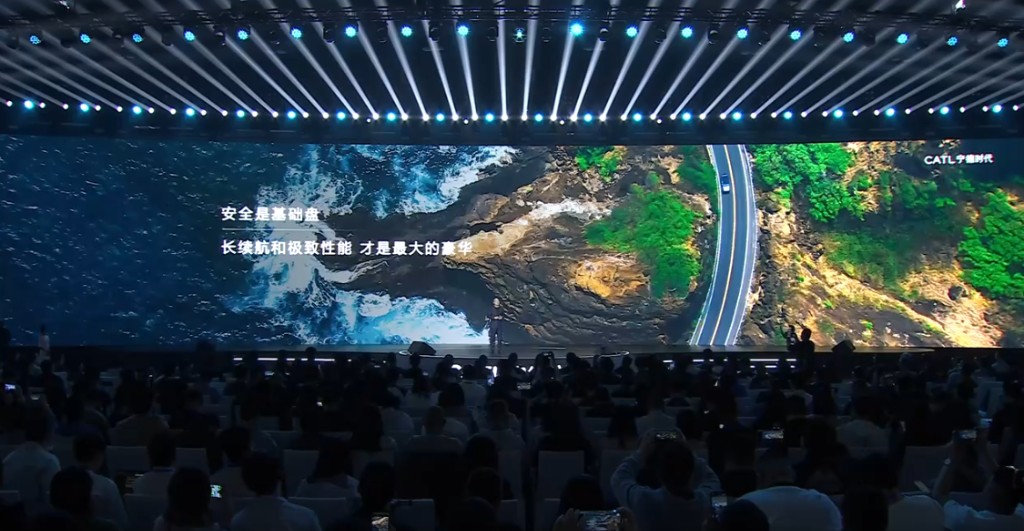
On the evening of April 21, CATL launched its third-generation Shenxing super-charging battery at the "2026 Super Tech Day" press conference, once again breaking industry records for charging speed: reaching 98% from 10% in just 6 minutes and 27 seconds, outperforming the same metric for BYD's second-generation Blade Battery released in March this year. At the same time, Company Chief Scientist and Academician of the Chinese Academy of Engineering Wu Kai announced that core manufacturing issues for sodium-ion batteries have been solved, with large-scale mass production expected later this year.
The announcement sent two clear market signals: first, CATL has established a definitive technological advantage over competitors in the super-charging sector; second, the commercialization of sodium-ion batteries is accelerating, potentially unlocking new growth opportunities in extreme climate travel and energy storage applications.
Zeng Yuqun noted during the press conference that CATL is embracing artificial intelligence to build large scientific models based on physical mechanism deduction combined with big data learning. He stated that with 25 million vehicles currently in operation and 3,000 energy storage stations, CATL possesses extensive relevant data. By using AI-accelerated quantum chemistry calculations, the company can more accurately simulate microscopic mechanisms; meanwhile, mining vast amounts of experimental and operational data provides significant empowerment. This gives CATL the confidence to develop even better batteries.
Third-Generation Shenxing Super-Charging Battery: 10% to 98% in Just 6 Minutes and 27 Seconds!
At the 2026 "Super Tech Day" press conference, CATL launched its third-generation Shenxing super-charging battery, capable of achieving equivalent 10C and peak 15C performance. In terms of charging time, it takes 1 minute to charge from 10% to 35%, and only 6 minutes and 27 seconds to reach 98%. In comparison, BYD's second-generation Blade Battery released in March this year requires 9 minutes to charge from 10% to 97%.
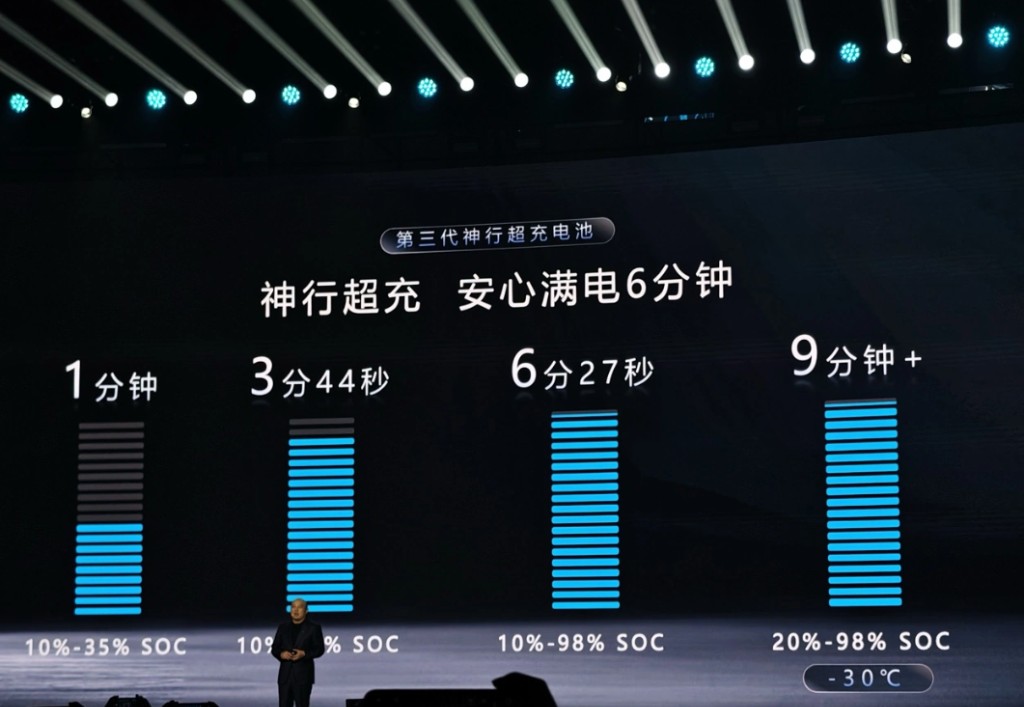
This super-charging capability is not exclusive to the Shenxing series; the newly released Qilin and Xiaoyao super-charging products will also come standard across the entire lineup. All three battery brands under CATL have now entered the "six-minute full charge" era.
According to Gao Huan, Chief Technology Officer of CATL, the true core challenge in super-charging is not "trickle charging" but "temperature rise." The higher the temperature rise, the faster the battery life degrades. Reducing internal resistance is the key path to controlling temperature rise. The third-generation Shenxing super-charging battery boasts the "lowest average internal resistance for super-charging globally" at 0.25mΩ, representing a 50% reduction compared to other super-charging batteries in the industry.
Addressing external concerns about super-charging damaging battery life, Gao Huan stated, "True super-charging must be fast and safe throughout the entire lifecycle. Sacrificing battery life or energy density for short-term charging speed has never been an option for CATL."
Sodium Batteries to Achieve Large-Scale Mass Production This Year
Wu Kai, Chief Scientist of CATL and Academician of the Chinese Academy of Engineering, emphasized that pursuing a multi-chemical system approach for battery materials is essential. Every material has its own limitations, and no single material can achieve perfection. By building capabilities across diverse systems to meet different needs in various scenarios, users can find solutions best suited to them. CATL currently focuses primarily on three material types: lithium iron phosphate, ternary lithium, and sodium-ion, while simultaneously advancing more frontier chemical systems.
He explained that sodium-ion batteries offer broad application scenarios in extreme conditions such as high temperatures and severe cold for travel, as well as in energy storage. Core manufacturing challenges have already been resolved, with large-scale mass production planned for later this year.
Third-Generation Qilin Battery Debuts: Range Exceeding 1,000 Kilometers
CATL unveiled its third-generation Qilin battery, achieving equivalent 10C super-charging and peak 15C performance. The battery delivers a weight energy density of 280Wh/kg and a volume energy density of 600Wh/L, enabling a driving range exceeding 1,000 kilometers.
Gao Huan, Chief Technology Officer of CATL, stated at the event that sedans equipped with CATL's condensed-state Qilin batteries can achieve ranges exceeding 1,500 kilometers, while keeping the battery pack weight under 650 kilograms. Safety remains uncompromised; the Qilin condensed-state battery upgrades liquid electrolytes to condensed-state electrolytes, completely resolving safety concerns.
Summarizing the innovation, Gao Huan concluded, "The Qilin battery represents the optimal solution for high-end pure electric vehicles. Without the Qilin, there is no premium status."
Domestic Market Share Surpasses 47%
Gao Huan, Chief Technology Officer of CATL, announced that as of February 2026, the number of new energy vehicles equipped with CATL power batteries has surpassed 25.8 million.
In the first quarter of this year, our domestic market share exceeded 47%, meaning that for every two new energy vehicles sold domestically, one is equipped with CATL batteries.
As of March this year, our products have covered over 150 countries and regions worldwide, serving more than 176 brands and reaching 529 passenger car models.
Industry data shows that in 2025, CATL's global power battery installations reached 541GWh with a market share of 39.2%, maintaining the top global position for nine consecutive years. Its domestic installation market share was 43.42%, with total power plus energy storage shipments reaching 661GWh for the year.
In the first quarter of 2026, domestic power battery installations totaled 59.53GWh, with market share rising to 47.72%. Combined power and energy storage shipments exceeded 200GWh.