


UBS Rates KNOWLEDGE ATLAS - "China's Anthropic"
Tsinghua-affiliated AI company KNOWLEDGE ATLAS is positioned by UBS as the "China version of Anthropic": focusing on coding at the model layer, developing proprietary agents at the engineering layer, and pricing based on capability. KNOWLEDGE ATLAS GLM-5.1 leads global open-source models in long-horizon tasks; usage surged threefold after a 30% price hike. ARR grew 6.4 times in four months, outpacing even Anthropic. Meanwhile, it offers superior value: matching 97% of competitor capabilities at just 22% of the price
A Tsinghua-affiliated AI company is walking a path highly similar to that of global top AI laboratories.
On April 20, UBS analysts Wei Xiong and others released a nearly 40-page research report covering Beijing-based AI company KNOWLEDGE ATLAS for the first time, issuing a "Buy" rating with a target price of 1160 HKD.
The report's core conclusion is straightforward: KNOWLEDGE ATLAS's model R&D and commercialization path closely mirrors that of the global AI leader Anthropic—therefore, analysts position it as the "China version of Anthropic."
Why the "China version of Anthropic"?
Anthropic is one of Silicon Valley's most prominent AI giants. It does not compete on flashy video generation but focuses single-mindedly on one thing: enabling AI to write code.
UBS believes that from technical roadmap to monetization strategy, KNOWLEDGE ATLAS follows the exact same playbook as Anthropic.
First, strategic focus is highly aligned. Both companies chose programming capability as their breakthrough point because programming tasks yield verifiable results and quantifiable value, representing the shortest path for AI to evolve from "assistance" to "execution."
Anthropic bets on coding capabilities at the model level, emphasizing long-horizon tasks—i.e., whether AI can complete complex engineering tasks lasting several hours without human intervention.
KNOWLEDGE ATLAS adopted an almost identical path. The company launched its AI coding assistant product CodeGeeX as early as September 2022, making it one of the earliest domestic players to lay out AI programming.
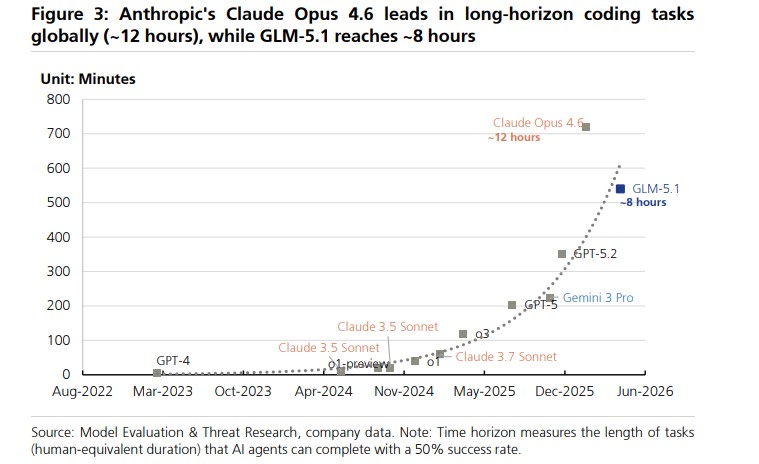
According to tests by METR (Model Evaluation and Threat Research Institute), Anthropic's Claude Opus 4.6 can complete work equivalent to approximately 12 hours of human effort (with 50% success rate); KNOWLEDGE ATLAS GLM-5.1 reaches approximately 8 hours, ranking first among global open-source models.
Second, the performance gap between models continues to narrow.
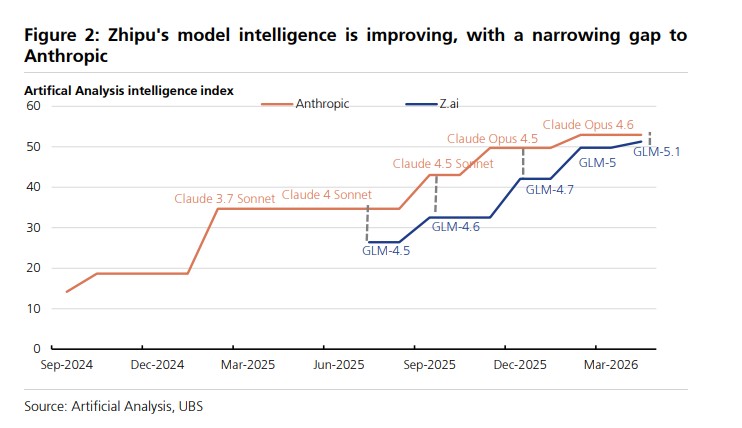
According to Artificial Analysis data, as of April 17, 2026, KNOWLEDGE ATLAS's latest flagship model GLM-5.1 ranked seventh globally in the comprehensive intelligence index, scoring 51.4 points, just two points behind Anthropic's Claude Opus 4.6 which scored 53.
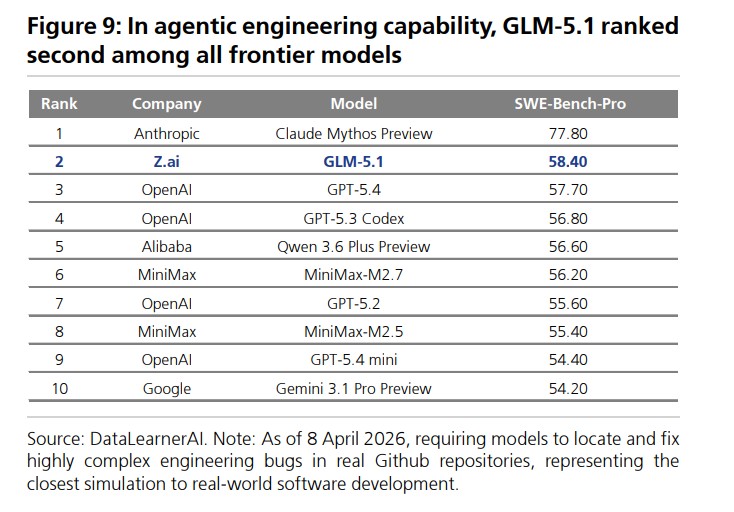
In SWE-bench Pro (an authoritative test simulating real-world code engineering tasks), GLM-5.1 ranked second globally with 58.4 points, trailing only Anthropic's Claude Mythos Preview (77.8 points) and surpassing GPT-5.4 (57.7 points).
Third, monetization rhythms are similar, but KNOWLEDGE ATLAS shows faster ARR growth and higher cost-effectiveness.
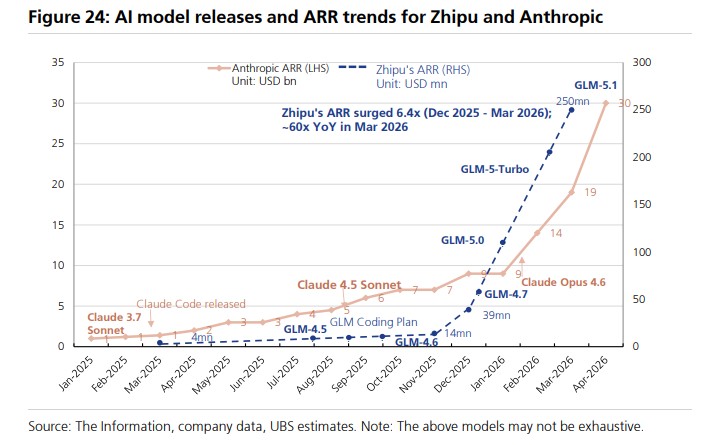
In December 2025, KNOWLEDGE ATLAS's Annual Recurring Revenue (ARR) on its open platform was $39 million. By March 2026, this figure had risen to $250 million—a 6.4-fold increase in just four months.
By comparison, Anthropic took approximately nine months to achieve a similar 6.4-fold growth in its early stages. Although Anthropic recently increased its valuation from $9 billion to $30 billion in just four months, that represents a 3.3-fold increase.
Both are monetizing rapidly, but KNOWLEDGE ATLAS has the edge. The report states: "Compared to global leaders, KNOWLEDGE ATLAS exhibits a steeper ARR growth curve, despite having a smaller base."
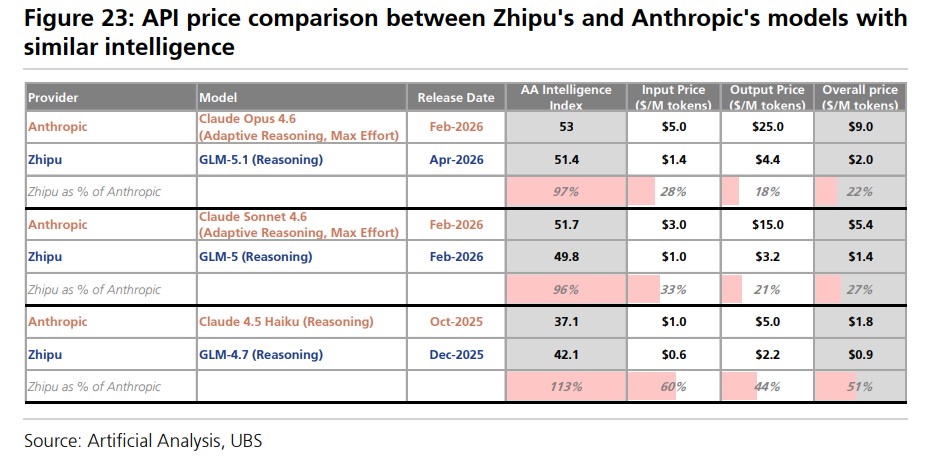
Meanwhile, KNOWLEDGE ATLAS offers better value. GLM-5.1's comprehensive pricing is approximately $2 per million tokens, whereas comparable-performance models like Claude Opus 4.6 cost around $9—meaning KNOWLEDGE ATLAS's pricing is roughly 22% of Anthropic's. This higher cost-performance ratio implies room for future price increases.
In summary, at the model layer, both focus on coding rather than multimodality; at the engineering layer, both develop proprietary coding agents; at the commercialization layer, both price based on model intelligence—higher capability commands higher prices, and demand rises even after price hikes.
Coding is the Core Battlefield
To understand KNOWLEDGE ATLAS, one must first understand why it treats coding capability as its most critical strategic pivot.
The report's logic is that coding capability is the key threshold for AI entering real enterprise scenarios. The ability to write code means executing complex multi-step tasks and replacing real engineer workflows, significantly boosting commercial value.
KNOWLEDGE ATLAS has walked this path for nearly four years.
From CodeGeeX 1 in 2022 (a 13-billion-parameter multilingual code model) to GLM-5.1 released in April 2026, KNOWLEDGE ATLAS has completed the leap from a "code completion tool" to an agent capable of independently running for 8 hours to complete complex engineering tasks.
Specifically, in METR's long-horizon task tests, GLM-5.1 achieved a task completion span of approximately 8 hours (meaning the AI completes work equivalent to 8 hours of human labor with 50% success rate), ranking first globally among open-source models. In contrast, Anthropic's Claude Opus 4.6 reaches approximately 12 hours, ranking first globally.
In the Code Arena agent programming rankings, GLM-5.1 ranks third globally, trailing only Claude Opus 4.6 (thinking version) and Claude Opus 4.6.
External benchmark tests and industry surveys indicate that the GLM series models have become a "top choice" for enterprise customers in programming-related tasks, enjoying strong user recognition.
Pricing Power: A 30% Price Hike Leads to 3x Usage Increase
The most direct validation of commercialization capability is pricing power.
In February 2026, KNOWLEDGE ATLAS directly raised prices on its Coding Plan by 30%, while simultaneously tightening usage limits and reducing model selection options.
The result was unexpected: according to OpenRouter data, in March 2026, KNOWLEDGE ATLAS's total token usage surged approximately threefold month-over-month.
Even more intriguingly: GLM-5.0 was then the highest-priced model in KNOWLEDGE ATLAS's product line, yet its usage share in March 2026 was the highest among all models.
The report interprets this as: "This indicates users' willingness to pay for high-performance models and demand resilience; price increases did not suppress usage."
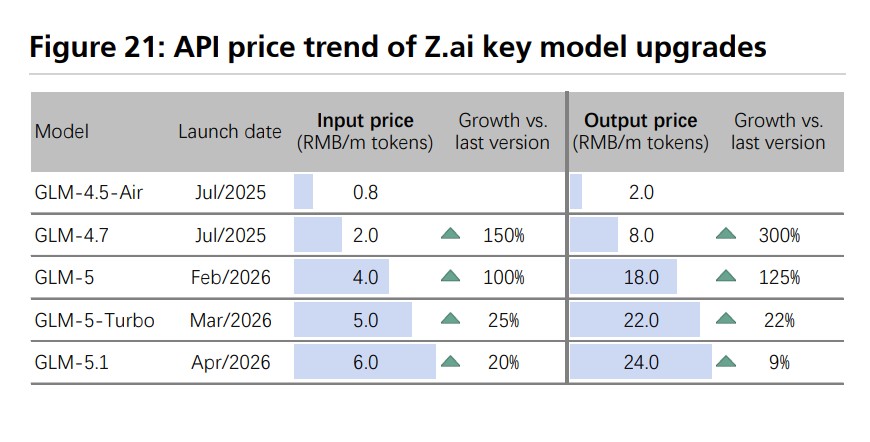
Looking at pricing evolution, KNOWLEDGE ATLAS pursued two parallel pricing strategies: first, raising prices synchronously with model upgrades—GLM-5.0 saw input prices rise 100% and output prices rise 125% compared to GLM-4.7; GLM-5-Turbo and GLM-5.1 each rose about 20% over their previous versions. Second, direct price adjustments, such as the 30% hike on the Coding Plan in February 2026.
Compared to Anthropic, KNOWLEDGE ATLAS still holds significant cost-effectiveness advantages. Report data shows: GLM-5.1 and Claude Opus 4.6 have comparable comprehensive intelligence scores (97%), but GLM-5.1's comprehensive pricing is only about 22% of Anthropic's. This means as KNOWLEDGE ATLAS models continue to improve, there remains substantial room for price increases.
R&D Strength: Tsinghua DNA
KNOWLEDGE ATLAS's R&D foundation stems from Tsinghua University.
All five founders are Tsinghua alumni, and Tsinghua Asset Management Company holds a 3.53% stake in KNOWLEDGE ATLAS. KNOWLEDGE ATLAS maintains deep cooperation with Tsinghua University's Knowledge Engineering Research Group.
The R&D team exceeds 800 people, with R&D personnel accounting for 74%. The company has published over 20 papers on arXiv (the core preprint platform in the AI field), figures that exceed those of similar emerging domestic AI laboratories. As of June 30, 2025, KNOWLEDGE ATLAS's research and academic advisory team had published approximately 500 high-impact papers.

At the technical innovation level, the report highlights three key areas: dynamic sparse attention mechanisms (similar to DeepSeek's attention mechanism, reducing training and inference costs while maintaining long-text capabilities), the "Slime" asynchronous reinforcement learning framework (improving post-training efficiency), and native agent integration design (ARC framework, integrating agents, reasoning, and programming capabilities).
Walking on Two Legs: Private Deployment and Open Platform
KNOWLEDGE ATLAS's current revenue structure is "heavy-light"—in 2025, private deployment (on-premise) accounted for 74% of total revenue, while the open platform API accounted for 26%.
Private Deployment: The Stable Foundation
Private deployment primarily targets government entities and large enterprises. Clients include nine of China's top ten internet companies, as well as government-backed institutions such as Hangzhou Urban Construction Investment Group, Zhuhua Huafa Group, and Chengdu High-tech Zone.
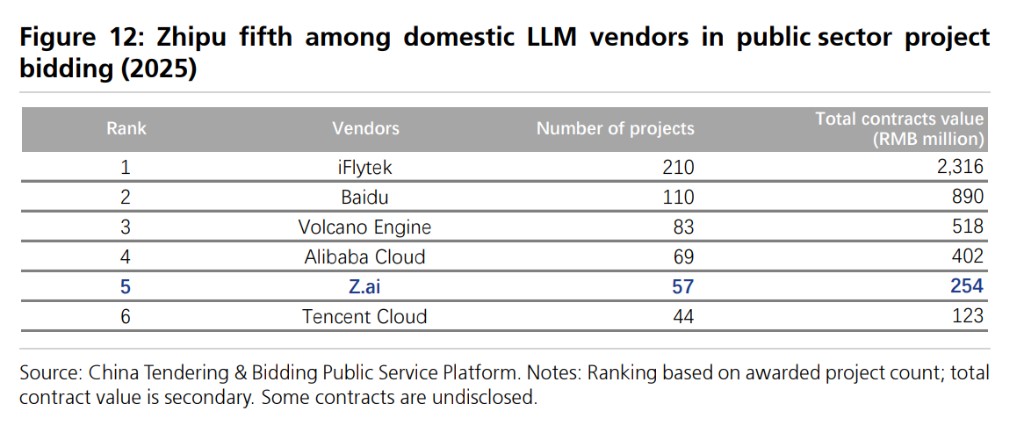
In 2025, KNOWLEDGE ATLAS won bids for 57 large-model projects in public service sectors, with a total contract value of 254 million RMB, ranking fifth among domestic large-model vendors (the top four being iFlytek, Baidu, Volcano Engine, and Alibaba Cloud).
Gross margins for private deployment remain in the 50%-70% range, standing at 49% in 2025, which is considered healthy. However, the report also notes that Days Sales Outstanding (DSO) rose from 107 days to 153 days in 2025, and accounts receivable increased from 100 million RMB to 339 million RMB, warranting continued attention.
Open Platform: The Future Growth Engine
The report is more optimistic about the open platform and API business.
In September 2025, KNOWLEDGE ATLAS launched its Coding Plan; in March 2026, it simultaneously introduced the "Claw Plan" (targeting agent framework needs) alongside GLM-5-Turbo. The Claw Plan gained 100,000 new users within two days of launch, reaching 400,000 within 20 days. As of March 2026, the open platform's total user count reached 4 million.
Paid token consumption surged 15-fold over the six months from October 2025 to March 2026.
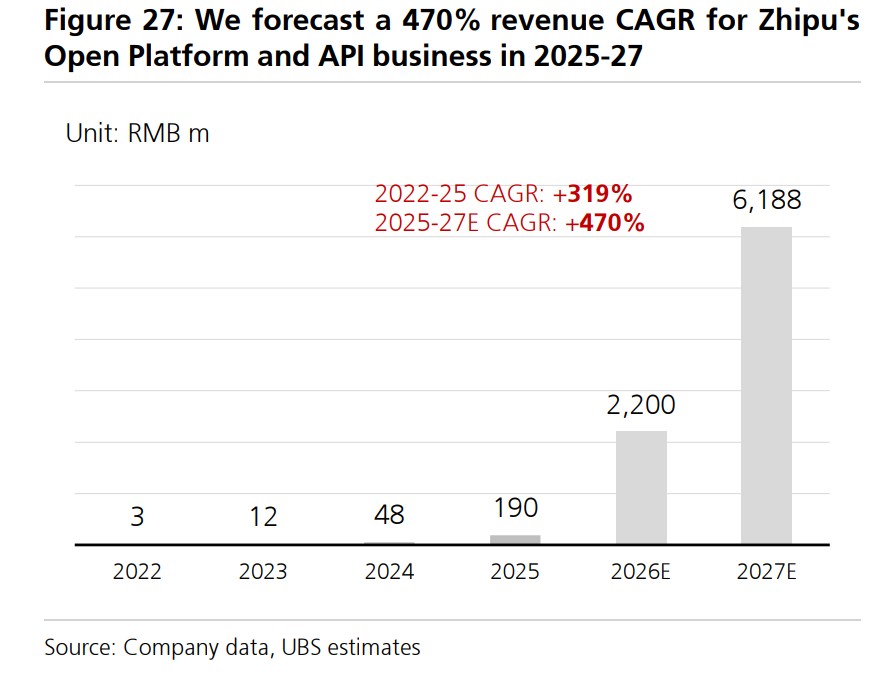
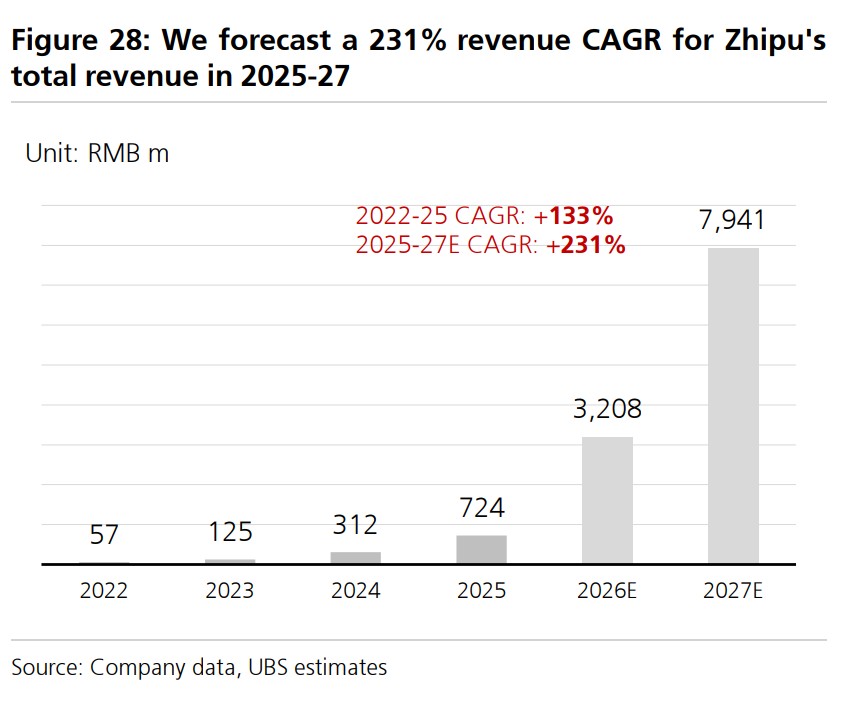
UBS forecasts that open platform revenue will grow from 190 million RMB in 2025 to 6.188 billion RMB in 2027, at a compound annual growth rate (CAGR) of 470%; total revenue CAGR for the same period is projected at 231%, rising from 724 million RMB to 7.941 billion RMB.
The rapid adoption of OpenClaw (an emerging agent framework) further accelerates this trend. According to OpenRouter data, as of April 2, 2026, GLM-5-Turbo ranked third in token usage on OpenClaw.
231% Compound Growth Rate: Revenue Forecasts and Downside Risks
UBS forecasts that KNOWLEDGE ATLAS's total revenue CAGR from 2025 to 2027 will be 231%:
- 2025 Revenue: 724 million RMB;
- 2026 Forecast Revenue: 3.208 billion RMB (343% year-over-year growth);
- 2027 Forecast Revenue: 7.941 billion RMB.
Among these, the open platform business is forecast to grow at a CAGR of 470%, increasing from 190 million RMB in 2025 to 6.188 billion RMB in 2027, with its revenue share rising from 26% to 78%.
However, meanwhile, KNOWLEDGE ATLAS remains in a loss-making phase. Net losses are forecast at 5.157 billion RMB for 2026 and 4.747 billion RMB for 2027. Profitability is expected no earlier than 2029 (forecast net profit: 261 million RMB). As revenue scales up, the loss rate will gradually narrow.
Key downside risks include intensifying competition in the large-model industry; potential customer churn if internet giants (ByteDance, Tencent, Alibaba, etc.—all existing major clients of KNOWLEDGE ATLAS) enhance their self-developed model capabilities; constraints on computing power supply; and geopolitical risks.
