


AI Data Center Expansion Accelerates, Global AI Optical Module Market Projected to Reach $26 Billion by 2026
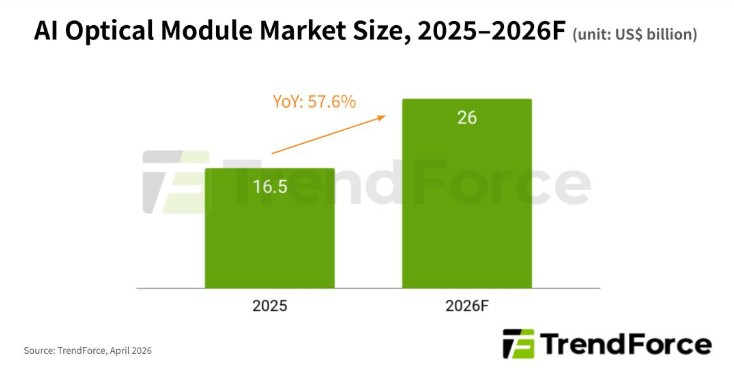
The global AI optical transceiver module market is expanding rapidly, projected to grow from $16.5 billion in 2025 to $26 billion in 2026, an increase of over 57%. Driven by demand from North American hyperscale data centers, 800G modules are currently mainstream, while 1.6T products are accelerating into mass production. However, supply of core chips such as EML lasers remains tight, constituting the primary bottleneck for capacity expansion
The global AI optical transceiver module market is entering a period of rapid expansion, though structural constraints within the supply chain are becoming increasingly apparent.
On April 20, according to the latest research by TrendForce, the global AI optical transceiver module market size is expected to grow from $16.5 billion in 2025 to $26 billion in 2026, representing a year-over-year increase of over 57%.
Pressure on the supply side is rising simultaneously. Core optoelectronic chips represented by Electro-Absorption Modulated Lasers (EML) and Continuous Wave Laser Diodes (CW-LD) continue to face tight supply, becoming the primary bottleneck constraining capacity expansion.
Demand Side: North American Hyperscale Data Centers Continue to Drive Procurement of 800G and Higher Specifications
AI data centers continue to expand, driving a sharp rise in demand for 800G and higher-speed optical transceiver modules.
TrendForce points out that traffic in North American hyperscale data centers maintains an annual growth rate of over 30%, prompting cloud giants such as Google, Microsoft, and Meta to continuously expand their deployment of GPUs and AI servers, further driving procurement demand for high-speed optical interconnect products.
Behind this demand growth lies the rigid dependence of AI server cluster interconnection on high-bandwidth, low-latency optical links. 800G optical modules have currently become the mainstream specification for backbone interconnection in AI data centers, and with 1.6T products gradually entering mass production, the next-generation upgrade cycle has already begun ahead of schedule.
TrendForce also notes that the growth logic of the AI optical module market is evolving from single-product specification upgrades to three parallel tracks: market expansion, technological generational shifts, and diversification of application scenarios. The rise of edge computing and Data Center Interconnection (DCI) demands will simultaneously drive the expansion of the 800G and 1.6T ZR/ZR+ coherent optical module markets.
Supply Side: Shortage of Core Components like EML Chips Becomes Primary Bottleneck for Capacity Expansion
While demand is robust, structural constraints facing the supply side are becoming increasingly evident. TrendForce has identified several key bottlenecks constraining capacity expansion.
The primary issue lies in the tight supply of core optoelectronic chips. Key components such as EML lasers and CW-LDs are constrained by capacity allocation, resulting in continued tight supply.
At the same time, high-precision manufacturing processes such as optical alignment limit the scale-up of production capacity, while challenges in power consumption and thermal management continue to impact system design and deployment schedules.
In response, upstream purchasers such as Nvidia have shifted to Long-Term Agreements(LTAs), while technology roadmaps are also accelerating towards low-power linear pluggable optical devices (LPO) and silicon photonics integration to replace traditional high-power DSP architectures, fundamentally alleviating pressure regarding power consumption and thermal constraints
Industry Layout: International Manufacturers and Taiwan Supply Chain Accelerate Positioning in the 1.6T Track
Facing dual pressures from tightening component supplies and technological generational transitions, all parties in the industry chain have begun laying out new rounds of capacity expansion and technology deployment.
Internationally, leading manufacturers such as Coherent, Lumentum, and Applied Optoelectronics have launched capacity expansion and technology layout initiatives. In Taiwan, manufacturers such as ELASER and LuxNet Corporation are also advancing corresponding capacity expansion and technology deployment.
TrendForce points out that this upgrade cycle brings significant structural growth opportunities for the Taiwanese optical communication supply chain. Taiwanese manufacturers have established a solid capability foundation in contract manufacturing, EML laser chips, passive optical components, and module packaging and testing, and continue to advance their layout in silicon photonics and LPO technology directions.
TrendForce emphasizes that 2026 to 2027 is a critical juncture for Taiwanese manufacturers to enter the 1.6T supply chain. The ability to successfully complete design introduction at top-tier clients will largely determine the market share landscape among various manufacturers in the next-generation optical module market.
