


Earnings Preview | Musk and Google's endorsement create a valuation of $340 billion. Will Intel's Q1 earnings report be a dream come true or a bubble warning?
Intel will announce its Q1 2026 financial report on April 23, and the market is full of expectations for its performance. The stock price rose about 86% in 2026, reaching $70.32, mainly benefiting from its progress in artificial intelligence and wafer foundry sectors. Intel's "Terafab" project with Musk and its collaboration with Alphabet boosted market confidence. However, the market expects Q1 revenue to be $12.32 billion, a year-on-year decrease of about 2.75%, and investors face the challenge of whether the fundamentals can keep up with the high valuation
According to Zhitong Finance APP, after a long period of silence, Intel (INTC.US) staged a stunning comeback in 2026. As of last Friday's close, the stock has risen approximately 86% year-to-date, with the price briefly touching $70.32, the highest intraday price since the burst of the internet bubble, just a step away from the historical peak in August 2000.
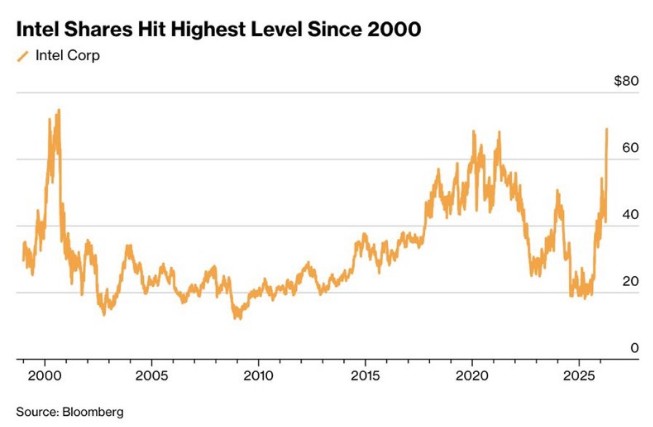
The catalyst for this frenzy is not the traditional PC business, but rather the market's immense imagination regarding Intel's foray into artificial intelligence (AI) and the foundry sector.
Recently, Intel confirmed its participation in Elon Musk's "Terafab" AI chip project, collaborating with SpaceX and Tesla (TSLA.US) to develop processors aimed at robotics and data centers. This project clearly relies on Intel's 18A process technology, which Wall Street views as a key vote of confidence in its strategy to reverse its downturn.
At the same time, Intel's deep cooperation with Google (GOOGL.US) further solidifies its data center business foundation. On April 9, the two parties announced a joint development of multiple generations of Xeon CPUs and custom IPUs (Infrastructure Processors) specifically tailored for Google's cloud infrastructure. Amin Vahdat, Senior Vice President of Google Technical Infrastructure, explicitly stated that Intel's Xeon product roadmap is a significant source of confidence.
However, as Intel is set to announce its Q1 2026 financial results after the market closes on April 23 (Thursday) Eastern Time, a harsh "performance test" is about to arrive. With the stock price already reflecting extremely optimistic expectations, investors face a core question: Can the recovery of fundamentals keep pace with the lofty valuations?
Fundamental Concerns: Supply Constraints and Cash-Burning Dreams
Currently, the market generally expects Intel's Q1 revenue to be $12.32 billion, a year-on-year decline of approximately 2.75%, with earnings per share around $0.01.
In fact, amidst the cheers, a closer look at Intel's actual operational guidance reveals that risk signals have already been illuminated.
When announcing the Q4 financial results last January, management provided a concerning outlook for Q1: revenue is expected to be between $11.7 billion and $12.7 billion, significantly down from $13.7 billion in Q4 of last year.
The culprit behind the revenue headwinds is the supply constraints across the industry. Intel admitted that Q1 will be the lowest point for available supply, with gradual improvement expected only in Q2. Even more worrying is the impact on profit margins— the company expects its adjusted gross margin in Q1 to shrink to about 34.5%, significantly lower than the 37.9% in Q4.
Rosenblatt analyst Kevin Cassidy pointed out that even if server CPU demand surges due to the explosion of AI agents, with average selling prices expected to rise by 10%-15%, Intel's limited capacity will not be able to fully seize this market opportunity In addition, the financial cost of transformation is extremely heavy.
To realize the modernization blueprint for AI wafer foundry, Intel is consuming cash flow at an unprecedented rate. Its foundry business is expected to incur an operating loss of approximately $10.3 billion in fiscal year 2025, with a negative free cash flow of $1.5 billion over the past 12 months. Although the company's move to repurchase its remaining stake in the Fab 34 plant in Ireland aims to consolidate assets, the enormous capital expenditures and the ramp-up of the 18A process continue to test the company's balance sheet.
Indeed, the bullish logic in the market is that when these investments eventually translate into sustained foundry revenue, the heavy investments will ultimately pay off. The partnership with Terafab undoubtedly indicates that project reserves are forming.
However, translating these commitments into actual large-scale production and generating substantial profits will still take time, and the process is accompanied by significant execution risks.
Valuation Alert: "Perfect Pricing" at a 135x P/E Ratio
This directly leads to the sharpest question currently—valuation bubble. After a recent significant surge, Intel's total market capitalization has swollen to approximately $340 billion, with its forward P/E ratio reaching an astonishing 135 times.
At such a valuation multiple, investors are paying not just for a "successful turnaround story," but are betting on nearly perfect execution over the next decade—requiring both rapid resolution of supply chain issues and the foundry business to convert into substantial profits in the short term.
Cassidy holds a cautious view on short-term opportunities ahead of the earnings report. He points out that although demand for data centers is strong, Intel's "limited supply response capability" will offset the demand benefits, compounded by the ongoing margin pressure from the 18A ramp-up, making the first-quarter report likely lack surprises.
If the earnings report on April 23 shows any signs of supply relief falling short of expectations or increased gross margin pressure, the market may not show any mercy towards this "perfectly priced" stock.
Analyst Discrepancies Widen: A Huge Gap from $51 to $76
Currently, Wall Street's views on Intel are extremely polarized. According to data compiled by MarketBeat, among the analysts covering the stock, only 6 have given a "buy" rating, while as many as 26 recommend "hold," and 6 give a "sell" rating, with an average target price of only $51.25.
In the bullish camp, Benchmark has set a Wall Street high target price of $76, believing that its manufacturing progress and high-end collaboration pipeline are significant undervalued catalysts for a major value reassessment. KeyCorp has also raised its target price to $70, noting that the ongoing CPU supply shortage and two rounds of price increases for Intel's server and client CPUs provide recent revenue support.
In contrast, TD Cowen and Cantor Fitzgerald have raised their target prices to $60 but maintain a "neutral" rating, believing that the current stock price has fully reflected all recent positive catalysts.
Earnings Report Focus: Can Foundry Orders Translate into Real Profits?
It is undeniable that Intel is taking bold steps, and its foundry business shows real potential. However, an excellent business strategy does not directly equate to a high-quality investment target. Considering the company's enormous capital needs and already high valuations, the current risk-reward ratio indeed lacks attractiveness Therefore, the financial report on April 23 may become a key watershed. Investors will not only closely monitor the demand for the Xeon chips, profit margins, and cash management, but also hope to see clearer signals indicating that interest in the foundry business can be converted into actual revenue.
Rosenblatt's Cassidy stated that the market focus will be on Intel's 18A node, paying attention to whether its advancement will further drag down gross margins. Additionally, investors will closely watch whether the company can win more wafer foundry customers after announcing partnerships with Google, Terafab, and others. Management previously indicated that more information about foundry customers is expected to be disclosed in the second half of this year, with plans to achieve mass production by 2028. Cassidy pointed out, "Any positive signals regarding external customer progress will support the stock price."
In the long term, Cassidy believes Intel will benefit from the continued growth in data center demand and the broad expansion in the computing field. However, he also emphasized that Intel's transformation is a multi-year process and remains highly dependent on execution.
"Although Intel is making progress in process technology and products, we still need to see better yields, stronger gross margins, and clearer evidence that the company can translate improvements in products and processes into sustainable profitability," the analyst concluded
