


Unbelievable Rapid Reversal! Mag 7 Leads US Stocks to New Highs with 20% Rally Since Late March
Tech giants are making a powerful comeback, reshaping the US stock market landscape at an astonishing pace. Since the March lows, the Mag 7 has rallied over 20%, recovering approximately $4 trillion in market value within just a few weeks. After a significant compression in valuations, super-large cloud computing firms like Microsoft have regained attractiveness; warming expectations for AI commercialization combined with a 19% earnings growth outlook continue to boost market confidence in tech stocks. Despite concerns over hedge fund selling and capital expenditure risks, divergent views persist, but institutions have now locked their sights on this "catch-up rally"
Tech giants are making a powerful comeback, pushing US stocks toward new historical highs.
Since the S&P 500 hit its 2026 low on March 30, the tech giant sector led by the Mag 7 has rallied over 20%, recovering approximately $4 trillion in market value within just a few weeks. The S&P 500 and NASDAQ-100 indices successively set new records, while the tech sector surged from being the worst-performing segment of the S&P 500 to becoming the leading force. This speed of reversal caught market participants off guard.
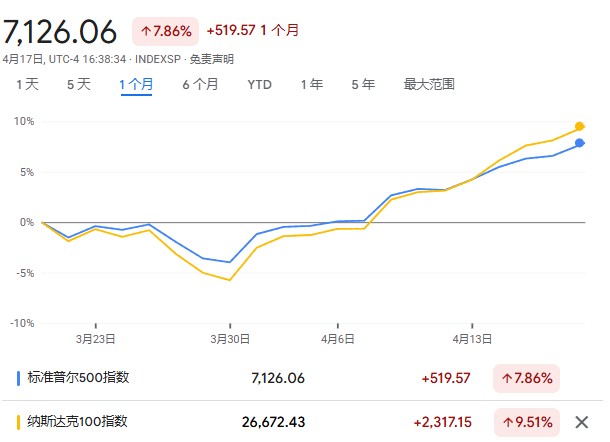
In this rally, seven tech stocks—Nvidia, Amazon, Microsoft, Broadcom, Alphabet, Meta, and Apple—contributed more than half of the recent gains in the S&P 500. Microsoft's trajectory is particularly typical: the stock plummeted as much as 34% from its peak on October 28 to its low on March 27, before staging a strong 19% rebound. Ohsung Kwon, Chief Equity Strategist at Wells Fargo, stated, “The past six months tell us that without tech stocks, the S&P 500 finds it difficult to truly rise.”
Despite ongoing geopolitical tensions in the Middle East and high oil prices keeping inflation sticky, market risks have not dissipated, yet investor confidence has clearly recovered. Paul Wick, Chief Investment Officer at Seligman Investments, characterized this rally as a "catch-up trade" and a "positioning trade," suggesting it partly reflects a technical repair following prior oversold conditions.
Valuations Retreat, Tech Stock Attractiveness Returns
A key backdrop to this rally is that the valuations of the Mag 7 have significantly normalized after a sharp previous correction. Excluding Tesla's extremely high valuation, the Mag 7 currently trades at about 24 times expected earnings, a clear compression from 29 times at the end of last October, substantially narrowing the gap with the broader S&P 500's valuation of roughly 21 times.
Taking Microsoft as an example, its current share price corresponds to 23 times expected earnings, lower than the 33 times seen on October 28 and also below its 10-year average of 27 times. Even after experiencing its strongest single-week gain since April 2015, Microsoft's stock price remains 22% below its all-time high in October.
Kwon pointed out that it is precisely this relatively lagging performance that makes super-large cloud computing firms attractive "catch-up targets" in the current market. Many missed this rally and are now pondering what to chase, and super-large cloud computing firms appear to be the more attractive choice.
Divergent Views Persist After Hedge Fund Selling
Despite the strong momentum of the rally, internal market divergence has not been eliminated. Just two weeks ago, according to data from Goldman Sachs' prime brokerage business, hedge funds sold US tech stocks at the fastest pace in over five years, with net outflows occurring across almost all tech sub-sectors. Software accounted for about 60% of total net sales, driven almost entirely by short positions.
At the same time, concerns regarding tech giants' continued heavy investment in AI capital expenditures have not fully subsided. According to Bloomberg-aggregated data, the four major spenders—Amazon, Microsoft, Alphabet, and Meta—are expected to invest a combined total of over $618 billion in capital expenditures in 2026, a significant increase from $376 billion in 2025.
Microsoft's cloud computing growth prospects, heavy capital expenditures, and potential impacts from AI startups like Anthropic on its software business remain core concerns suppressing its valuation.
Improved AI Return Expectations, Earnings Growth Supports Confidence
However, several market observers believe the pessimistic narrative surrounding AI investment returns is quietly shifting.
Wick, an analyst at Seligman Investments, noted that positive developments at Anthropic and cases like Block achieving downsizing through AI-driven efficiency gains are prompting investors to re-examine the commercial potential of AI. "I think these developments are causing investors to start thinking that perhaps AI will indeed deliver substantive returns."
From an earnings outlook perspective, according to Bloomberg Industry Research data, the Mag 7 expects earnings growth of 19% this year, higher than the 17% expected for the rest of the S&P 500 constituents; this gap is expected to widen further by 2027, with Mag 7 earnings growth potentially reaching 22% compared to 15% for the rest of the S&P 500.
Garrett Melson, Portfolio Strategist at Natixis Investment Managers Solutions, stated that concerns regarding capital returns and cash flow suppression due to capital expenditures are fading. “These companies' current businesses remain highly profitable, generating substantial cash flows, which truly establishes their status as defensive assets in the market.” Kwon forecasts that the S&P 500 will reach 7,300 points this summer, representing another gain of approximately 2.4% from Friday's closing price.
