


Short-Selling Firms Target the 'Tax Arbitrage' Empire: Regulatory Crackdown Looms as Trillion-Dollar Ecosystem Comes Under Fire
Short-seller Orso Partners has targeted asset management giant AMG, which manages $813 billion in assets, zeroing in on its subsidiary AQR's $57 billion 'tax-avoidance business.' Leveraging tax optimization strategies, AQR saw assets surge tenfold over two years, contributing over 20% of AMG's profits. However, with the U.S. Treasury tightening regulations, Orso warns that once the regulatory hammer falls, AMG's profits will be hit first
A short-selling campaign targeting Wall Street's "tax-avoidance business" is now focusing on an asset management giant with a market capitalization worth tens of billions of dollars.
According to a letter to investors recently obtained by Bloomberg, short-seller Orso Partners has established a short position in Affiliated Managers Group (AMG). AMG is an investment firm managing $813 billion in assets, including stakes in AQR Capital Management, founded by Cliff Asness.
Orso's logic is direct: The core engine behind AQR's rapid growth in recent years—its tax optimization strategy—is facing a direct threat from tightening regulations. Once these regulations take effect, AMG's earnings will be hit first.
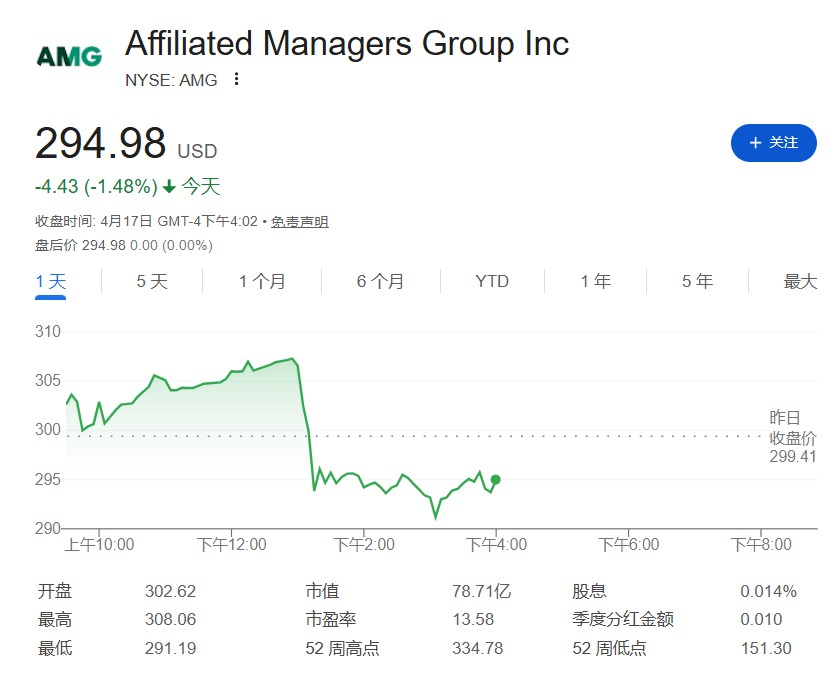
Following the report, AMG shares fell as much as 1.7% to $294.28 on the day, wiping out a previously strong intraday rally that had gained up to 2.9%.
How Big Is This "Tax-Avoidance Business"?
In recent years, the sustained rise in U.S. stocks has allowed wealthy investors to accumulate substantial taxable gains. In response, Wall Street has seen the emergence of products known as "tax-aware long-short strategies," designed specifically to help high-net-worth clients legally reduce their tax burdens.
The operational logic is not complex: Hold profitable stocks for the long term to defer taxation, while actively selling losing stocks to "harvest losses." These losses can then offset other gains, reducing the current year's tax bill.
These strategies have now expanded across hedge funds, ETFs, and separately managed accounts. According to prior Bloomberg reports, the total scale of such strategies exceeds $1 trillion.
AQR is the leader in this space. The company began aggressively promoting its tax optimization products at least from 2024, with assets under these strategies growing tenfold over two years to reach approximately $57 billion. In 2025 alone, AQR added a record $75 billion in assets, bringing its total to $189 billion.
How Important Is AQR to AMG?
This is the core logic behind Orso's short position in AMG.
AMG reported net inflows of $51 billion last year, representing a 36% year-over-year increase. During a conference call in February, AMG officials stated that this growth was "primarily driven by AQR."
Dava Ritchea, AMG's Chief Financial Officer, noted during the same call that, given AQR's "strong performance, continuous innovation, and differentiated expertise," AQR is expected to contribute more than 20% of AMG's earnings in 2026.
In other words, AQR has become an increasingly concentrated and critical component of AMG's profit structure. This means that if AQR's core business faces disruption, the financial impact on AMG could be significantly amplified.
Where Exactly Lies the Regulatory Risk?
Nathan Koppikar, a portfolio manager at Orso, wrote plainly in his letter: Some of AQR's tax optimization strategies use leverage or complex derivative instruments to generate large trading losses, which could attract attention from the Internal Revenue Service (IRS).
"This aggressive tax positioning is built on regulatory arbitrage and is highly vulnerable to IRS scrutiny," he wrote.
Signs of regulatory pressure are already emerging. According to Bloomberg, the U.S. Treasury Department is preparing to tighten regulation on at least one category of related strategies. Meanwhile, Fidelity Investments began limiting clients from opening new long-short separately managed accounts in February—a move widely viewed as a signal that the ability of such strategies to attract new capital may already be constrained.
Koppikar wrote in his letter: "When the regulatory hammer falls, AQR's assets under management and fee income will suffer heavy blows. Given that AQR now holds an increasingly large and concentrated share of AMG's profits, this damage will directly flow through to AMG's bottom line."
