


Zhu Jiangming Aims to Dethrone Luxury Cars
Rewriting the logic of the premium segment
Author | Chai Xuchen
Editor | Zhou Zhiyu
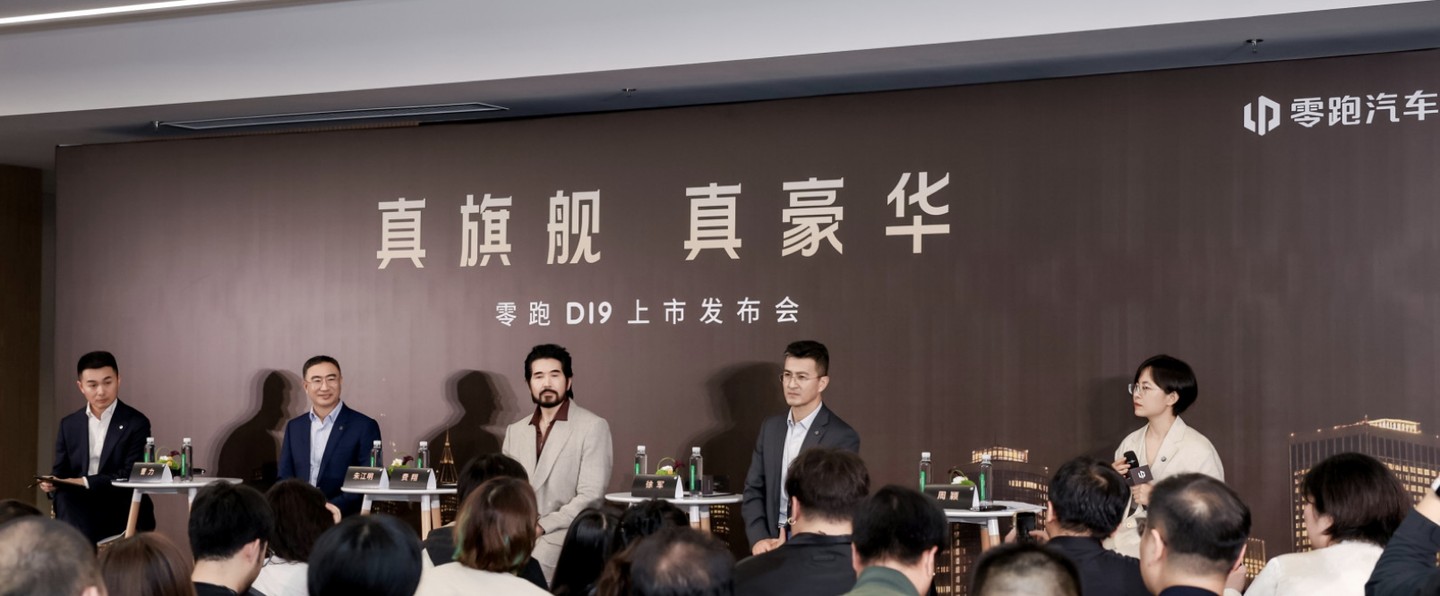
Leapmotor returned its second major press conference of the year to its home turf.
On the evening of April 16, Leapmotor entered the full-size SUV battlefield with a disruptive price point, launching its first flagship model, the D19. A large SUV exceeding 5.2 meters in length, offering six- and seven-seat layouts, available in both pure electric and extended-range powertrains, and packed with high-end configurations, was directly positioned in the 200,000+ RMB price bracket by Leapmotor.
Over the past year, China's large SUV market has been sufficiently vibrant. Models like the Li Auto L9, Aito M9, and a wave of new "Series 9" vehicles have established family flagship SUVs as one of the clearest high-profit tracks in the new energy era.
Leapmotor urgently needs to find a new profit growth engine. In 2025, Leapmotor achieved nearly 600,000 new vehicle deliveries, recorded a net profit of 540 million yuan, and successfully turned an annual loss into a profit. However, when allocated per unit, Leapmotor's current net profit per vehicle remains at approximately 900 yuan.
In the capital-intensive automotive manufacturing industry, meager per-unit profits lack the risk resistance needed to withstand market fluctuations. While maintaining a low-price, high-volume strategy can solidify the sales baseline, it cannot support the enterprise's future investment in advanced technologies.
This is why automakers must strive to "move up." The responsibility for this mission falls on the D19.
For Leapmotor, the D19 is currently its highest-priced model, but its strategy remains unchanged: the "premium alternative route."
Currently, consumers are gradually accepting a new rule: cars with larger space, higher configurations, and stronger intelligence should sell around the 400,000 RMB mark. The arrival of the Leapmotor D19 has broken this fixed impression.
The D19 attempts to challenge the existing price order directly with a set of cross-class hardware. Chairman Zhu Jiangming stated frankly to Wall Street News during communications: "Leapmotor can not only manufacture mainstream cars selling tens of thousands of units monthly, but also create top-tier luxury cars that can truly compete with million-yuan-level luxury vehicles."
From a specification perspective, the D19 does not follow a traditional entry-level route. Dual Qualcomm chips, high-voltage platforms, large batteries, air suspension, LiDAR, and three-motor performance versions—equipment originally more common in models above 300,000 RMB—have been collectively brought down to the 200,000+ RMB range.
This is why, after the price announcement, the market's first reaction was not "cheap," but "why can it be sold so cheaply?"
The answer likely lies in Leapmotor's underestimated capabilities: cost control.
Leapmotor Senior Vice President Cao Li pointed out: "We certainly cannot manufacture cars at a loss, so there must be a reasonable gross margin, which is what we will defend." He mentioned that Leapmotor reduces labor costs and improves quality through factory automation and intelligent production, as well as self-developed software and hardware; then compresses overall costs through standardized and universal design.
In other words, the low price behind the D19 is the result of Leapmotor's manufacturing system. This is why Leapmotor dares to fight this battle.
Over the past two years, Leapmotor rapidly scaled up its business relying on its mainstream B-series and C-series models, establishing a stable sales foundation among new forces earlier than competitors. However, the flip side of scale is that the brand has long remained perceived in the mass market: capable of making cost-effective cars, but perhaps not capable of making premium cars.
Leapmotor must break through this boundary.
Zhu Jiangming explained the logic very realistically: "To survive, we must not incur losses. Second, we need scale; without scale, there is no future." He simultaneously emphasized, "How Leapmotor increases its scale in the near term is more important than the goal of profitability, because this is a matter of survival."
This logic is particularly cruel in today's automotive industry. Relying solely on 100,000 to 150,000 RMB models to drive volume may bring sales, but it may not sustainably support high-level R&D investments. Intelligent driving models, electronic architecture upgrades, and charging infrastructure construction are all long-term cash-burning projects. Leapmotor needs products in higher price brackets to open up profit space, and it needs flagship models to lift the brand's ceiling.
Cao Li told Wall Street News, "Currently, Leapmotor integrates all the top technologies from the industry into this single vehicle." At the same time, the D platform bears the highest positioning within the Leapmotor system, "its positioning and configuration will be pushed to the maximum."
Cao Li further stated to Wall Street News that Leapmotor can not only manufacture mainstream cars selling tens of thousands of units monthly but also create top-tier luxury cars that can truly compete with million-yuan-level luxury vehicles, adding, "I also hope our luxury cars can sell tens of thousands of units per month."
However, Leapmotor is well aware that the premium market cannot be conquered by specification sheets alone.
Xu Jun revealed that among the current D19 order users, over 70% hold a bachelor's degree or higher, primarily consisting of multi-child families or three-person households, with ages concentrated between 30 and 40. The replacement purchase ratio reaches 90%, with many users from tier-one cities. These consumers are not buying their first car; they have higher requirements for products, services, and brands.
Therefore, Leapmotor began upgrading its service system simultaneously.
Xu Jun said, "Not all stores can sell the D series; out of over 1,000 stores, currently only about 600 are qualified." Additionally, D19 users enjoy benefits such as two free vehicle usage days per year, door-to-door delivery, and a replacement car provided if repairs take longer than 24 hours.
If the D19 can establish itself firmly, the impact on the industry will be very direct. It will cause the price anchor in the large SUV market above 300,000 RMB to begin loosening. Consumers will recalculate whether the same size, same configuration, and similar experience are worth spending an extra 100,000-plus yuan.
In the future, if Leapmotor's model of "high specifications at low cost" is validated, the competition among automakers will deepen into supply chain depth, self-development capabilities, and organizational efficiency.
Zhu Jiangming's assessment of the industry is also candid: "The elimination round has not ended. We believe the next two to three years will be the norm, but whether there will be so many new cars released every day after three years? I think there won't be."
The subtext of this statement is that the excitement will eventually pass, and only systemic players will remain.
What the final monthly sales figure for the D19 will be is still difficult to conclude. However, it has already sent a clear signal: Leapmotor is no longer satisfied with being a filler in the mass market but is starting to actively enter the core battlefield where there are profits and the fiercest competition.
A price of 219,800 yuan is an entry ticket. The true outcome depends on whether Leapmotor can prove one thing—that the premium market does not necessarily belong only to high-price players.
The following is the transcript of the conversation with Leapmotor Chairman Zhu Jiangming, COO Xu Jun, and Senior Vice President Cao Li:
Q: What is the user profile of the D19 orders?
Xu Jun: High-knowledge individuals, with over 70% holding a bachelor's degree or higher. They are mostly multi-child families or three-person households. Among the selected models, extended-range versions account for 60%. The age group is mainly between 30 and 40. There is strong recognition for technology across the board, with many users from tier-one cities. The replacement purchase ratio has basically reached 90%.
Q: After the D19, how do you hope others will view Leapmotor?
Cao Li: Leapmotor is earnestly focused on making good products. Whether it's the A-series under 100,000 RMB or the D-series, which are luxury models approaching 300,000 RMB, pricing is based on cost. For the same price, customers can get better quality and higher configurations.
Leapmotor can not only manufacture mainstream cars selling tens of thousands of units monthly but also create top-tier luxury cars that can truly compete with million-yuan-level luxury vehicles. I also hope our luxury cars can sell tens of thousands of units per month.
Q: There are increasingly more Series 8 and 9 three-row SUVs. Some executives say to "forget MPVs." How do you view these opinions?
Zhu Jiangming: People have always said MPV volumes will increase rapidly. We see some incremental growth now, but not as fast as expected. From the demand perspective of various models, these types of vehicles will all continue to exist in the future, looking at the broader categories.
Looking at large SUVs, future vehicles will move in two directions. One is small models like the A-series, serving as a family's second or third car. Looking at developed countries, these small cars will definitely become more numerous. The other type is a large vehicle for the whole family to travel together. So it will polarize towards these two ends. The middle ground, traditional A-segment and B-segment cars, previously existed because the economy wasn't good enough, leading people to choose lower-priced cars for commuting to meet basic family travel needs.
Previously, buying a car required years of savings. Now, with rising salaries, it has become easier to buy a car. Therefore, the future direction of cars is developing towards these two ends. Even with fully autonomous driving, the trend remains the same: shared mobility will lean towards smaller vehicles, while family versions, as autonomous driving becomes more prevalent, will move towards larger vehicles.
Q: Will the pricing of the Leapmotor D19 squeeze gross margins?
Cao Li: We certainly cannot manufacture cars at a loss, so there must be a reasonable gross margin, which is what we will defend. We save costs by utilizing all automated and intelligent production processes in our factories. Not only are components self-developed, but the production lines are also intelligent and automated. Both software and hardware are self-developed, allowing us to save costs in this area. By saving significant labor costs while maintaining excellent quality control, this is one aspect we can demonstrate.
On another hand, through self-developed smart manufacturing, we control costs well and improve quality. Additionally, standardized and universal design allows us to achieve standardization and universality effectively. These are experiences reflected in cost. Comprehensive cost management means we can produce good things that, according to product pricing, are indeed not too expensive.
Q: The industry is seeing increased volume but not increased profit. There is talk of normalizing battery cells. Leapmotor has been doing front-end self-research in this area. How do you view industry standardization?
Zhu Jiangming: I am from a different class than Li Bin. He said your standardization is done very well, especially regarding promoting cell standardization. Last year, Leapmotor sold nearly 600,000 cars. This year, our target is 1 million, and we only use three types of battery cells.
Any industry is forged through competition. Chinese brands' proportion in the global 70-80 million passenger vehicle market is still not high. We cannot say we have won yet. We must pursue profits and work harder to build the competitiveness of Chinese brand automobiles. Only then can we make automobiles as ubiquitous globally as air conditioners, refrigerators, televisions, and mobile phones, achieving a 50%-60% share worldwide.
Only when any Chinese product achieves a 50%-60% share has it passed this threshold. China accounts for 30% of global demand. With such a large volume and cost advantages, we can sell to neighboring countries. We need scale advantages.
Q: Over 90% of D19 users are replacement buyers, and they are highly educated groups with higher requirements for vehicle experience and service. How does the service approach for the D19 differ from ABC models in terms of overall service?
Xu Jun: Actually, every time Leapmotor launches a car, it is not just a technological upgrade but also an upgrade in service levels. For each launch, we utilize this opportunity to raise the bar for Leapmotor's entire service system. In Leapmotor's service philosophy, we advocate "selling a car creates a friend for life," so the pursuit of service is endless.
Not all stores can sell the D series; they must receive our certification. Out of over 1,000 stores, currently about 600 are qualified. Secondly, in all pre-sales and after-sales, we aim to create temperature-driven service. MOT (Moment of Truth) is about providing a sense of warmth. D19 users can enjoy two free vehicle usage days per year, door-to-door delivery, and a replacement car if repairs exceed 24 hours. These services might seem ordinary to other automakers, but everyone should remember we are in the 200,000-300,000 RMB segment. Providing such services, combined with this definition, represents Leapmotor's attitude towards service and users.
Q: Is the part reuse rate between the D platform and BC platforms high?
Cao Li: Let me state the conclusion first: the reuse rate between the D platform and BC platforms is not high. The cost of the D platform is certainly significantly higher than that of BC, which is evident from the selling price. From a long-term perspective, how to make the D series more competitive within its class is key. Although the D series shares less with other platforms, our overall architecture design is interconnected. For example, the electrical and electronic architecture and our CTC battery platform are all standardized. Our factories are flexible switching facilities capable of handling multiple platforms, so in terms of major architecture, we have achieved standardization.
Long-term architectural integration means higher R&D efficiency. Opening a completely new platform requires investing more R&D resources. Electrical architecture, software, and hardware system platforms are very resource-intensive. Therefore, once we perfect platformization, R&D efficiency will be higher. Part reuse will further reflect cost advantages once the D platform itself gains sufficient volume. Combined with overall investment control, we maintain certain advantages.
Q: Sales of the A10 have been very strong. How do you ensure delivery?
Xu Jun: Delivering upon launch is something we have achieved, but it was merely passing the bar because market enthusiasm exceeded our expectations. We completed 30,000 orders at the fastest speed, but factory production always involves a ramp-up process. This highlights another advantage of ours: full-domain self-research. We have the ability to quickly adjust our production rhythm. Under the same conditions, Leapmotor can always solve problems at the fastest speed.
Cao Li: When I said earlier that A10 sales depend not on how many can be sold but on our factory capacity, we indeed encountered a bottleneck. I need to find ways to increase capacity.
Q: Currently, there are thousands of models on sale in the Chinese market. How does Leapmotor secure sufficient profit space?
Zhu Jiangming: Indeed, there are too many models now. Tonight alone, six new cars were launched. The elimination round has not ended. We believe the next two to three years will be the norm, but whether there will be so many new cars released every day after three years? I think there won't be. Because developing each car is extremely cost-saving for us. Including all labor, it costs 1 billion yuan. For a completely new model, 1 billion yuan is very frugal.
If only a few thousand units are sold, the R&D investment is huge. Secondly, for the factory, when set up, there is hope, usually planning for at least 10,000 units per month. If the result is only 5,000 units, the cost becomes incredibly high. Making cars is truly difficult. I believe if we look back in two or three years, having six new cars released daily will definitely not happen. This is a process returning to reality through competition.
To summarize why every Leapmotor model sells well: the key is learning from mistakes. Planning errors gave us a great lesson, so we are extremely cautious, thoroughly researching the entire product roadmap to plan and design everything well. Since three years ago, from C11 to C10 to C16, each model has been better than the last.
Reviewing the entire 2025 B-series, our three models basically achieved monthly sales of 10,000 units. During peak times, sales exceeded 10,000. The A10 finally became a hit, reaching 10,000 units monthly. Creating a hit is quite difficult.
Cao Li: To date, the number of cancelled orders is zero. No one has cancelled.
