


JD.com Q1 Earnings Surprise? Wall Street: Core Business Recovery Plus Narrowing Losses in Food Delivery Segment
Three major Wall Street investment banks—Barclays, JPMorgan Chase, and HSBC—collectively adopted a bullish stance on JD.com on the same day. The core logic lies in the unexpected growth momentum of high-margin businesses such as daily necessities and platform services in the first quarter, alongside an increasingly clear trend of narrowing losses in the new food delivery business, as regulators continue to signal to market participants the need to return to rational competition
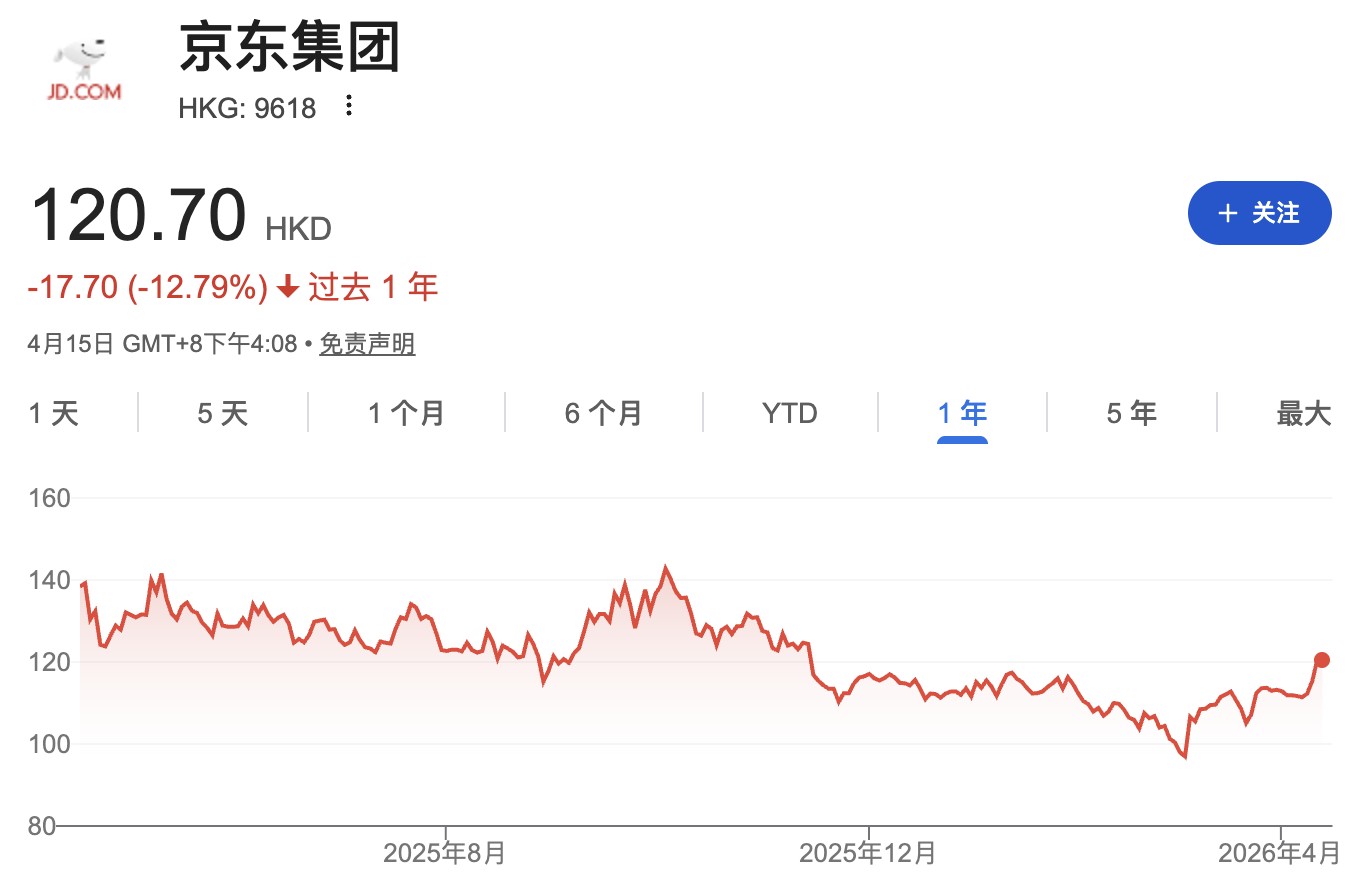
Multiple positive signals are converging, with major Wall Street institutions issuing a collective bullish statement on JD Group on the same day.
According to Trading Wind Desk, Barclays, JPMorgan Chase, and HSBC released research reports sequentially on April 14, all expressing strong confidence in the improving fundamentals of JD.com.
The common logic among the three institutions focuses on two main lines: First, the consumption and e-commerce environment improved in the first quarter, with high-margin businesses such as daily necessities and platform services showing growth momentum that exceeded expectations;
Second, the trend of narrowing losses in the new food delivery business is becoming increasingly clear, and regulators have continuously sent signals to market participants requiring a return to rational competition, further reinforcing the certainty of loss convergence.
Daily Necessities and Platform Businesses Become Key Focus, Expected to Drive Revenue Structure Optimization
In forward-looking assessments of JD.com's first quarter by major banks, the acceleration of growth in both daily necessities and platform & marketing services was repeatedly highlighted.
According to Barclays' industry research, these two businesses grew year-over-year by 12.1% and 15% respectively in the previous fourth quarter, and may accelerate further in the first quarter. Year-over-year revenue growth for daily necessities in the first quarter is expected to rise from the previously forecasted 12.0% to 12.5%, while year-over-year revenue growth for platform and marketing services is revised upward from 13.5% to 15.5%.
HSBC also expects that daily necessities will maintain a year-over-year growth rate of 12.5% in the first quarter, with platform and advertising revenue growing approximately 15% year-over-year.
At the same time, home appliances and 3C categories remain drag factors. Barclays forecasts that revenue in this segment will still decline by about 8% year-over-year in the first quarter, consistent with prior expectations, and predicts that it could turn positive by the third quarter of 2026 at the earliest—when the high-base effect of trade-in subsidies gradually fades, helping to re-accelerate overall revenue growth in the second half of the year.
Food Delivery Loss Inflection Point Nears, Overall Loss Reduction Pace Exceeds Expectations
On the new business front, the narrowing of losses in the food delivery segment is a key basis for major banks upgrading their earnings forecasts.
JPMorgan Chase believes that regulators have recently issued multiple rounds of signals opposing irrational competition, and subsidy levels in the domestic food delivery market have shown signs of cooling, prompting the bank to narrow its 2026 new business loss forecast from 45 billion yuan to approximately 35 billion yuan (an improvement of about 10 billion yuan compared to market consensus).
HSBC estimates that losses in the food delivery business will narrow from approximately 36 billion yuan in 2025 to about 25 billion yuan in 2026, representing a significant decline.
Regarding user metrics, HSBC cited QuestMobile data showing that JD.com's monthly active users (MAU) grew 13% year-over-year in the first quarter, outpacing competitors' growth rates of 2%-3%. The daily active user ratio (DAU/MAU) also increased by approximately 2 percentage points year-over-year to 23%-24%, laying the foundation for platform monetization through improved user quality.
JoyBuy Europe Expansion Proceeds More Cautiously; Short-Term Focus on Experience and Fulfillment
Regarding overseas expansion, institutional language has become more cautious, shifting focus from "expansion speed" to "investment pace and controllable losses."
Barclays quoted management statements indicating that JD.com's investments in European operations via JoyBuy will proceed "gradually," with short-term priorities focused on user experience, particularly fulfillment experience, rather than business scaling.
JPMorgan Chase similarly observed that after launching in Europe in March, JoyBuy's spending on customer acquisition remains "quite cautious," and expects international business progress in 2026 to be even more prudent compared to the loss reduction seen in flash sales.
HSBC estimates that due to prior investments in warehousing and distribution, overseas operations will still incur losses in 2026, with quarterly losses potentially ranging from 1 billion to 2 billion yuan, fluctuating with order volume.
Valuation Divergence Limited; Current Stock Price Considered Attractive
On valuation, although the three institutions employed different methodologies, all conclusions pointed to a clear safety margin in the current stock price.
Barclays used the EV/EBITDA valuation method, raising the target multiple from 5x to 6x (based on 2027 expected EV/EBITDA), setting a target price of $41; the bull case corresponds to a 7x EBITDA multiple with a target price of $48; the bear case corresponds to 4x, with a target price of $27.
JPMorgan Chase provided a $38 target price based on a 9x 2027 expected P/E ratio (three-year average), corresponding to approximately 11x expected P/E for 2026, and noted that the valuation of core businesses alone (excluding all new business losses) is only about 6x, implying considerable upside potential even under the most optimistic scenario.
HSBC adopted the DCF valuation method (WACC at 10.6%, terminal growth rate of 3.5%), maintaining a $35 target price, considering the current approximately 9x 2026 expected P/E ratio attractive, while also noting that a buyback facility worth approximately 5% of market value (about $2 billion, valid until August 2027) provides additional valuation support.
