


Interview with Ziyuan Kutuo COO: There is no competition in quadruped robots right now
Regarding competition and revenue targets for quadruped robots, Ziyuan Kutuo has different ideas
On April 10th, Ziyuan Kutuo held its first media communication meeting in Shanghai, where COO Qiu Heng comprehensively elaborated on the strategic positioning and commercial ambitions of Ziyuan Robot, a newly independent subsidiary.
Ziyuan Kutuo was just registered on April 9th and has been spun off from Ziyuan Group's Lingxi product line. Qiu Heng explained the reason for the independence very directly: the growth of the quadruped business has been too rapid, and it would be overshadowed if it continued under the halo of humanoid robots. The group's judgment was that quadruped robots are giants in themselves and need to be operated independently.
Qiu Heng repeatedly emphasized a core concept: Ziyuan Kutuo is not making robot dogs, but quadruped robot "people." The difference lies in AGI. His original words were impactful: the robot dogs on the market are "all brainless," and "there is no competition at all in making quadruped robots."
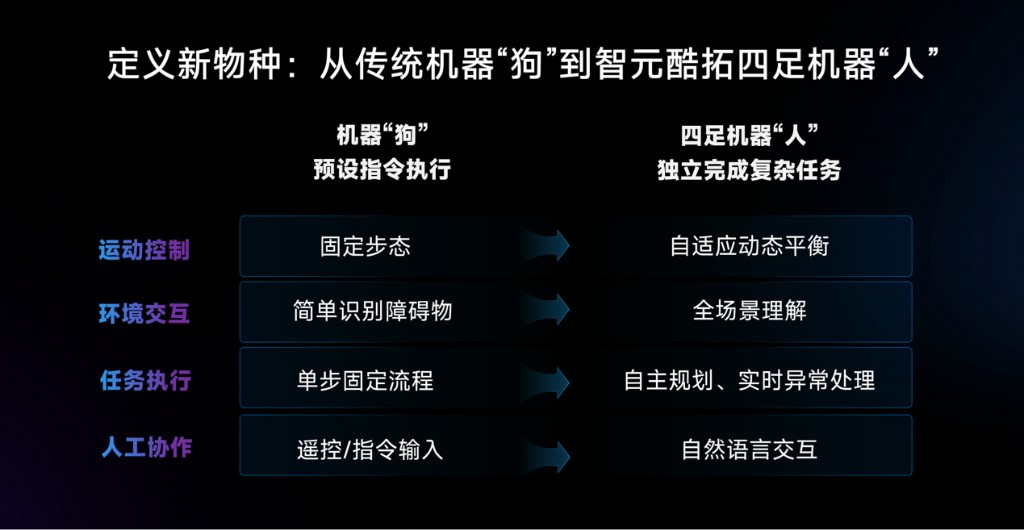
This statement is confident, and its foundation comes from the technology reuse within Ziyuan Group. The "brain" and "cerebellum" are almost entirely shared, the training data is highly generic, and using Genie Studio to train quadruped operation models reduces the workload by 70% compared to starting from scratch.
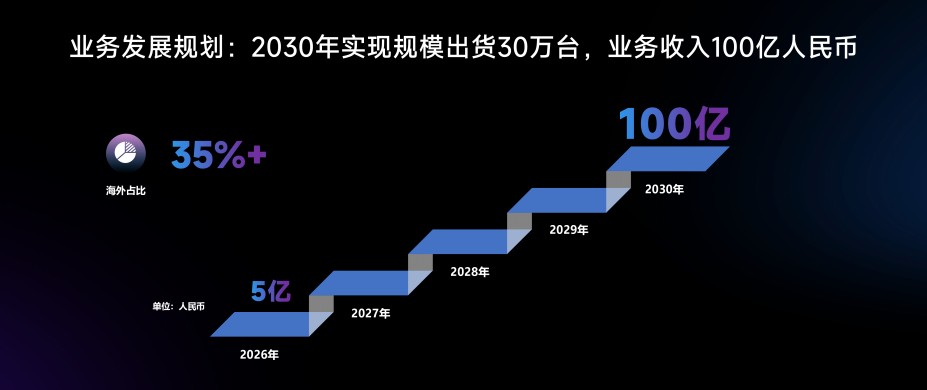
Financial targets are equally aggressive. The revenue target for 2026 is 500 million yuan, aiming for 10 billion yuan by 2030, with overseas sales accounting for 35%. The first quarter has already surpassed the entire previous year, with medium-sized quadruped robots selling out to the point of warehouses being emptied. They even had to recall demo units for the partner conference on April 17th. Overseas orders accounted for over 40% in Q1.
However, Qiu Heng also set clear boundaries. They will not seek financing for now, "The boss said this market is very, very large and worth a lot of money, so don't sell it off right now." They will not pursue B2C for the time being, focusing instead on thoroughly penetrating industry scenarios such as power grids, mines, security, and logistics, "We want to create productivity tools."
Regarding competition with Unitree and Deep Robotic, Qiu Heng's response was thought-provoking. He said that he "doesn't see intense competition" in the current market, and customers are buying intelligence capabilities. "If you buy a stupid dog, customers won't want a second one." In terms of supply chain costs, he pointed out that one should not look only at the shipment volume of quadruped robots; humanoid and quadruped robots share the supply chain, and the total number of joints is what constitutes true scale.
The upcoming D2 Max will be the key product for Ziyuan Kutuo to differentiate itself, claiming to be the first L3 intelligent driving quadruped robot for all terrains, capable of seeing the path ahead, autonomous navigation, and generalization across multiple tasks within a single industry. Qiu Heng predicts that 2026 will be the breakout year for quadruped robots.
The following is an edited excerpt of the interview:
Logic behind the spin-off
Qiu Heng: Ziyuan Kutuo is Ziyuan's most important subsidiary, different from previous business models involving hands, data, or leasing. It has been separated from the main product line. In the future, Ziyuan will handle humanoid robots, and Kutuo will handle quadruped robots. President Deng has high expectations for us; Kutuo will definitely become very, very large.
Regarding financing and IPO
Qiu Heng: We will not seek financing for now because we do not want to dilute shares. The boss said this market is very, very large and worth a lot of money, so don't sell it off right now. Will we go public? We look forward to that day.
Regarding competition
Reporter: Unitree already has a large shipment volume, and Deep Robotic also has a large volume. What about cost advantages?
Qiu Heng: When comparing, one cannot look only at quadruped robots because humanoid and quadruped robots share the supply chain. How many joints does a humanoid robot have, and how many joints does a quadruped robot have? Adding them up will reveal who has greater scale. This year is Ziyuan Kutuo's first year of creation, and we are not saying we need to be number one in our first year. I can only say that our speed to become number one will be faster than any other company.
Reporter: Will prices decrease?
Qiu Heng: Costs and prices will definitely decrease rapidly. But at least for now, we don't see intense competition in the market. In most cases, customers look at whether you can serve them well, not whether the price is one or two thousand yuan more. If you buy a stupid dog, customers won't want a second one.
Core differences in intelligence
Qiu Heng: All the robot dogs currently in the industry are "blind." They only adjust their gait using reinforcement learning when their feet slip. A normal person seeing a pit would either go around it or jump over it; they wouldn't step into it. What we at Kutuo want to do is to look ahead with our "eyes" first, then choose a path, and then walk.
Reporter: Is intelligence a real demand or a false demand?
Qiu Heng: If someone doesn't need intelligence, the only reason is that they believe intelligence is unattainable or they can't afford it. It's like asking someone if they want to live in a 1,000-square-meter house. Perhaps everyone wants to, but it's a bit expensive to consider. Our intelligence is about unlocking people's latent needs.
Regarding L3 intelligent driving
Reporter: L3 is just beginning to be piloted in cars. How can the safety of L3 for quadruped robots be guaranteed?
Qiu Heng: Intelligent driving for quadruped robots has an easier aspect: a limited range of movement, allowing for intelligent driving within that confined area. The difficult part is all-terrain capability. Cars don't run into mountains and ditches, but quadruped robots might completely run up mountains, into ditches, or into rivers. We call this "3D" intelligent driving, whereas car intelligent driving is relatively planar.
Regarding shipments and industry penetration
Qiu Heng: We currently have shipments in six scenarios: patrol, inspection, emergency response, fire fighting, education, and entertainment. However, all fields are in a very early stage, with the overall market penetration rate not even reaching 1%. In the first quarter, we achieved the volume of the entire last year, and we expect the second quarter to exceed the total annual volume.
Reporter: When will the breakout point be?
Qiu Heng: 2026 is already a breakout point. The feedback loop for quadruped robots might be faster than for humanoid robots, as it is, after all, simpler.
Regarding ToC
Qiu Heng: We currently have no plans for ToC (direct-to-consumer). It will be ToB (business-to-business) first, then ToC, which is related to the maturity of the technology. The industry environment is relatively limited, making it easier to close the loop. The home environment is very diverse and requires more complex intelligence. What we want to create are productivity tools. Let's do a good job in power grids, coal mines, security, and logistics first, and then consider whether to work in homes.
Regarding data reuse
Reporter: Ziyuan has over 3 million real-world footage. Humanoid and quadruped robots have different forms. How can they be reused?
Qiu Heng: They are training the same brain. Humanoid robots also don't look exactly the same; Jingling, Yuanzheng, and Lingxi don't look entirely alike, but they are all collecting data and training the same brain. The differences are not that significant and might require a little time, not a complete restart.
Regarding cost reduction
Qiu Heng: With shipment volumes increasing several times in the next few years, a 20-30% cost reduction should be normal. Cost reduction mainly comes from the volume itself.
Regarding 6G and communication
Qiu Heng: 6G standards will be finalized in nine years, and we hope to be among the first to use it after standardization in 2029. The integration of communication and sensing in 6G is particularly important for us. Robots need radar, distance measurement, sensing, and terrain scanning. While scanning, communication is also handled.
Regarding future forms
Reporter: Why not make a six-legged robot?
Qiu Heng: In the future, it could be six-legged, eight-legged, but we need to perfect the four-legged design first. Many animals in the world are four-legged, indicating that this form is highly adaptive in nature. Once the intelligent brain is developed, even 100 legs would be possible. The key is to develop the brain first; once it's developed, whatever it's attached to, it becomes that "person."
This article comes from WeChat Official Account "Hard AI". For more cutting-edge AI news, please click here.
