


Optical Module Giant Lumentum: Sells Out Three Years of Capacity in Just Two Quarters
Lumentum CEO Michael Hurlston stated that the capital expenditures of US hyperscale cloud providers are "massive and without end," and the company is "increasingly unable to keep up with demand, and it will only take two quarters for us to sell out all of our capacity for the entire year of 2028."
The demand for optical interconnects driven by AI data centers is pushing upstream capacity to its limits. Global leader in optoelectronic devices, Lumentum, has announced that purchases of its optical components by major US tech companies are accelerating, and the company may sell out its entire capacity until 2028 within the next two quarters.
According to Bloomberg, Lumentum CEO Michael Hurlston said in an interview in Tokyo on Friday that the capital expenditures of US hyperscale cloud providers are "massive and without end," and the company is "increasingly unable to keep up with demand, and it will only take two quarters for us to sell out all of our capacity for the entire year of 2028."
This statement pushes the company's previous disclosure of "sold out at least until the end of 2027" further out and reinforces market expectations for the resilience of AI data center construction demand, even as the Iran conflict disrupts oil markets and impacts the global economy.
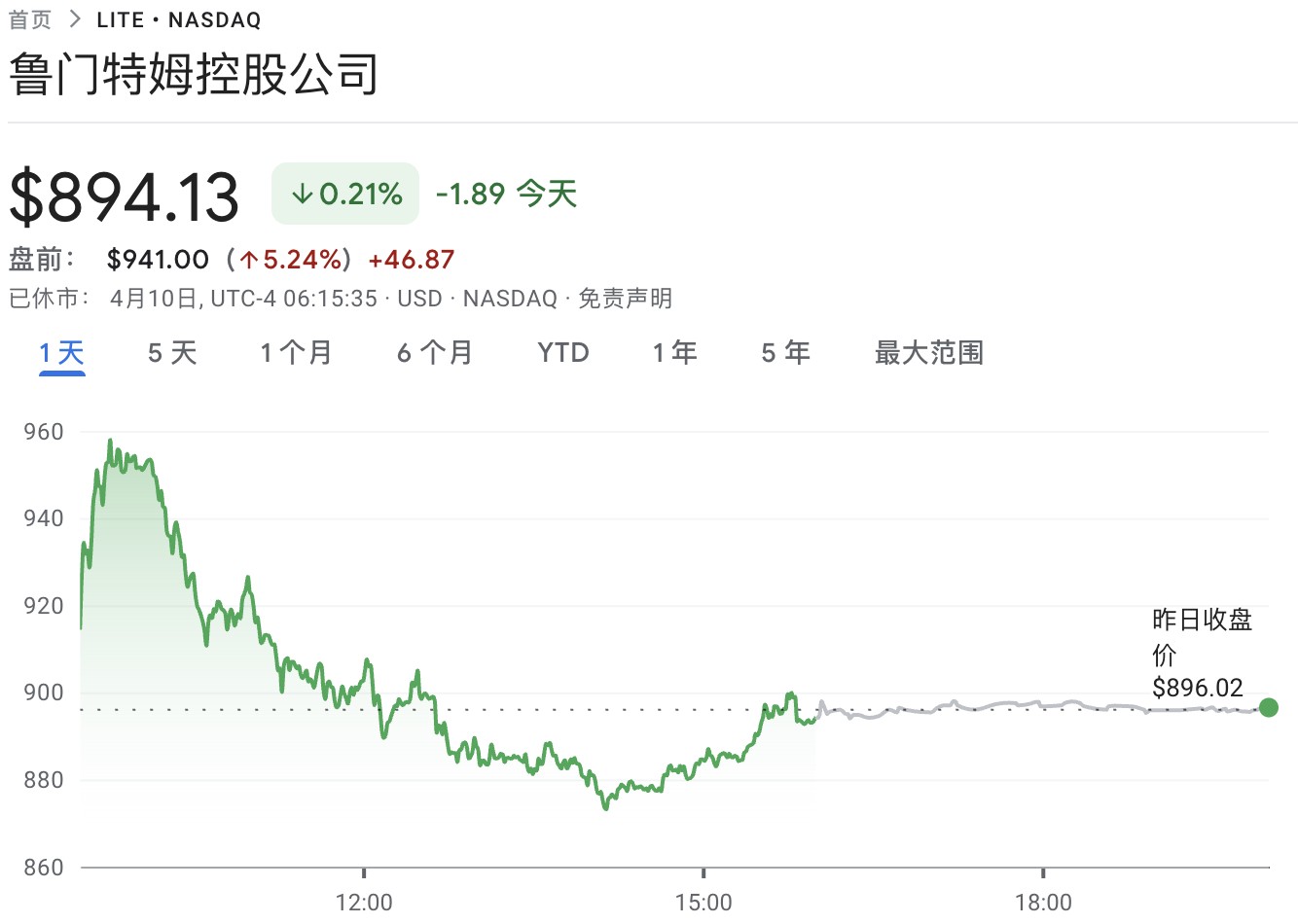
The market reacted swiftly. The company's stock price rose as much as 7.6% in pre-market trading, and its remarks also boosted competitor Coherent. Last month, both companies received $2 billion investments from Nvidia each, with Nvidia also securing procurement agreements and related rights for advanced laser components.
Orders Sold Through 2028, 12x Capacity Expansion Still Fails to Meet Demand
Hurlston's latest assessment hinges on the "locking" of order visibility. He stated that the "sold out" designation refers to non-cancellable agreements, making the extension of the order coverage period directly meaningful for revenue certainty.
In his view, this AI-driven cycle cannot last forever, but it possesses a certain sustainability for "at least five years." For investors, this statement shifts market focus from short-term fluctuations to longer-term supply-demand gaps and delivery capabilities.
To keep up with demand, Lumentum has already increased the capacity of its key factories in the Tokyo metropolitan area by 12 times over the past two years.
The company plans to invest at least $100 million in this base and neighboring facilities, an investment Hurlston suggested "could rise to $250 million."
He also emphasized that industry bottlenecks are shifting to the optoelectronic component segment, with pressure coming from customers' frequent inquiries about delivery pace, including how much can be produced "this quarter, next quarter, and the quarter after."
Japanese Supply Chain is Key: Relocation Not Feasible, Seeking New Factory Sites
Lumentum's Sagamihara factory is described by the company as one of the most advanced indium phosphide device production bases globally, capable of stable and high-quality output.
However, space for new equipment at the Sagamihara and nearby Takao plant sites is limited. The company is searching for new locations in Japan for expansion, targeting old electronic manufacturing plants that can be retrofitted to shorten the time to bring new capacity online.
He also stated that moving production out of Japan is not feasible because indium phosphide manufacturing requires precise control over variables such as temperature, humidity, mixing speed, and water quality, and the network of surrounding material and process suppliers is crucial.
The company has signed a seven-year agreement with a Japanese supplier, which Hurlston described as "critical."
