


War, Oil Prices, and Gold: Three Paradigms Under Geopolitical Conflicts
Similarly, during wars and oil price surges, gold sometimes rallies significantly and at other times weakens—Guohai Securities, after reviewing eight major geopolitical conflicts over the past 50 years, points out that the direction of gold prices is never determined by the conflict itself, but by whether oil prices can "shift their center of gravity," whether inflation gets out of control, and whether central banks dare to compromise. Comparing this to the 2026 US-Iran conflict, the three checkpoints currently resemble a combination of "high-level volatility." The war is just the starting point; macroeconomics will determine the final outcome
When geopolitical conflicts arise, the market's first reaction is often to "buy gold." However, looking at the longer term reveals that during similar wars and oil price surges, gold sometimes experiences significant rallies, sometimes surges and then retreats, and at other times even weakens. What truly determines the direction of gold prices is often not the conflict itself, but whether oil prices can elevate inflation to a new level, and whether central banks will suppress this "war premium" with higher real interest rates.
Lin Jiali, an analyst at Guohai Securities, plainly states the core logic in his report: "Geopolitical conflicts only bring a first-order, short-term risk aversion sentiment to gold. Whether gold can achieve a trend-driven, long-term bull market depends on second-order determinants: whether oil prices materially lift the inflation center of gravity and how central banks respond to inflation (the trajectory of real interest rates)."
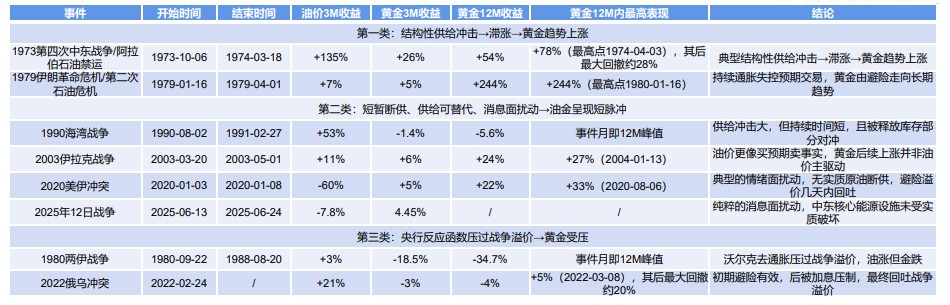
This report analyzes samples such as the Fourth Middle East War/Oil Embargo in 1973, the Iranian Revolution crisis in 1979, the Iran-Iraq War in 1980, the Gulf War in 1990, the Iraq War in 2003, the US-Iran conflict in 2020, the Russia-Ukraine conflict in 2022, and the "12-Day War" in 2025, placing them within a framework to identify three common "paradigms": Structural supply shocks leading to stagflation and a trend-driven gold bull market; temporary supply disruptions or substitutability causing only a short pulse in oil and gold prices; and central bank reaction functions overriding the war premium, causing gold to fall instead.
Applying this historical framework to the 2026 US-Iran conflict, the report offers a "realist" conclusion: the oil price center of gravity might rise from $70 to the $95-$105 range, but inflation is currently "high but not out of control," and the Federal Reserve is not yet "behind the curve." Under this combination, gold is more likely to be an asset in a high-level, wide-ranging oscillation. For a smoother upward trend, one would need to wait for a ceasefire coupled with a weakening US economy and signals of rate cuts from the Fed, or for the conflict to escalate to a prolonged blockade of the Strait of Hormuz, causing inflation expectations to de-anchor and forcing central bank concessions—the latter path would be more turbulent, potentially starting with a decline.
Don't Focus on the War: Whether Oil Prices "Shift Their Center of Gravity" is the First Hurdle
The report categorizes oil price shocks into "pulses" and "center of gravity shifts," differentiating based on the size and duration of the supply gap and whether it can be offset by alternative supplies.
In 1973, the key was not the day the war started, but the OAPEC oil embargo against the US: oil prices surged from about $2.9/barrel before the embargo to $11.65/barrel in January 1974, and high oil prices did not fall even after the embargo ended. Gold did not rise unilaterally immediately after the outbreak of war; instead, it briefly dipped. The true main rally phase occurred after the oil price shock was confirmed by the market to be a more long-term inflation problem.
Conversely, although the 1990 Gulf War caused a sharp increase in oil prices due to a sudden supply reduction, it was soon offset by inventory releases and substitute supplies. Oil prices fell, and gold quickly retreated to near pre-war levels. The US-Iran conflict in 2020 and the "12-Day War" in 2025 were closer to "tail-risk repricing": the market priced in the worst-case scenario, and once it was confirmed that oil transport was not cut off or retaliation was contained, the premium was quickly unwound.
The report emphasizes that as long as oil prices do not transition from a "news-driven spike" to a "new price center of gravity," it is difficult for gold to extend its safe-haven rally into a sustained trend.
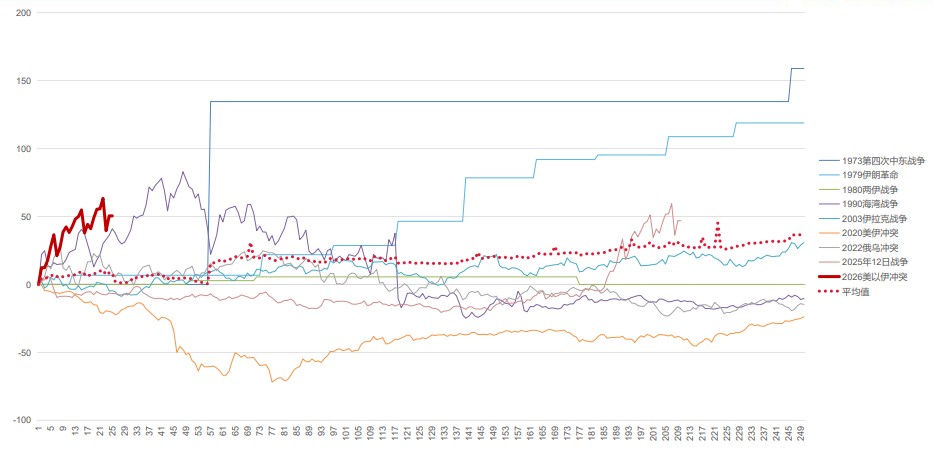
Stagflation is the Switch from Safe Haven to Trend, Not Just "Rising Oil Prices"
The impact of rising oil prices on gold must pass through the second filter of "inflation + growth." The report describes the typical environment for gold to shift from a short-term safe haven to a trend-driven rally as a stagflationary scenario where both high inflation and low growth are priced in.
The Iranian Revolution crisis in 1979 is cited as a classic example: crude oil prices nearly doubled between 1979 and 1980, rising from less than $15/barrel in late 1978 to nearly $40 in 1980; US CPI soared to 13.3% by the end of 1979. Coupled with the initially soft monetary policy at the time, market confidence in the fiat currency system was shaken, leading gold into a historic bull market.
In contrast, consider the Iraq War in 2003: Iraq's pre-war export volume averaged about 2 million barrels/day, a smaller shortfall compared to the 1990 supply disruption. Furthermore, other OPEC members had the capacity and willingness to compensate. Gold prices traded uncertainty before the war and fell after the "sell the news" event upon its outbreak. Its subsequent strengthening was driven more by broader macroeconomic gold bull market logic than by oil prices themselves.
Central Bank Reaction Functions Are Often "Harder" Than Battles: Real Interest Rates and the Dollar Can Suppress War Premiums
The report singles out a third paradigm: Even though war and oil prices are directionally bullish for gold, if central banks adopt strong tightening measures to combat inflation, real interest rates and the dollar become the primary factors suppressing gold prices.
The Iran-Iraq War in 1980 is a typical example: the surge in oil prices did not prevent gold from significantly pulling back during Volcker's disinflationary cycle. The report emphasizes in its review that the true "killer" of gold was the rising opportunity cost brought about by soaring real interest rates and a strengthening dollar.
The 2022 Russia-Ukraine conflict also presented a similar structure: initial safe-haven demand was effective, but it was subsequently suppressed by the Federal Reserve's tightening. The report cites data showing that the US 10-year TIPS real yield rose by 250 basis points throughout 2022, and the dollar index appreciated by about 8%, leading gold to give back a significant portion of its war premium.
The implication here is direct: when the market begins to see "a more hawkish central bank" rather than "a more severe war" as the main narrative, gold easily transitions from a safe-haven asset to a macro asset priced by interest rates.
Deconstructing Gold: Exchange Rates, Risk, Rates, and Liquidity Compete for Explanatory Power
To answer "why gold prices follow vastly different paths despite similar oil price surges," the report introduces the World Gold Council's GRAM framework, breaking down gold returns into four drivers: exchange rates (dollar strength), risk and uncertainty, interest rates and liquidity, and momentum and trends (including ETF fund flows, net futures longs, etc.).
This breakdown itself does not provide a "magic indicator," but it highlights a often-overlooked fact: gold doesn't solely feed on "geopolitical risk." The dollar index, 10-year real interest rates, inflation expectations, and fund flows—any shift in the dominant variable can cause gold prices to trace entirely different curves within the same conflict.
Returning to 2026: The Three Checkpoints Currently Resemble a "High-Level Volatility" Combination
The report assesses the 2026 US-Iran conflict against the "three conditions" one by one.
Condition One: Will the Oil Price Center of Gravity Rise?
The judgment is that the center of gravity might rise from $70 to the $95-$105 range, but this heavily depends on negotiations and the resumption of traffic through the Strait of Hormuz. It cites information from the International Energy Agency, noting that the Strait of Hormuz handled an average of 20 million barrels of crude oil and petroleum products per day in 2025, accounting for about 25% of global seaborne oil trade. It also mentions that strategic petroleum reserve releases can partially mitigate the shortfall but cannot cover the entire gap, and LNG is not covered.
Condition Two: Is Inflation "Completely Out of Control"?
The report's judgment is "high but far from out of control": February CPI year-on-year was 2.4%, core CPI was 2.5%; January total PCE year-on-year was 2.8%, core PCE was 3.1%. In the New York Fed's February survey, the median for 1-year, 3-year, and 5-year inflation expectations was 3.0%, indicating that long-term expectations have not significantly de-anchored. It also clarifies the observation criteria: whether CPI/PCE rises continuously for 2-3 months, whether core inflation turns upward, and whether medium- to long-term expectations de-anchor.
Condition Three: Is the Central Bank Behind the Curve?
The conclusion is that it "cannot currently be defined as behind the curve." The report supports this with two points: calculating based on the midpoint of the policy rate range (3.64%), the ex-post real policy rate remains positive; as of March 27, the 10-year TIPS real yield rose to 2.13%, indicating the market does not price the Fed as being forced to tolerate inflation.
Putting the three conditions together, the report tends to believe that short-term gold prices will remain more constrained by the dollar and real interest rates, rather than being unilaterally driven by geopolitical news.
Three Scenarios: The Real Turning Point Lies in "Resumption of Navigation" and "Rate Cut Signals"
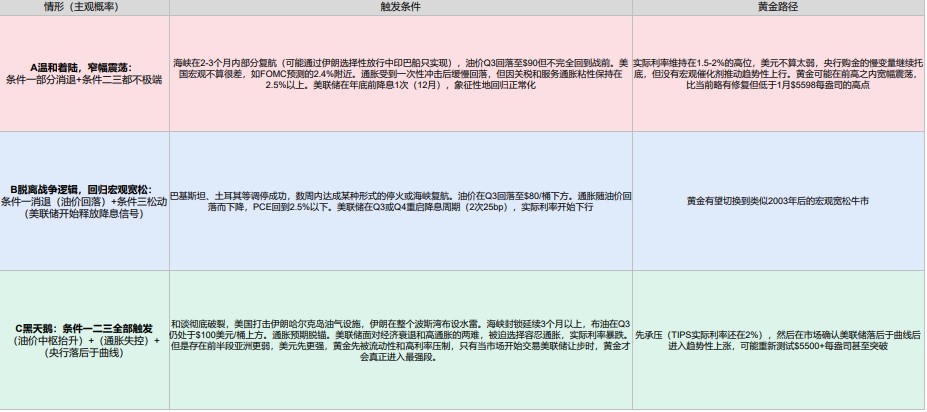
The report breaks down the subsequent scenarios into three paths:
-
A: Soft Landing, Narrow Oscillation— The strait partially reopens within 2-3 months, oil prices fall back to around $90/barrel but do not fully return to pre-war levels; inflation slowly declines but remains above 2.5%; the Federal Reserve cuts rates once by year-end. This corresponds to gold experiencing high-level, wide-ranging oscillations, but remaining below the January high of $5598/ounce.
-
B: Escaping War Logic, Returning to Macro Easing— A ceasefire or reopening of the strait within weeks, oil prices falling below $80/barrel in Q3, PCE returning below 2.5%, and the Federal Reserve restarting rate cuts in Q3 or Q4 (two 25bp cuts). Gold might transition to a "macro easing bull market" similar to the post-2003 period.
-
C: Black Swan - Peace Talks Collapse, blockade of the strait continues for over 3 months, oil prices remain high, inflation expectations de-anchor, and the Federal Reserve is forced to tolerate inflation between recession and inflation, leading to lower real interest rates. The report specifically cautions that in the first half of this scenario, gold might first be suppressed by liquidity and high real interest rates, only entering its strongest phase after the market begins to price in "central bank concessions." The upside potential is theoretically the largest, possibly retesting $5500+/ounce or even breaking through.
The report's operational implications are rather restrained: in the short term (the next 1-2 months), it advises against chasing rallies on the right side on days of geopolitical news breaks, suggesting waiting for signals of a "shift in pricing power" such as a turning point in the gold-oil ratio, a pullback in TIPS, or an upturn in ETF inflows. It also offers a more trading-oriented observation range: if gold prices retrace to $4200-$4400/ounce and hold in an environment where oil prices are $100+/barrel, it becomes attractive for allocation.
On a longer time scale, it summarizes its conclusion into one sentence: whether gold can transition from a "safe haven" to a "trend" ultimately depends on whether the impact on the Strait of Hormuz escalates from a price issue to a quantity constraint, and whether the Federal Reserve moves from inaction to signaling rate cuts. The war is merely the starting point; macroeconomics will determine the final outcome.
