


Strait of Hormuz "Remains Blocked," "World's Most Important Spot Price" Surges to $147, Reaching an ATH (All-Time High)!
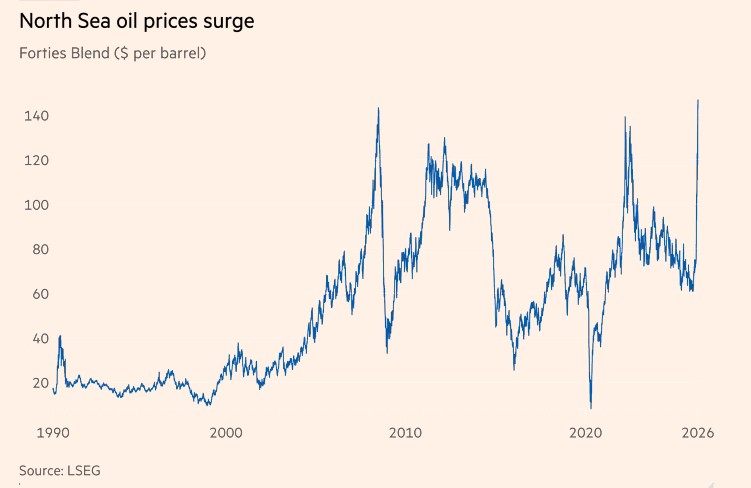
The North Sea spot oil price benchmark Forties Blend rose to nearly $147/barrel on Thursday, surpassing the peak seen before the 2008 financial crisis. Oil flow through the Strait of Hormuz has only recovered to 8% of normal levels, leading European and Asian refiners to scramble for spot supplies, which widened the spread between North Sea physical prices and Brent futures to over $30. Meanwhile, Saudi production capacity was damaged by 600,000 barrels per day, and a bypass pipeline was also attacked, intensifying the physical shortage
The ceasefire agreement failed to clear the key shipping lane, plunging the physical market into a supply crisis.
On Thursday, as European and Asian refiners scrambled to purchase North Sea spot crude, the North Sea spot oil price benchmark Forties Blend surged to nearly $147/barrel. According to LSEG data, this price has surpassed the historical high set on the eve of the 2008 financial crisis.
Meanwhile, the spread between North Sea spot prices and the Brent June futures contract (trading at $97/barrel) widened to over $30. This rare divergence directly reflects the market's deep panic over physical shortages.
According to a report released by Goldman Sachs to its clients, oil exports through the Strait of Hormuz have continued to decline recently, currently standing at only 8% of normal levels. Since the ceasefire agreement was announced, very few vessels have passed through the strait, and most are linked to Iran.
Rare Fracture in Market Liquidity
The rush for spot cargoes has spilled over into the derivatives market, causing structural anomalies.
According to traders, because the spread of Brent contracts for difference (CFD) — contracts that track the price difference between prompt and forward delivery — exceeded $30/barrel, surpassing the Intercontinental Exchange (ICE) threshold, the Brent CFD contracts for next week can no longer be traded normally. ICE, the main exchange for European oil trading, did not respond to requests for comment.
Brent CFDs are widely used by the market to hedge against the risk of rising oil prices. Several market participants stated they do not recall a time when Brent CFDs were untradable, and some trades have been forced into the over-the-counter (OTC) market.
Helima Croft, head of global commodity strategy at RBC Capital Markets, called futures market prices a "lagging indicator of the physical market reality in Middle East waterways."
Physical Market: Shortage Is Already a Reality
The core of this crisis is not just rising prices, but the disruption of physical supply.
Amos Hochstein, an energy advisor to former U.S. President Biden, warned: "If this situation continues for a few more days, the market may conclude that the Strait of Hormuz is closed indefinitely, which would not only drive up prices but could also trigger a crisis in Asia."
He further pointed out: "This is not just a problem of high oil prices; it is a real physical shortage that is occurring."
Asia is particularly vulnerable to this — approximately 80% of its required oil and petroleum products must be transported through the Strait of Hormuz.
Dennis Kissler, senior vice president of trading at BOK Financial, stated that the tight supply in the physical market "will continue until ships are once again passing through the Strait of Hormuz." He added: "Even if the strait opens, it will take 20 days to correct logistical issues; until then, the physical market will remain tight."
Saudi Capacity Damaged, Another Bypass Route Also Disrupted
Supply pressure does not only come from the blockade of the strait.
Saudi Arabia disclosed on Thursday that recent attacks on its energy infrastructure have led to a production decline of approximately 600,000 barrels per day (bpd). The damaged fields include Khurais and Manifa, representing about 5% of Saudi Arabia's normal capacity of 12 million bpd.
More critically, the Saudi East-West Pipeline — an alternative route specifically designed to bypass the Strait of Hormuz — was attacked this week, resulting in a loss of throughput of about 700,000 bpd. This means the "backup export route" that the market had pinned its hopes on has also been blocked.
Ceasefire Agreement Pending, Negotiations Yet to Start
Although a two-week ceasefire agreement between the U.S. and Iran was announced this Tuesday, the situation is far from stable. Within hours of the ceasefire being reached, Iran once again halted tanker passage.
Iranian Foreign Minister Abbas Araghchi stated on Thursday during a call with Saudi Foreign Minister Prince Faisal bin Farhan that Iran has not yet entered into direct negotiations with the United States.
Trump said that day, "Soon, you're going to see oil start to flow," but at the same time criticized Iran for "doing a very poor job in allowing oil shipments through" and warned Tehran that it "better not" charge tolls for safe passage.
Trump is dispatching a delegation to Islamabad, including Vice President JD Vance, envoy Steve Witkoff, and his son-in-law Jared Kushner, with plans to hold talks this weekend.
