


Breakfast | US Stock Indices Hit Largest Short Squeeze Since 2020, Fueled by US-Iran Ceasefire!
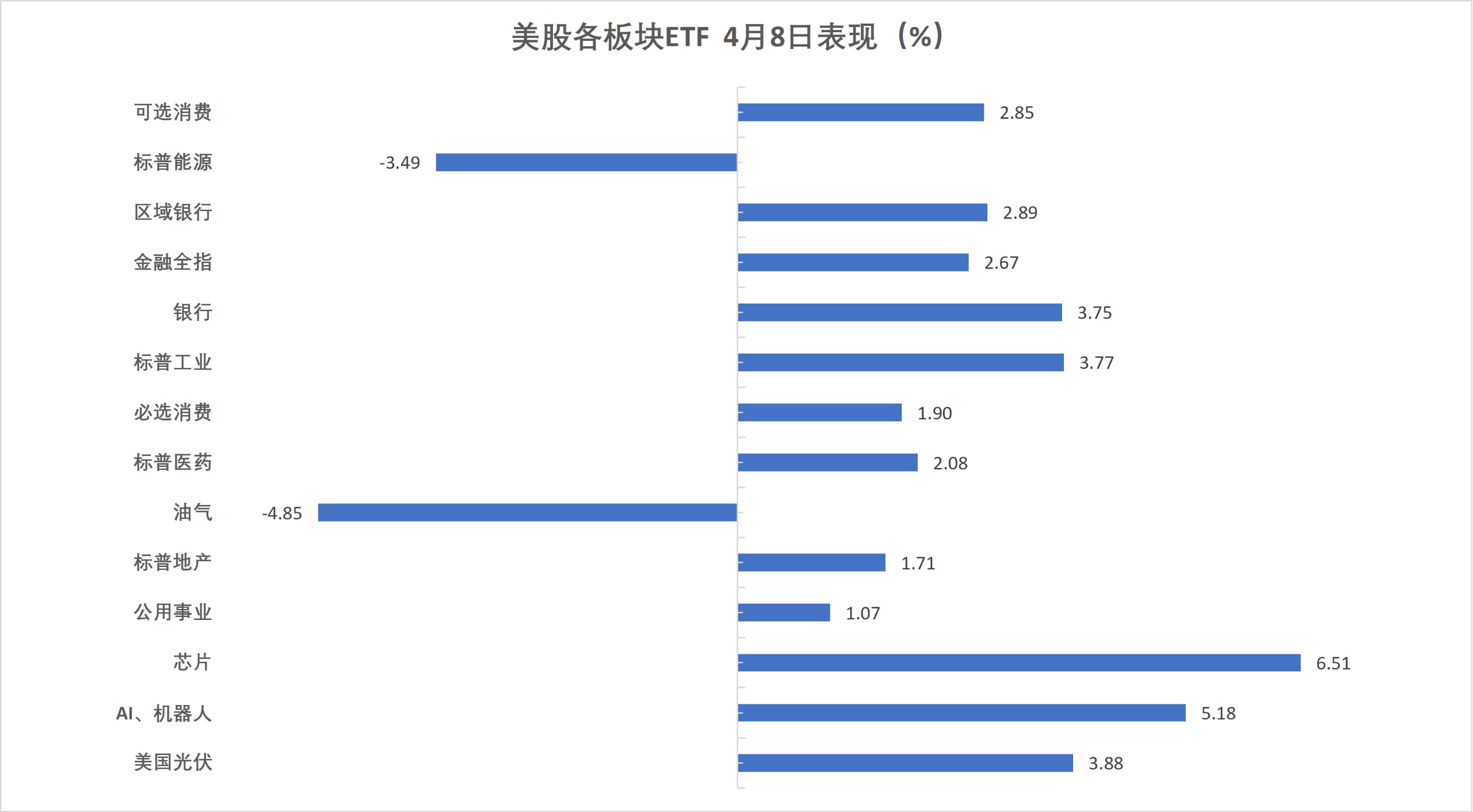
The three major US stock indices rose more than 2%, with the S&P 500 rising for the sixth consecutive trading day, marking the longest streak since September last year, and more than 400 stocks advanced. The Nasdaq surged 2.8%. Meta once rose 9.5%, while Tesla fell about 1%. The Philadelphia Semiconductor Index rose more than 6.3%, hitting a new historical high. SanDisk soared nearly 10% to a new high. Intel surged over 11%
Market Overview
Boosted by the US-Iran ceasefire, US stock indices saw the largest short squeeze since 2020, and European stocks recorded their largest gains since 2022.
Major US stock indices rose more than 2%, with the S&P 500 advancing for the sixth consecutive trading day, the longest rally since September last year, and over 400 stocks gaining ground. The Nasdaq surged 2.8%. Meta once jumped 9.5%, while Tesla dropped about 1%. The Philadelphia Semiconductor Index climbed over 6.3%, reaching a new all-time high. SanDisk soared nearly 10% to a new high. Intel surged over 11%. Airline and cruise line stocks experienced significant gains.
Global government bond yields plummeted in early trading, with 10-year yields in several European countries falling by double-digit basis points. However, during the US session, as market sentiment cooled and demand for US Treasury auctions declined, US Treasury yields rebounded. The 10-year US Treasury yield closed roughly flat, while the 30-year US Treasury yield even edged up by 1.2 basis points.
The dollar plummeted nearly 0.7% in a single day, erasing its gains for the year. The offshore yuan surged by over 200 points in a single day, reaching a nearly three-year high. Bitcoin rose 3%, briefly approaching $73,000 intraday, while Ethereum gained 5%.
Spot gold briefly surged over 3% before gradually retreating, ultimately closing with a slight gain of 0.3% from the previous day's close. Silver also experienced a rally and pullback, finishing up 1.5%. WTI crude oil futures fell over 16%, marking the largest daily drop since the COVID-19 pandemic impact in 2020.
During the Asian session, the ChiNext index surged by nearly 6%, with technology stocks broadly rallying. The yuan reached a three-year high, the Hang Seng Tech Index soared over 5%, and oil and gas stocks collectively declined.
Key News
China
Trump believes China is pushing for Iran's involvement in ceasefire negotiations; Ministry of Foreign Affairs responds.
Zhipu AI raises prices again by 10% and releases GLM-5.1, boosting its stock price.
A mysterious "Happy Horse" has landed and topped the charts, crushing Seedance 2.0, signaling another shift in video AI.
Overseas
After Lebanon was attacked, the Strait of Hormuz was reportedly closed again. Iran is said to be charging "transit fees" and limiting passage. The White House stated that Trump opposes the fees. Iran claims that ceasefire and other armistice terms for Lebanon have been violated, undermining the "basis for negotiation." Trump said the ceasefire does not include Lebanon. The White House announced that the first round of US-Iran talks will be held in Pakistan on the 11th, and Iran's initial "10-point plan" was rejected. Iran stated that it will only negotiate with the US if Lebanon's ceasefire is respected.
Federal Reserve Meeting Minutes: The Iran war poses dual risks; many officials are concerned about rising inflation or potential interest rate hikes. "The New York Times": Regardless of whether a ceasefire agreement is reached, the prospect of Fed rate cuts remains dim.
Anthropic's new disruption arrives! Claude management agents boost building and deployment speed tenfold.
Meta releases its first major AI model, Muse Spark, with its stock price once rising 9.5%.
Market Close
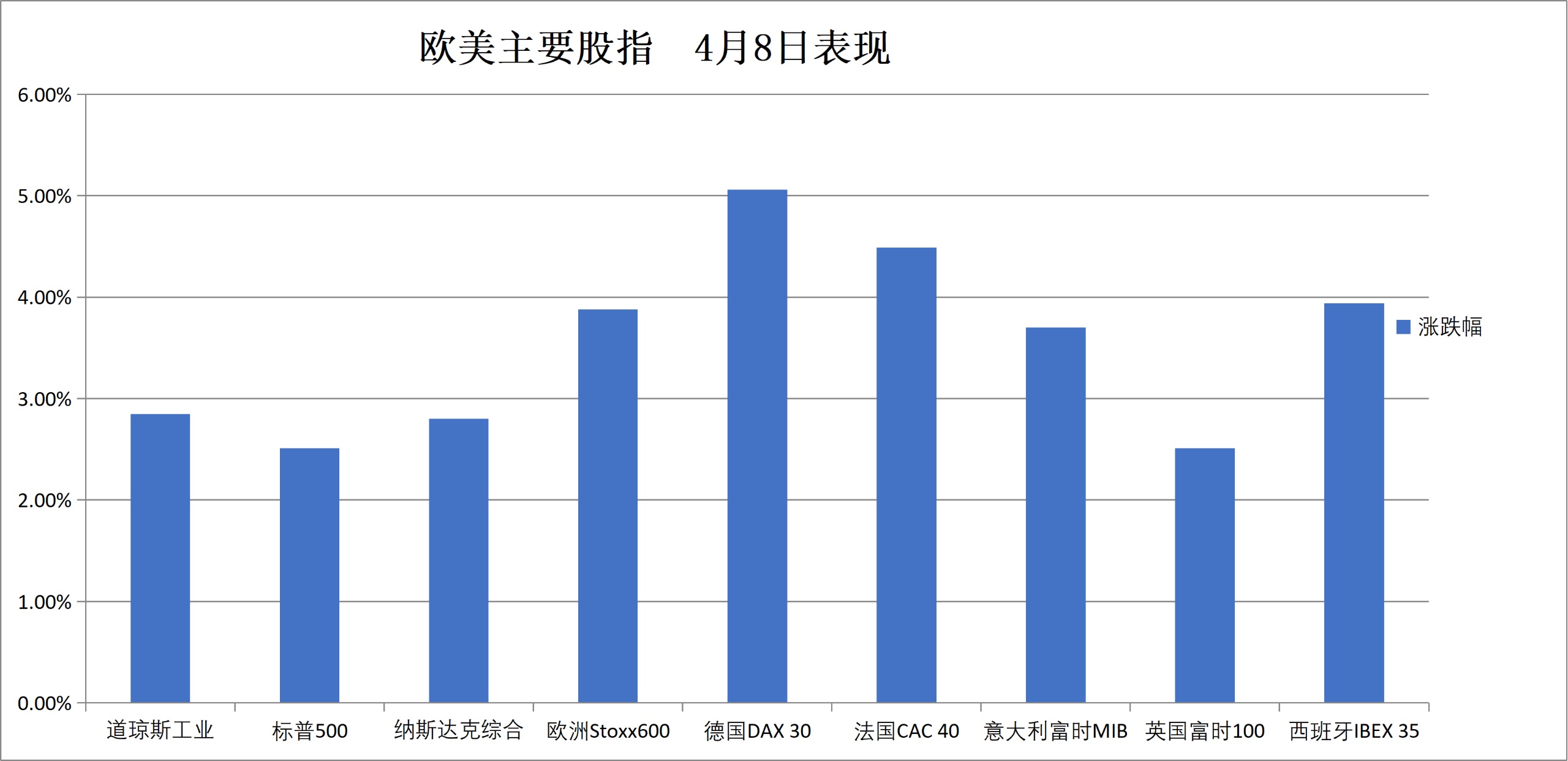
European and US Stocks: The S&P 500 index closed at 6782.81 points, up 165.96 points or 2.51%. The Dow Jones Industrial Average rose 2.85% to 47909.92 points. The Nasdaq Composite Index gained 2.80% to 22634.995 points. The European STOXX 600 index closed up 3.88% at 613.50 points.
A-shares: The Shanghai Composite Index closed at 3995.00 points, up 2.69%. The Shenzhen Component Index closed at 14042.50 points, up 4.79%. The ChiNext Index closed at 3347.61 points, up 5.91%.
Bond Market: The yield on the US 10-year Treasury note fell 0.98 basis points to 4.2831%. The yield on the US 2-year Treasury note fell 0.43 basis points to 3.7834%.
Commodities: WTI crude oil futures for May delivery closed down 16.41% at $94.41 per barrel. Brent crude oil futures for June delivery closed down 13.29% at $94.75 per barrel. Spot gold rose 0.27% to $4719.21 per ounce, after an intraday surge and pullback. Spot silver rose 1.56% to $74.1444 per ounce.
Detailed News
Global Highlights
China
Trump believes China is pushing for Iran's involvement in ceasefire negotiations; Ministry of Foreign Affairs responds. Mao Ning stated that since the outbreak of the Iran conflict, China has been actively committed to promoting peace and stopping the war. Foreign Minister Wang Yi has held 26 calls with foreign ministers of relevant countries, the Chinese government's special envoy for Middle East affairs has visited the Middle East and Gulf region, and China and Pakistan have jointly proposed a "Five-Point Initiative on Restoring Peace and Stability in the Gulf and Middle East Region."
Zhipu AI raises prices again by 10% and releases GLM-5.1, boosting its stock price! Zhipu AI officially released its new generation open-source model GLM-5.1 this week. Concurrently, the model aggregation platform OpenRouter shows that Zhipu GLM has further increased its prices by 10%, with cloud-based call prices increasing by 8% to 17% compared to the previous version, GLM-5 Turbo. This is at least the second price increase for the company since 2026. The news boosted market sentiment, with Zhipu's stock price soaring nearly 19% intraday.
Mysterious "Happy Horse" has landed and topped the charts, crushing Seedance 2.0, signaling another shift in video AI? The mysterious video model HappyHorse-1.0 has unexpectedly taken the top spot on the Artificial Analysis leaderboard, significantly outperforming products like Seedance 2.0 and sparking heated discussions. Its origin is unclear, with speculation pointing to an optimized version based on daVinci-MagiHuman, or possibly related to Alibaba. More importantly, open-source models are rapidly approaching the level of closed-source ones, potentially altering the industry landscape.
"Resigned colleague was refined and became digitally immortal". According to The Paper, a company in Shandong attempted to train a resigned employee into an AI digital clone to continue working. This digital clone can currently only handle simple tasks such as inquiries and creating spreadsheets; it is essentially prompt engineering and lacks memory and professional judgment. Netizens' anxiety stems from the "uncanny valley" effect and concerns about personal data being "distilled." The workplace is already being reshaped: AI will not replace your job, but "people who use AI" will. Reshaping yourself is not about turning yourself into data, but about becoming someone who cannot be defined by data.
Overseas
After Lebanon was attacked, the Strait of Hormuz was reportedly closed again. Iran is said to be charging "transit fees" and limiting passage. The White House stated that Trump opposes the fees. Iranian media reported that in response to Israeli attacks on Lebanon, Iran closed shipping in the strait, forcing oil tankers to turn back. The White House stated that Trump made it clear that a prerequisite for a ceasefire is that no transit fees will be charged for the strait. Reports indicate that Iran will charge $1 per barrel of oil, settled in Bitcoin; Iran informed mediators that it will limit the passage of ships through the strait to 12 per day. Service provider data shows that the first two ships to pass through the Strait of Hormuz after the ceasefire agreement announcement were carrying dry bulk cargo, not oil. Maersk stated it will not resume Hormuz routes for now; Hyundai Motor has rerouted its vessels around the Cape of Good Hope.
Iran claims that ceasefire and other armistice terms for Lebanon have been violated, undermining the "basis for negotiation." Trump says the ceasefire does not include Lebanon, Vance says it was never promised to include it. According to the Speaker of the Iranian Parliament, the violated Iranian ten-point plan also involves drone intrusions and uranium enrichment rights. Vance will lead a delegation to meet with Iran, stating that Iran misunderstood and thought the ceasefire agreement covered Lebanon, which the US never promised. Reports suggest that if Israel continues to attack Lebanon, Iran will consider withdrawing from the ceasefire; Iran is prepared to launch "deterrent actions" against Israeli military positions. The Iranian military stated that Israel must immediately stop attacking Lebanon, or it will face "heavy retaliation"; the US and Israel have "yielded" to Iran's ceasefire terms and are prepared to deal with a more intense, longer, and broader war. Trump reportedly does not oppose Israel confronting Hezbollah in Lebanon; the US Secretary of Defense threatened to seize Iranian enriched uranium. The Israeli Prime Minister stated that the temporary ceasefire is not the end of the war and that Israel is ready to return to the battlefield at any time. The Israeli military claims to have launched its largest air raid since the start of the current conflict in Lebanon. Lebanon reported that the air strikes resulted in hundreds of deaths and injuries, strongly condemning the "barbaric" actions.
The White House announced that the first round of US-Iran talks will be held in Pakistan on the 11th, and Iran's initial "10-point plan" was rejected. Iran stated that it will only negotiate with the US if Lebanon's ceasefire is respected. The White House announced that the negotiation team will be led by US Vice President Vance, and will include Middle East Envoy Wittekov and Trump's son-in-law Kushner. The US-accepted basis for negotiation is not the currently circulated "10-point plan" but a completely different revised and simplified Iranian proposal; the US insists that "Iran must not conduct uranium enrichment on its own territory."
Trump: Proposes joint management of the Strait of Hormuz by the US and Iran, threatens to impose a 50% tariff on countries supplying arms to Iran. According to CCTV News, Trump stated that the US might seek to establish a "joint project" with Iran to ensure the security of the Strait of Hormuz. Trump also said that any country supplying military weapons to Iran will have "any and all goods" sold to the US "immediately subject to a 50% tariff," adding that the measure would "take effect immediately" with "no exclusions or exemptions."
Trump: The Hormuz Strait will create "huge wealth," and most terms in Iran's proposal have been fully agreed upon. Trump's side stated that a long-term agreement on the Iran issue has a "strong framework" and insisted that any peace agreement would cover nuclear materials. He also said that most terms in Iran's proposal have been fully agreed upon. Trump refused to disclose whether he would restart previous threats if the agreement breaks down. Iran, on the other hand, stated that it has submitted ten ceasefire terms to the US, explicitly including the acceptance of Iran's uranium enrichment activities. This still shows a clear difference from Trump's emphasis on nuclear materials.
Iran claims the US has agreed in principle to fulfill eight obligations; if the US does not accept the "ten-point plan," the ceasefire agreement will be invalid. Iran's Supreme National Security Council stated that the US has agreed in principle to eight obligations, including stopping military actions, accepting Iran's uranium enrichment, lifting comprehensive sanctions, and paying compensation. However, Iranian officials stated that if the US does not accept the ten-point plan, the Supreme Leader will not approve the ceasefire agreement. Trump, on the other hand, said that most terms in Iran's proposal have been agreed upon. Iran will be led by Speaker Qalibaf in the negotiations, while the US side will be led by Vice President Vance.
Ceasefire agreement barely dry, Saudi oil pipeline hit by drone attack, Middle East situation tensions again. The attacked facility was a pumping station along Saudi Arabia's east-west oil pipeline. This pipeline has become the economic lifeline for Saudi energy exports, especially with shipping in the Strait of Hormuz nearly closed. Meanwhile, the UAE, Kuwait, and Bahrain all reported continued attacks hours after the ceasefire announcement.
Energy Chokehold "Thaws"! Qatar LNG Giant Resumes Maintenance, Production May Resume in Days. Following the Middle East ceasefire agreement, Qatar's Ras Laffan, the world's largest liquefied natural gas facility, is preparing to restart, with some production possibly resuming within the next few days, although the speed of capacity ramp-up remains unclear. Notably, any large-scale output recovery depends on ships being able to pass smoothly through the Strait of Hormuz.
Federal Reserve Meeting Minutes: The Iran war poses dual risks; many officials are concerned about rising inflation or potential interest rate hikes. The Fed minutes show that an increasing number of Fed officials are concerned that the Iran war could further fuel inflation and want to make it clear that the Fed might have to consider raising interest rates. Most officials worried that a prolonged war would harm the labor market, necessitating interest rate cuts, while many policymakers emphasized inflation risks, believing this could ultimately require rate hikes. Officials more concerned about inflation urged others to consider adding language to post-meeting statements about the possibility of rate hikes under certain circumstances.
"The New York Times": Regardless of whether a ceasefire agreement is reached, the prospect of Fed rate cuts remains dim. Nick Timiraos stated that a US-Iran ceasefire might simply trade one problem for another for the Fed: an energy shock that lasts just long enough to push up inflation but not so severely as to damage demand, leading to interest rates remaining unchanged for a long time. If the risk of the Iran conflict pushing the economy into recession is the strongest reason to resume rate cuts, then the end of the war might actually make it harder for the Fed to ease policy in the short term; meanwhile, a ceasefire also reduces the possibility of the Fed raising rates.
Anthropic's new disruption arrives! Claude management agents boost building and deployment speed tenfold. Claude management agents are a suite of composable APIs and a fully managed operating environment, freeing developers from handling underlying infrastructure. It enables AI to perform long-term tasks. Anthropic emphasizes that agents not only call models but are systems that can run continuously, make multi-step decisions, call external tools, and automatically correct errors and retry.
A 15 billion bet finally pays off? Meta releases its first major AI model, Muse Spark. Muse Spark is the first model released by Meta since establishing its "Superintelligence Lab" and the first model since Alex Wang, former CEO of Scale AI, took charge of the team last year. It shifts Meta's approach from open-source to closed-source. It focuses on being small and fast, and will be directly embedded in social media platforms like Facebook, with a focus on AI shopping assistants. Meta admits that some of its capabilities are not as advanced as models like ChatGPT, positioning it as a starting point model. Meta's stock price once rose 9.5%.
Dell CEO: AI memory demand will surge 625 times, supply shortages will last for years. Dell Technologies CEO Michael Dell made a startling prediction: the AI wave will drive a 625-fold increase in global memory demand—a 25-fold expansion in per-machine memory capacity coupled with a 25-fold increase in deployment scale. Catching up on the supply side will take years. The construction of sovereign AI and enterprise upgrades form a dual demand engine. He succinctly defined the current market divergence: it's not a question of "whether to buy," but "when to buy."
Research Highlights
In-depth Feature: How Did Trump "Drag" the US into the Iran War? Netanyahu "pitched" a quick victory in the White House Situation Room, the CIA directly called the plan "absurd," and Vice President Vance's efforts were in vain—Trump finally approved on Air Force One, with only 22 minutes to the deadline: "Operation Epic Fire is approved and cannot be stopped." A war that would reshape the Middle East had begun.
- Trump's Last-Minute TACO: Intermediaries relay messages back and forth, proposal modified multiple times in one day, Iranian high command finally approves, chaos behind the scenes. The US-Iran ceasefire was reached after a thrilling diplomatic game. Pakistan, Turkey, and Egypt shuttled to mediate, and the draft was revised several times in a day. It was only after a note from Iran's Supreme Leader Khamenei, who rarely appears in public, that a breakthrough occurred. Ironically, until the official announcement, White House staff and the Pentagon were still in a state of wartime confusion due to Trump's extreme pressure remarks. This extremely chaotic and secretive game has temporarily put a pause on the war.
Ray Dalio's Latest Long Article: "World War Has Begun," Probability of Outbreak Within Five Years Exceeds 50%. Bridgewater Associates founder Ray Dalio issued a new warning: the US-Israel-Iran conflict is not an isolated incident but part of a larger world war, with a probability of conflict outbreak exceeding 50% within the next five years. He cited a 500-year historical cycle, pointing out that the current situation is highly similar to 1913 and 1938, and is at a critical transition point from "pre-war" to "in-war"—conflicts typically escalate rather than de-escalate.
Goldman Sachs Trading Head: Why I Chose Not to Chase the Rally Amidst a Plunging Index? Goldman Sachs Delta-One business head Rich Privorotsky believes that if oil prices remain above pre-war levels, this rally is more of a technical rebound from short-covering rather than a trend worth chasing. The fragility of the ceasefire agreement and Iran's ambiguous statements on controlling passage through the strait pose potential risks. The ultimate arbiter for the market is the actual tanker traffic in the Strait of Hormuz, and this data will take time to verify.
Super-bull Tom Lee: Ceasefire Means US Stocks "Bottomed Out" and Could See a "Decisive" Rebound. Tom Lee believes that the achievement of the US-Iran ceasefire agreement eliminates the possibility of large-scale bombing operations, signaling that US stocks have "bottomed out." If the S&P 500 can reclaim its 200-day moving average, the market is highly likely to see a "decisive upward breakout."
Replacing Gas Turbines, Is the Preferred Answer for AI Power Gas Generator Sets? HSBC believes that gas generator sets, with their short delivery times, quick startup, and flexibility, are rapidly replacing gas turbines as the preferred transitional primary power source for AI data centers. Leading manufacturers' orders are filled through the end of 2027, and supply shortages are expected to continue through 2027-2028, with equipment prices still increasing by 10% to 15% annually during this period.
Domestic Companies
China's First Browser "Lobster" Launched, Free to Use with WeChat Scan. Tencent Cloud has released China's first browser intelligent agent, "Lobster" QBotClaw, which users can access for free by scanning a WeChat QR code. The tool supports file operations, browser automation, and other capabilities, enabling tasks such as price comparisons and content posting across multiple platforms. QBotClaw is compatible with OpenClaw skills and supports configuration of mainstream large model API keys, marking an acceleration in the implementation of low-threshold AI automation applications.
Over 100 Institutions Eyeing a Quantum Computing Company. The quantum computing sector is experiencing an unprecedented capital frenzy—total financing in Q1 2026 has already surpassed that of all of 2025. Liangyi Wansheng, incubated by Tsinghua University's atomic quantum computing team, secured an A-round financing of hundreds of millions of yuan within its first year of establishment. Shunwei Capital, iFlytek, and others are all involved, with a hundred institutions vying for shares. From complete machine development to quantum intelligence integration, this company's full industry chain ambition might be the best indicator of capital betting on the "eve of an explosion" in quantum computing.
The Battle for "Thousands of Sails" Constellation: The Bottleneck of Satellite Networking. China's satellite internet constellation, "Thousands of Sails," completed its first constellation launch this year, with a total of 126 satellites in orbit. This is still far from the goal of building a 15,000-satellite constellation by 2030. The biggest obstacle ahead is not technology but a severe shortage of commercial rockets—slow production capacity ramp-up, limited national resources, and increasingly stringent launch approval processes.
China Aluminum Q1 Net Profit Expected to Increase by 50% to 58% Year-on-Year, a Historical Best for the Period. China Aluminum expects its net profit attributable to the parent company in the first quarter of 2026 to reach 5.302 to 5.585 billion yuan, a year-on-year increase of 50% to 58%, marking a historical best for the same period. The profit is mainly driven by the core business, with a corresponding increase in non-recurring net profit. The substantial improvement in performance is attributed to three core factors: the marginal cost reduction from full production capacity, increased self-procurement ratio enhancing raw material bargaining power, and refined cost reduction management through full industry chain synergy.
Overseas Macro
ECB Rate Hike Expectations "Cool Down Overnight"! Ceasefire Agreement Boosts Market, European Bonds See Largest Single-Day Gain Since 2023. Following the US-Iran ceasefire agreement, oil prices plummeted, quickly easing market concerns about inflation. Traders rapidly reduced rate hike bets, removing one 25-basis point rate hike expectation each from the European Central Bank and the Bank of England. European bond markets recorded their largest single-day gains since 2023. However, analysts point out that the ceasefire is "time-limited and fragile," and the sustainability of the rebound is in question.
Overseas Companies
SpaceX IPO Countdown: The Most Expensive IPO in History is Coming, and This Time Retail Investors Are Also at the Table. SpaceX's listing is officially entering its final countdown, expected to go public in June, with an estimated valuation of $1.75 trillion to $2 trillion, potentially becoming the largest IPO in history. The biggest highlight of this offering is that retail investor allocations can reach up to 30%, far exceeding industry norms. The market is watching whether its multiple business narratives can support its valuation and whether the listing of this giant will squeeze the financing space for other companies.
Today's News Preview
China's March financial data.
The 14th China Electronics Information Expo opens.
US Q4 real GDP.
US February Core PCE Price Index, Personal Income, Consumer Spending.
US Initial jobless claims last week.
