


ECB Rate Hike Expectations Cool "Overnight"! Ceasefire Agreement Boosts Market, European Bonds See Largest Single-Day Rally Since 2023
Following a ceasefire agreement between the US and Iran, oil prices plummeted, quickly easing market concerns about inflation. Traders rapidly scaled back rate hike bets, leading to the removal of one 25 basis point rate hike expectation for both the European Central Bank and the Bank of England. The European bond market recorded its largest single-day rally since 2023. However, analysts point out that the ceasefire is "time-limited and fragile," raising doubts about the sustainability of the rebound
The ceasefire agreement between the US and Iran triggered a chain reaction, causing oil prices to plunge 13% in a single day. The European bond market experienced its strongest single-day rally in over two years, and market bets on interest rate hikes by the European Central Bank and the Bank of England narrowed significantly.
Late on Tuesday, the United States and Iran reached a two-week ceasefire agreement, which will reopen the Strait of Hormuz to shipping. Following the news, Brent crude oil plummeted 13% on Wednesday, falling to approximately $95 per barrel, a nearly one-month low.
The sharp drop in oil prices quickly alleviated market concerns about the inflationary impact on the global economy. Traders rapidly scaled back their rate hike bets earlier in the day, with expectations for one 25 basis point rate hike each being removed for the European Central Bank and the Bank of England.
This shift in expectations directly drove a significant strengthening of the European bond market. The yield on two-year UK government bonds fell by 24 basis points in a single day to 4.17%, and the yield on two-year German government bonds similarly dropped by 24 basis points to 2.49%, both marking the largest single-day volatility in over three years. Long-term bonds also rallied in tandem, with the overall gains being the strongest of 2023.
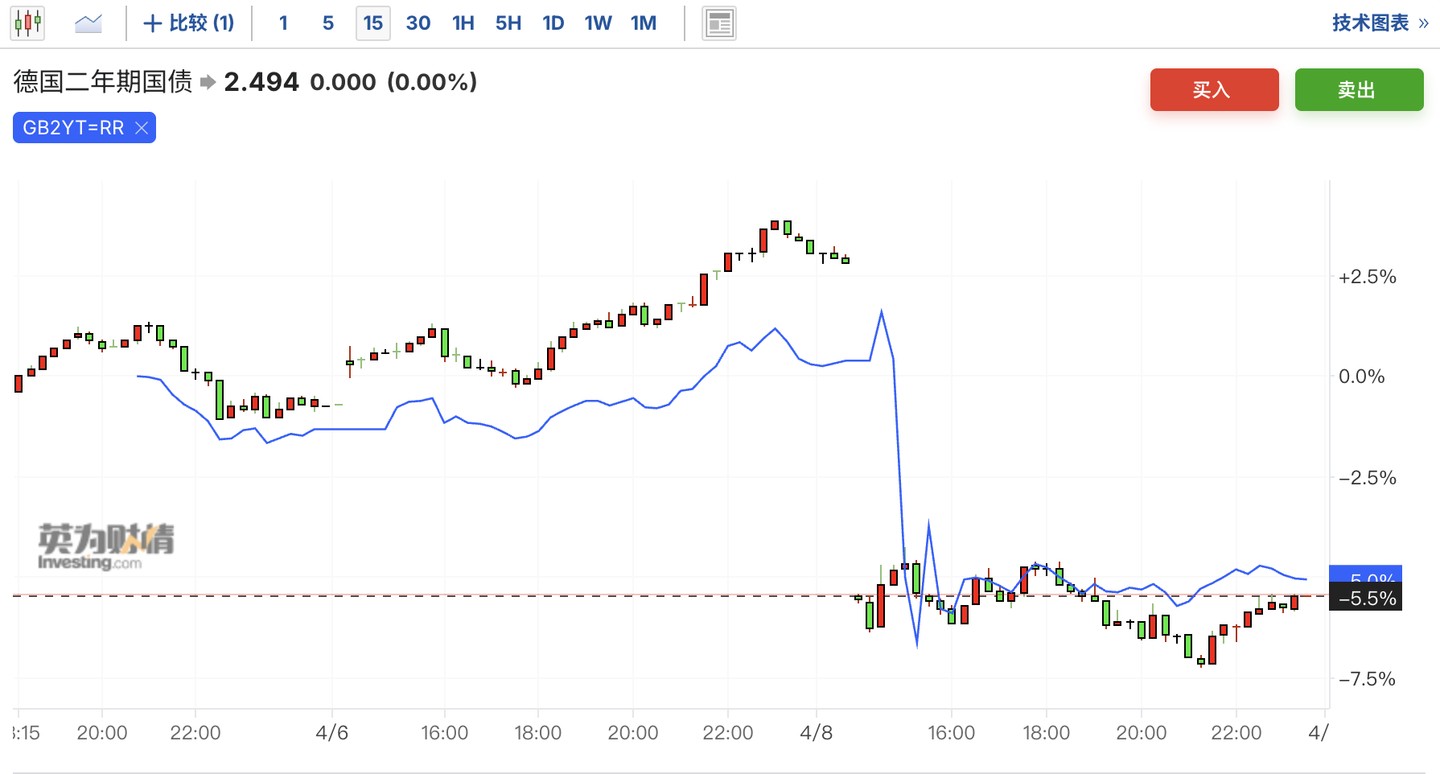
Rate Hike Expectations Plummet, Short-Term Bonds Lead Gains
Following the ceasefire agreement, interest rate expectations in the Eurozone and the UK saw a noticeable pullback. According to implied prices in the swap market, the European Central Bank's rate hike expectations for this year have fallen to two 25 basis point hikes, with the first expected no earlier than June. On Tuesday, the market was pricing in three rate hikes for the entire year.
For the Bank of England, the market currently expects only one rate hike this year, one less than on Tuesday, with the first rate hike now anticipated at the September meeting instead of the June meeting.
Short-term bonds, which are highly sensitive to interest rate expectations, showed particularly strong gains. Initially, at the outbreak of the conflict, short-term bonds suffered the most severe declines due to inflation fears driven by rising oil prices, especially in energy-importing economies like the UK and the Eurozone. With the recent retreat in oil prices, these bonds have been the first to record substantial rebounds.
Long-term bonds also performed strongly. The yield on 10-year UK government bonds fell by 21 basis points to 4.70% on Wednesday morning, and the yield on 10-year German government bonds dropped by 16 basis points to 2.92%, both marking the largest single-day decline since 2023. US Treasuries also strengthened in line, with the yield on 10-year US Treasury bonds falling by 11 basis points to 4.24%.
It is important to note that before the conflict broke out, the market had expected the Bank of England to cut rates twice this year, while the European Central Bank was expected to remain on hold. Current market pricing indicates that the rate hike expectations, which were pushed up due to geopolitical risks, have only been partially corrected, and the bond market as a whole has not yet returned to pre-conflict levels.
Analysts: Fragile Ceasefire, Sustainability of Rebound in Doubt
Several market participants expressed caution regarding the sustainability of this rebound.
Neil Shearing, Chief Group Economist at Capital Economics, stated, "If energy prices stabilize and economic growth turns out to be stronger than expected, central banks will be far less likely to implement the degree of tightening currently priced in by the market."
Altaf Kassam, Head of European Investment Strategy at State Street Investment Management, noted that the ceasefire is "time-limited and fragile," and the market needs to see "a sustained recovery in energy supply and follow-through on the political front" before pricing this rebound as a lasting turning point.
Mohit Kumar, Chief European Economist at Jefferies, echoed a similar sentiment, pointing out that "even if the strait reopens, it could take months for energy supplies to normalize." He added that due to a high dependence on imported energy, "Europe's situation will be more unfavorable than that of the United States from a macroeconomic perspective."
