Central Bank Gold Purchases: The End of an Era?
UBS noted that the structural trend of gold purchases by the official sector has not changed, and despite a slowdown in pace, central banks will remain net buyers of gold. As market concerns over the "low growth + high inflation" combination and geopolitical tensions intensify, the medium-to-long-term upward trend for gold is strengthening, with the year-end target price maintained at $5,600
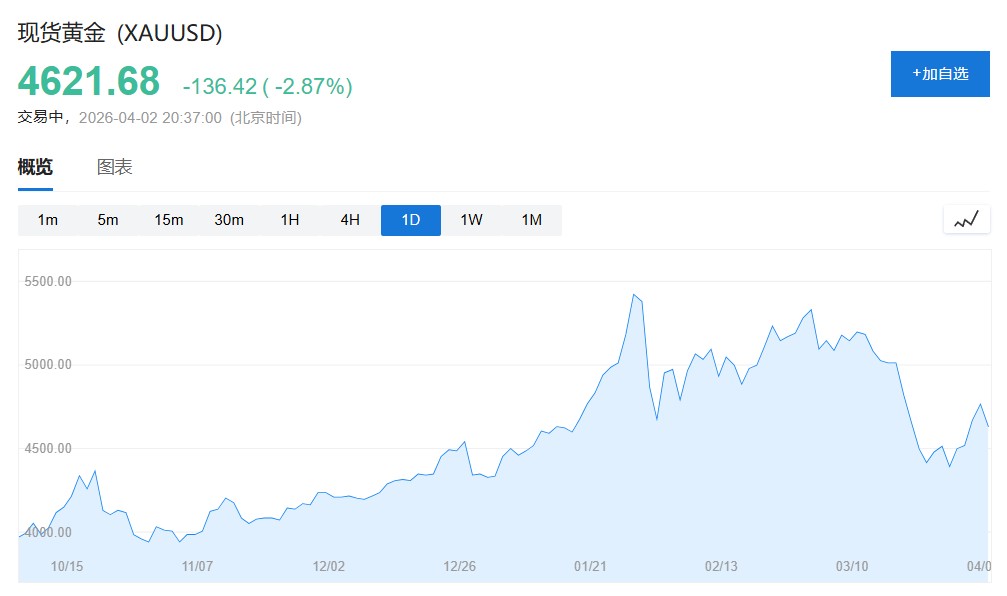
Since the deterioration of the situation in Iran, the gold market has experienced sharp volatility, with gold prices falling as much as 16% in March, and Turkey's commencement of gold sales has triggered strong market concerns over whether the "central bank gold buying trend" is reversing.

According to Chasing Wind Trading Desk, UBS's latest research report clearly states that the structural trend of gold purchases by the official sector has not changed, and central banks will remain net buyers of gold. Although high volatility in the short term has led strategic buyers to temporarily wait on the sidelines, strong demand from the Chinese market provides solid support for gold prices.
UBS believes that the current market correction is an excellent opportunity for investors to build strategic gold positions. As concerns about the "low growth + high inflation" combination and geopolitical tensions intensify, the medium-to-long-term upward trend for gold is strengthening. UBS expects the average gold price this year to reach $5,000 and maintains its year-end target price of $5,600.
From Buyers to Sellers? Central Bank Sell-off Panic Severely Exaggerated
The most pressing question for gold market participants is: are central banks selling gold? Especially given the potential for a prolonged conflict in the Middle East, the market fears that central banks will be forced to sell gold reserves to cope with surging inflation, slowing economic growth, and currency devaluation. This concern is considered the primary reason for the 16% drop in gold prices in March.
However, UBS believes that the possibility of a structural shift in the official sector is extremely low.
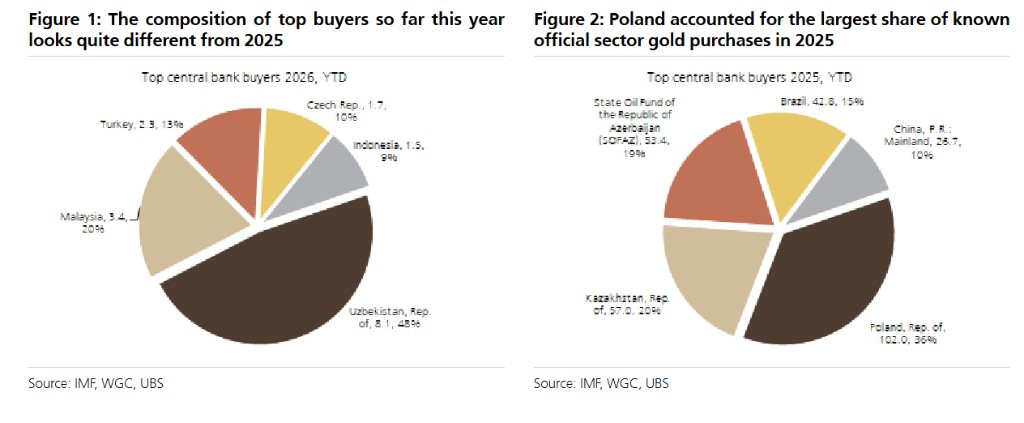
UBS expects central bank gold purchases to slow only gradually, with estimated purchases this year between 800 and 850 tons, slightly lower than the approximately 860 tons in 2025. In the process of accumulating gold reserves over the past fifteen years, it is normal for individual central banks to sell in certain months. This could be for tactical profit-taking at highly attractive entry levels or portfolio rebalancing triggered by rising gold prices.

The Truth Behind Turkey's 50-Ton Gold Sale
Recent news reports that the Central Bank of the Republic of Turkey (CBRT) sold approximately 50 tons of gold within a few weeks have drawn significant market attention. However, UBS strongly warns investors not to take these headlines at face value.
Turkey is unique in its use of gold as a policy tool. Since the introduction of the Reserve Option Mechanism (ROM) in 2011, part of the total gold holdings reported by the Turkish central bank actually represents positions of domestic commercial banks. Furthermore, part of the reported sell-off appears to be swap transactions rather than direct sales.
UBS noted that data currently able to decompose changes in Turkey's total gold holdings is lagging, and the market needs to wait for more detailed data to see the true trend.
Strategic Buyers Temporarily on the Sidelines, Chinese Demand Supports the Bottom
Since 2022, purchases by central banks and official institutions have been a major support for the gold bull market. However, recent market flows indicate that the official sector and long-term strategic investors have chosen to wait and see during the recent price correction.
The extreme uncertainty triggered by the Middle East conflict in early March, along with a sharp rise in U.S. real interest rates and a stronger dollar, put heavy pressure on gold prices, leading to a washout of long positions and short selling.
However, sustained healthy demand from China (with domestic prices maintaining a premium) helped limit the downside, stabilizing the market around $4,500. As expectations for Fed rate hikes reverse, gold prices are now gradually recovering toward $4,700.
Central Banks' Trump Card Exposed: Buy and Hold Remains the Absolute Mainstream
To address investor questions about how central banks manage their gold reserves, UBS cited the "Fifth Biennial Global Reserve Management Survey 2025" (covering 136 institutions) published by the World Bank late last year.
The data reveals the true logic of central bank gold management:
-
Lack of quantitative basis for decisions: Most central banks decide on gold holdings based on "legacy considerations" (approx. 47%) and "qualitative assessments" (approx. 26%), rather than quantitative portfolio optimization models. Only about a quarter of central banks include gold in a formal strategic asset allocation framework.
-
Very few short-term trades: In terms of investment style, as many as 62% of central banks adopt a "buy and hold" strategy. Crucially, only about 4.5% of central banks indicated they would make short-term tactical adjustments to their gold reserves.
-
Core drivers for increasing holdings: Among central banks reporting changes in gold reserves in 2024, more than half cited "diversification" as the strongest driver for increasing positions. Other major reasons include local gold purchase programs (approx. 35%) and geopolitical risks (approx. 32%). Only about 6% of central banks cited liquidity needs as a reason for changing positions.
Corrections are Opportunities for Strategic Position Building
While gold prices may face more consolidation and volatility in the coming weeks as the market continues to reassess geopolitical risks, UBS firmly believes that gold's long-term fundamentals remain strong.
Speculative positions are now quite clean, while long-term market participants remain under-invested.
UBS emphasizes that price corrections are opportunities to build strategic gold positions. Due to mark-to-market adjustments in the first quarter, UBS has fine-tuned this year's average annual gold price forecast from $5,200 to $5,000 but firmly maintains the year-end target price of $5,600 set in late January.