


Extreme Oil Prices vs. Extreme Volatility: Which Will Collapse First?
Oil prices saw their largest single-day gain since recent high-level consolidation, with implied daily volatility nearing 6%, potentially leading to a malfunction in market pricing mechanisms. JPMorgan believes oil prices may continue to rise. The short-term divergence between oil prices and the S&P 500 (inversely) has expanded to extreme levels; if this divergence corrects in a low-liquidity environment during the Easter holiday, market volatility could amplify again
Oil prices are dominating global market pricing at a pace rarely seen in recent years, with soaring implied volatility causing market pricing chaos. This intertwining of supply shocks and volatility crises is spreading to stock and interest rate markets. The question investors currently face is, "Can the market withstand an acceleration of short squeezes?"
Oil prices saw their largest single-day gain since recent high-level consolidation. Concurrently, the short end of the Brent crude option volatility curve has been heavily bought, with the market's implied daily volatility approaching 6%—a level typically associated with functional disorder.
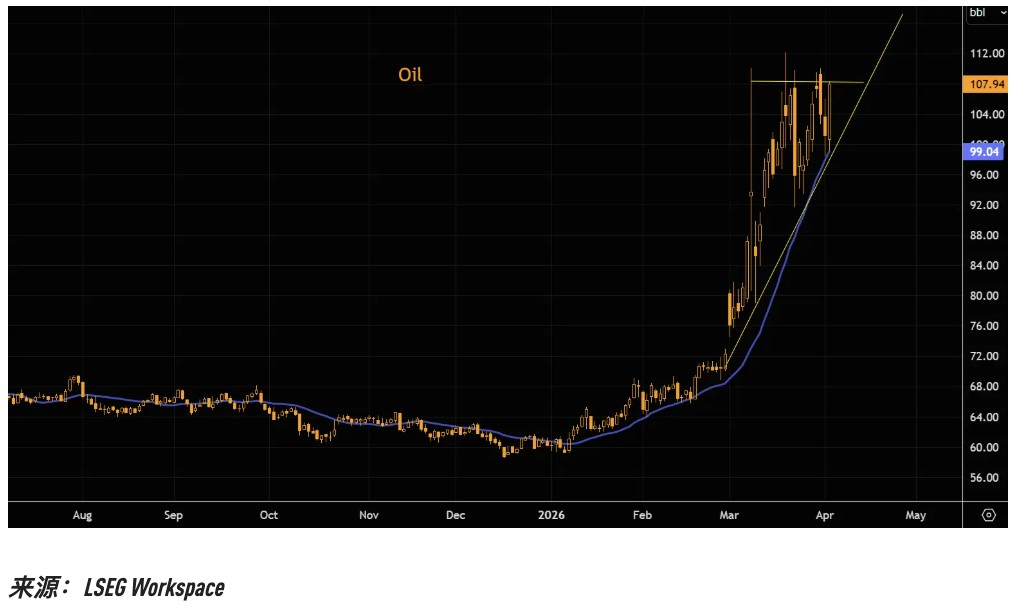
JPMorgan analyst Kaneva points out that there is currently an estimated "missing supply" of about 14.3 million barrels per day, while the market price of approximately $107 per barrel only implies about 11 million barrels per day of supply disruption, suggesting prices could still see further upward revision.
Meanwhile, Bank of America's bubble risk indicator has pushed Brent crude to its highest risk level, a signal that previously accurately captured the interim tops in silver, gold, and the Korean KOSPI index.
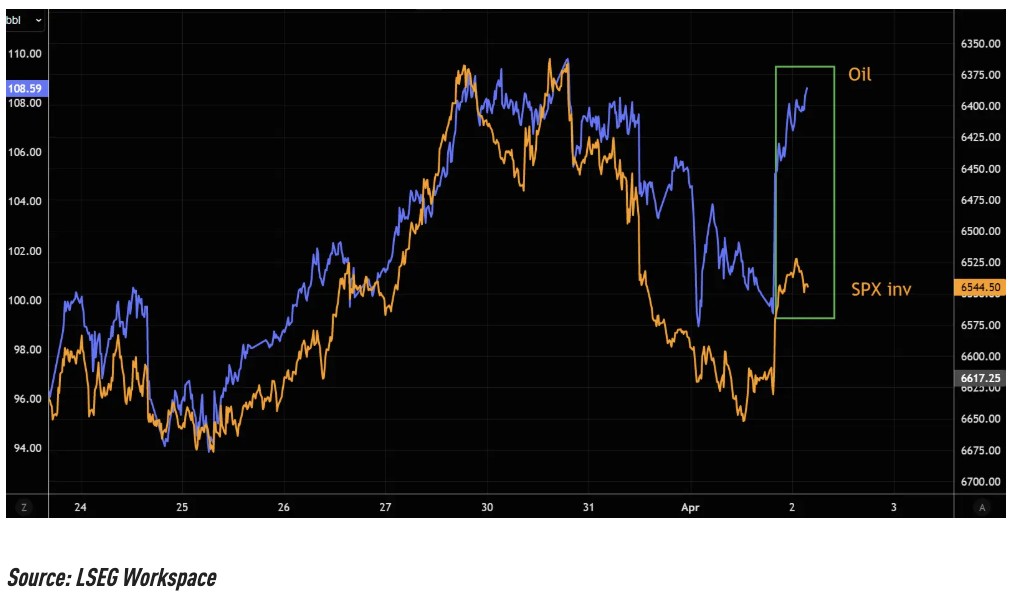
The short-term divergence between oil prices and the S&P 500 (inversely) has expanded to extreme levels; if this divergence corrects in a low-liquidity environment during the Easter holiday, market volatility could amplify again.
Supply Deficit Exceeds Geopolitical Premium: Oil Prices Still Face Upward Pressure
According to Kaneva's analysis, the market is currently facing an estimated "missing supply" of about 14.3 million barrels per day. The current market price of $107 per barrel implies a geopolitical premium of about $40, corresponding to a priced-in disruption volume of approximately 11 million barrels per day.
This gap suggests that if the market eventually converges to the full 14.3 million barrels per day deficit, oil prices still have room for further upward movement.
From a technical perspective, oil prices achieved a precise rebound at the intersection of a steep trendline and the 21-day moving average, forming the largest single-day rising candlestick in the consolidation phase. If the closing price rises slightly, the risk of further short squeezing will significantly increase.
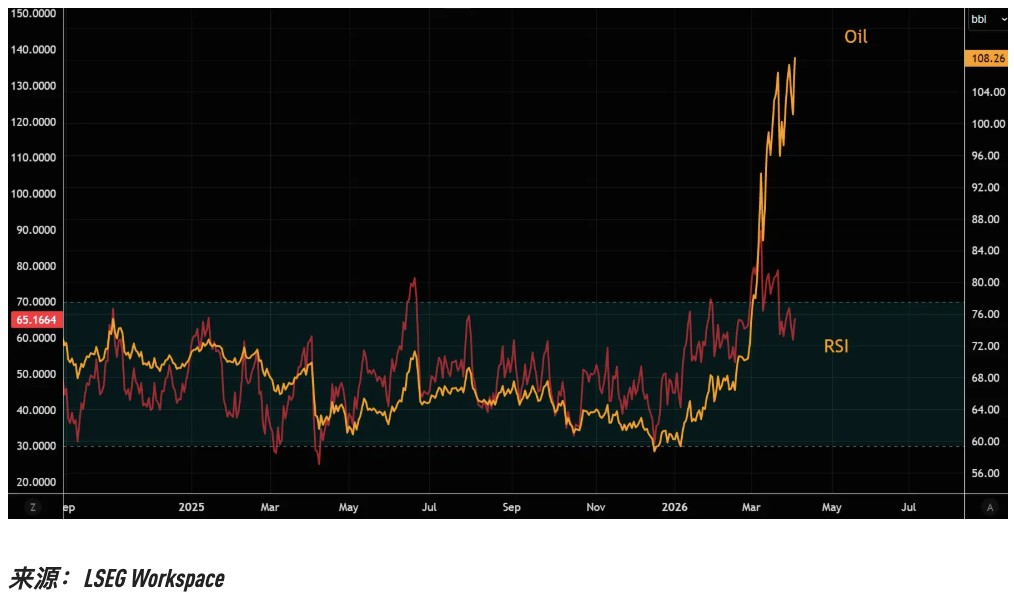
Notably, the RSI has retreated during the consolidation period and still has ample room for further overbought conditions in the short term, indicating no clear top signal on the technical front.
Volatility Disorder: What Scenario Is the Market Pricing In?
The structure of the Brent crude volatility curve is currently under extreme pressure, with the short end of the curve being strongly bought. The 25-delta call skew remains high, while the 25-delta put skew is relatively subdued.
This combination clearly outlines the market's directional bias: bulls are actively paying for upside tail risk, while demand for downside protection is noticeably neglected.
When the market's implied daily volatility reaches approximately 6%, functional disorder is a systemic normal reaction, not an anomaly. Volatility shocks are not digested overnight, and this state of disorder has clearly made investors uneasy.
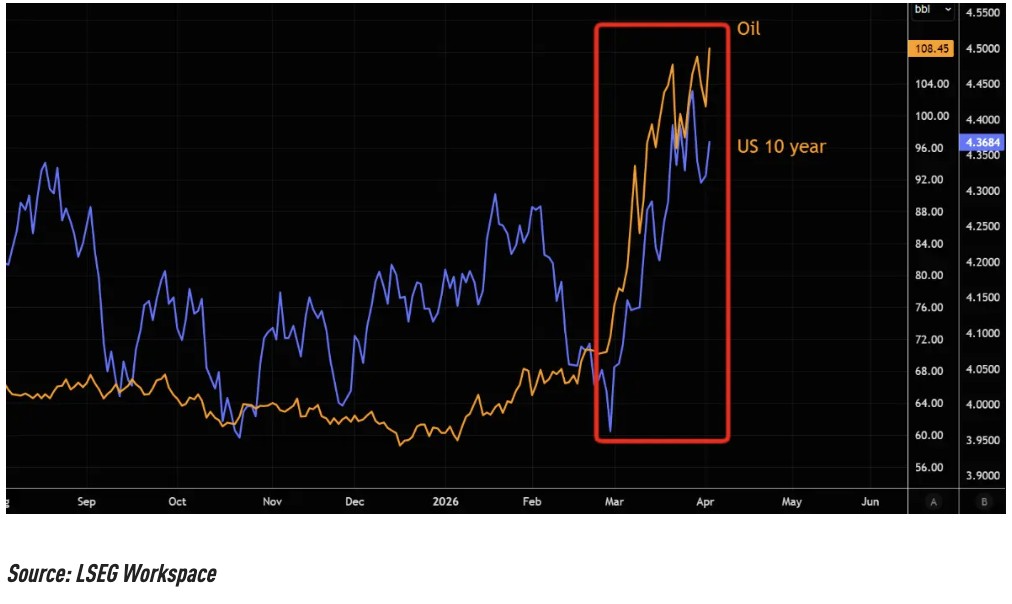
The interest rate market has also not escaped this situation. Amidst such strong oil price performance, the pressure on yields has not eased; instead, it has continued. This linkage further squeezes the breathing room for risk assets.
Bubble Signal Sounds: When Will the Reversal Come, and What Will Be Its Magnitude?
Bank of America's bubble risk indicator currently lists Brent crude as the highest-risk asset, a signal that has previously successfully marked the interim peaks in silver, gold, and the Korean KOSPI index.

Simultaneously, the short-term divergence between oil prices and the S&P 500 (inversely) has expanded to extreme levels. The market faces two possibilities:
First, the influence of oil prices as a core driver of stocks is weakening; Second, this divergence will close rapidly in the thin liquidity environment of the Easter holiday. The latter scenario implies greater immediate risk for equity investors.
This is no longer just an oil price rally. When volatility is under extreme pressure, it forces all other assets to reprice—often in a violent manner.
