


Approaching Recession Trades
Trump's pain has significantly intensified over the past month, market confidence is gradually eroding, and recession trades are beginning to dominate. Even if the war ends, crude oil supply chains cannot fully recover, and demand will contract, increasing the probability of a recession. The risk of oil prices spiking in the short term may negatively impact the US economy. Recently, four signs of recession trades have emerged, including oil prices not falling, US stocks playing catch-up in declines, interest rate hike expectations easing, and stagflation trades evolving into fundamental concerns. Risk warnings include uncertainty in Trump's military policies, the impact of energy shortages on demand, and inflation risks from a rapid pivot by global central banks
Key Content:
Trump's pain over the past month has significantly exceeded the levels of last year's tariff war – the issue is no longer whether Trump wants to end it, but how to end it; this has also become Trump's strategic weakness and the core reason for his proactive "showing weakness" over the past week.
After four weeks of "looking through the trade," market confidence is being depleted, and recession trades are gradually dominating. These are all based on a consensus: even if the war ends immediately, crude oil supply chains cannot be fully restored, and demand will inevitably contract correspondingly with the damage to supply, thereby increasing the probability of a recession.
Compared to persistent worries, we believe we should be more concerned about the backlash against the US economy caused by the "one-off shock" risk of oil prices spiking again in the short term.
In addition to logical deductions, we have also seen four signs of recession trades occurring over the past week.
First, some potential easing events have not led to a pullback in oil prices; second, US stocks are also showing catch-up declines; third, the previously escalating expectations for interest rate hikes have eased; and fourth, stagflation trades are evolving into concerns about fundamentals.
Equities and commodities still face the challenge of fundamental destruction, while interest rates (bonds) may be the first assets to bottom out. A further surge in oil prices to round number levels (US$115-120) could become the trigger for a full-blown recession trade; in addition, any deterioration in the situation, such as a halt in negotiations, disruption of the Strait, escalation of bombing, or intervention by Gulf states, are potential triggers for a full-blown recession trade.
In short, the mark of ending the war is to see when and at what cost the Strait will "partially open" to whom, but any form of "partial opening" cannot prevent a slowdown in the global economy (compared to before the war). Recession trades are not just "the wolf is coming"; stocks, bonds, and commodities are gradually pricing in the probability of a recession, and too many (unilateral) uncontrollable factors are accumulating.
Risk warning 1) Significant uncertainty in Trump's military policies, with ground troop invasion by the US leading to a loss of control. 2) The impact of energy shortages on demand is significantly greater than analyzed, dragging the global economy into recession. 3) Rapid pivot by global central banks, bringing a second wave of global inflation risk.
Body
Trump's pain over the past month has significantly exceeded the levels of last year's tariff war – the issue is no longer whether Trump wants to end it, but how to end it; this has also become Trump's strategic weakness and the core reason for his proactive "showing weakness" over the past week.
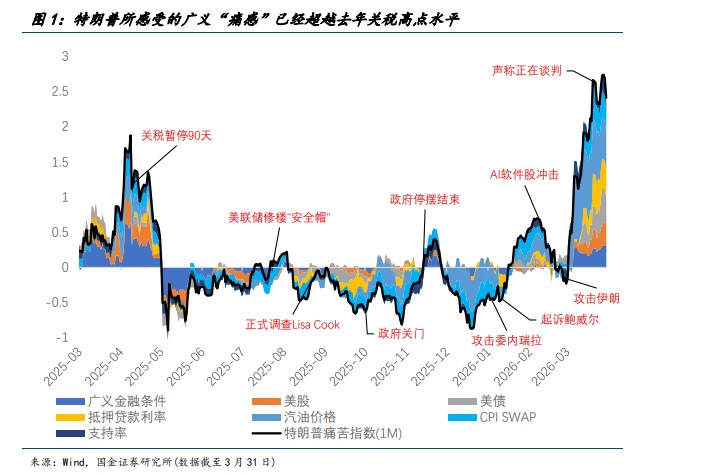
The longer the war drags on, the greater the impact on demand – this includes the demand for production corresponding to economic growth and the demand for survival corresponding to social stability.
After four weeks of "looking through the trade," market confidence is being depleted, and recession trades are gradually dominating. These are all based on a consensus: even if the war ends immediately, crude oil supply chains cannot be fully restored, and demand will inevitably contract correspondingly with the damage to supply, thereby increasing the probability of a recession.
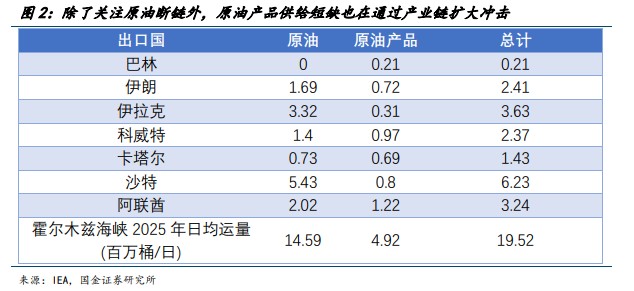
Approximately 24% of global seaborne naphtha, 20% of LNG trade, and 30% of ammonia nitrogen fertilizer pass through this route. Amidst an increasing number of chemical companies declaring force majeure (i.e., reducing production), we will see extremely widespread impacts: from high-energy-consuming semiconductor supply chains (packaging, solvents) to high-value-added automotive production and electronics industry chains (plastic products, precision instruments).
The decline in cracker operating rates will lead to an extreme shortage of olefin products. As time goes on, the impact will be amplified through every link of the supply chain: from orders to revenue, then to production continuity and employment stability, affecting the entire chain from production to consumption (income).
Another concern is the extreme climate fluctuations of a potential super El Niño year, which could amplify the impact of fertilizer shortages on grain production. Since ancient times, food shortages have been accompanied by "war and chaos." Russia's Ministry of Agriculture has suspended exports of ammonium nitrate until April 21, 2026, to prioritize domestic spring planting; other major agricultural countries may also temporarily suspend fertilizer exports to prioritize their own domestic demand and social stability, making food issues another pain point and source of growth pressure for various countries.
For the United States, the reality is that the friction costs embedded in oil prices are difficult to eliminate in the short term. Although as a net energy exporter, in a static framework the US would benefit from high oil prices and the dividends of low exposure to the Strait of Hormuz, the reality is more complex.
The "persistence" and "peak pulse" of oil prices jointly determine the pressure on the US economy. A significant spike again in the short term or a longer maintenance at current levels would be detrimental to the US economy. According to a simple "rule of thumb," for every 10% increase in oil prices, real GDP growth decreases by about 0.1%, and overall inflation increases by about 0.15%.
In terms of persistence, if Brent crude oil remains around $100 for the whole year, overall US CPI will be pushed up by about 1%; if it falls back to $80, the increase in CPI for the whole year will be about 0.5%. In terms of peak pulse, if Brent crude oil spikes to $110 or even $120 in April, US CPI year-on-year may remain at 3.5% for two consecutive months. This could shake residents' inflation expectations (especially since retail gasoline prices have risen 33% in the past month, from $3 to $4), further exacerbating the Fed's inflation concerns and leading to a more hawkish stance.
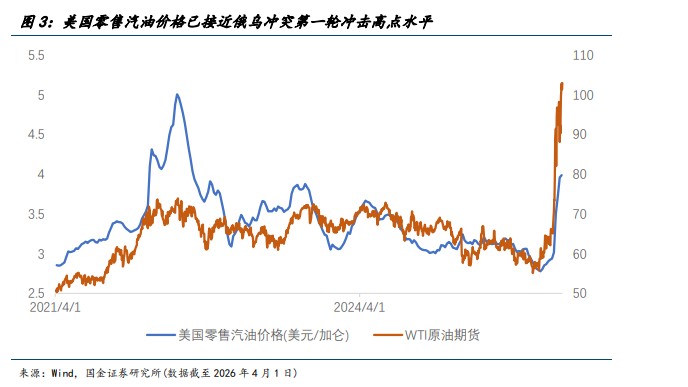
Compared to persistent worries, we believe we should be more concerned about the backlash against the US economy caused by the "one-off shock" risk of oil prices spiking again in the short term.
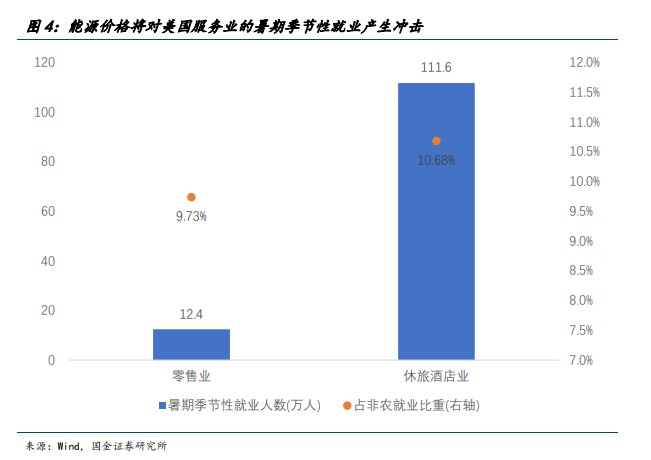
On the one hand, due to the lag in transmission, US residents will feel the pain more acutely; on the other hand, the decline in transportation supply will cause irreparable damage to the US service industry. The hospitality and retail sectors combined have about 1.3 million seasonal jobs, accounting for over 20% of total non-farm employment. With increased transportation costs, service consumption will inevitably be impacted, thus affecting the seasonal revenue and employment of the service industry, putting further pressure on the US economy.
In addition to logical deductions, we have also seen four signs of recession trades occurring over the past week.
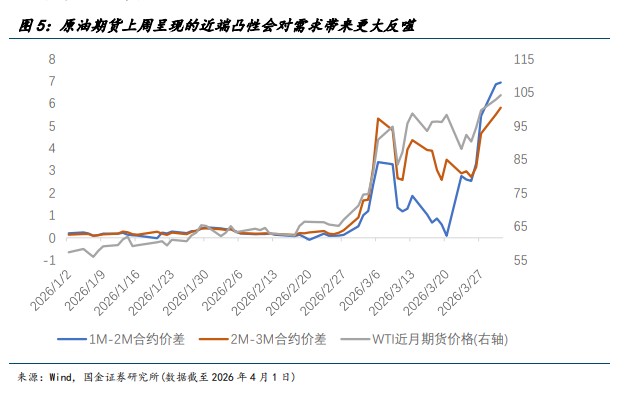
First, some potential easing events have not led to a pullback in oil prices, such as Iran selectively allowing several merchant ships to pass through the Strait of Hormuz, and the "real or fake" negotiation process mentioned by Trump. Based on closing prices, crude oil futures prices remain high and continue to hit new highs, meaning the market is trading at higher crude oil futures prices.
Notably, the nearby crude oil futures spread (1M-2M) last week (March 26) became positive for the first time since the war began, higher than the spread for longer-term futures (2M-3M). This nearby convexity foreshadows the suppression of demand by high oil prices.
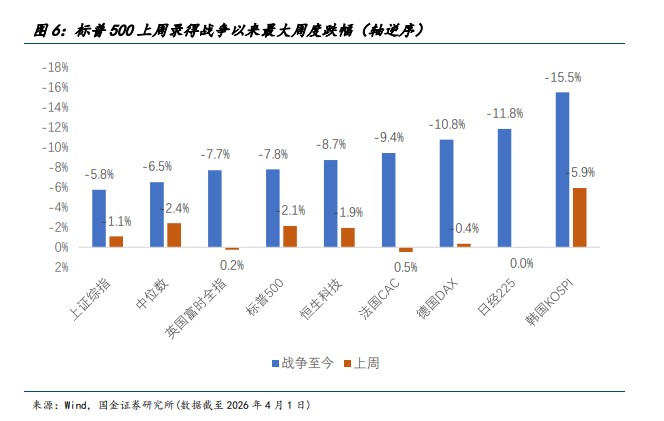
Second, US stocks are also showing catch-up declines. Apart from the directly benefiting energy oil and gas sectors, high-certainty storage assets temporarily served as a safe haven within the tech sector – this market thinking of pursuing earnings certainty has undergone a significant change in the face of the "ground troop threat" that has been gradually approaching. US stocks recorded their largest weekly decline since the war last week (March 22-28), and their cumulative decline since the war has exceeded the median level of major global equity markets.
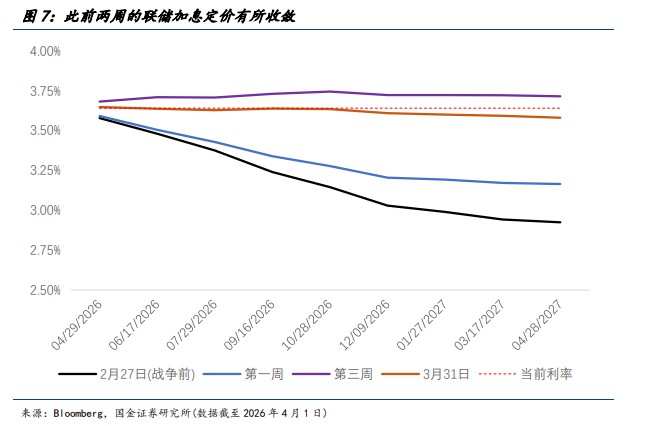
Third, the previously escalating expectations for interest rate hikes (partially due to CTA liquidations, but also due to speculative bets) have eased: particularly, the Fed rate hike pricing from the previous two weeks has reversed. For economies outside the US and China, tightening trades are merely a superficial narrative; under the current fundamental conditions, rate hikes will almost certainly lead to a recession, not to mention pricing in the possibility of three ECB rate hikes this year.
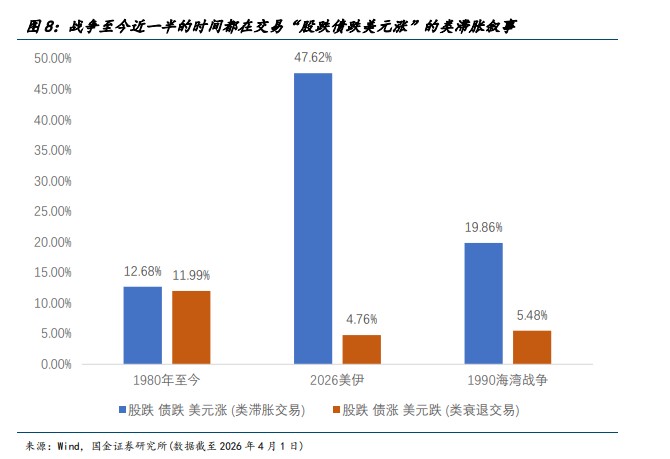
Fourth, stagflation trades are evolving into concerns about fundamentals. Over the 21 trading days since the war (up to March 31), the combination of falling stocks, falling bonds, and rising dollar (a form of stagflation trade) occurred on 10 days, which is significantly higher than the probability distribution during the Gulf War (or its preceding five weeks), and also higher than the probability distribution since 1980, indicating the market's extreme focus on inflation thus far.
However, under the oil shock, US Treasury yields are no longer rising with oil prices. After a significant bear flattening, the US Treasury yield curve has begun to steepen bullward, with the 2-year Treasury yield falling faster. This indicates that the market is increasingly focusing on growth risks.

Equities and commodities still face the challenge of fundamental destruction, while interest rates (bonds) may be the first assets to bottom out. A further surge in oil prices to round number levels (US$115-120) could become the trigger for a full-blown recession trade; in addition, any deterioration in the situation, such as a halt in negotiations, disruption of the Strait, escalation of bombing, or intervention by Gulf states, are potential triggers for a full-blown recession trade.
In short, the mark of ending the war is to see when and at what cost the Strait will "partially open" to whom, but any form of "partial opening" cannot prevent a slowdown in the global economy (compared to before the war). Recession trades are not just "the wolf is coming"; stocks, bonds, and commodities are gradually pricing in the probability of a recession, and too many (unilateral) uncontrollable factors are accumulating.
Risk Disclosure and Disclaimer
Markets are risky, and investment requires caution. This article does not constitute personal investment advice, nor does it consider the specific investment objectives, financial situation, or needs of individual users. Users should consider whether any opinion, view, or conclusion in this article is suitable for their particular situation. Investment based on this is at your own risk.
