


Breakfast | Expectations of a US-Iran ceasefire heat up, US stocks see largest rally since May last year!
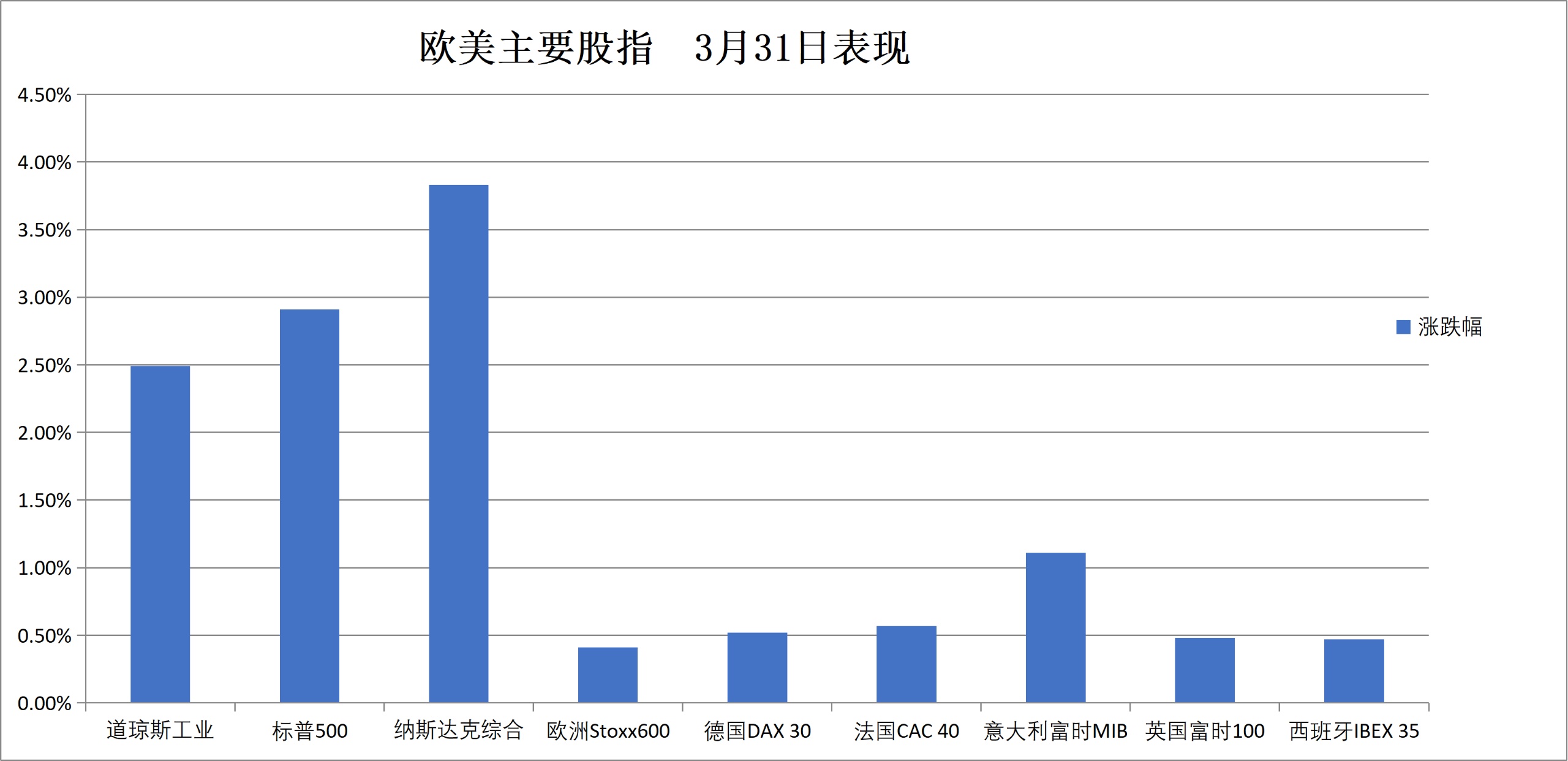
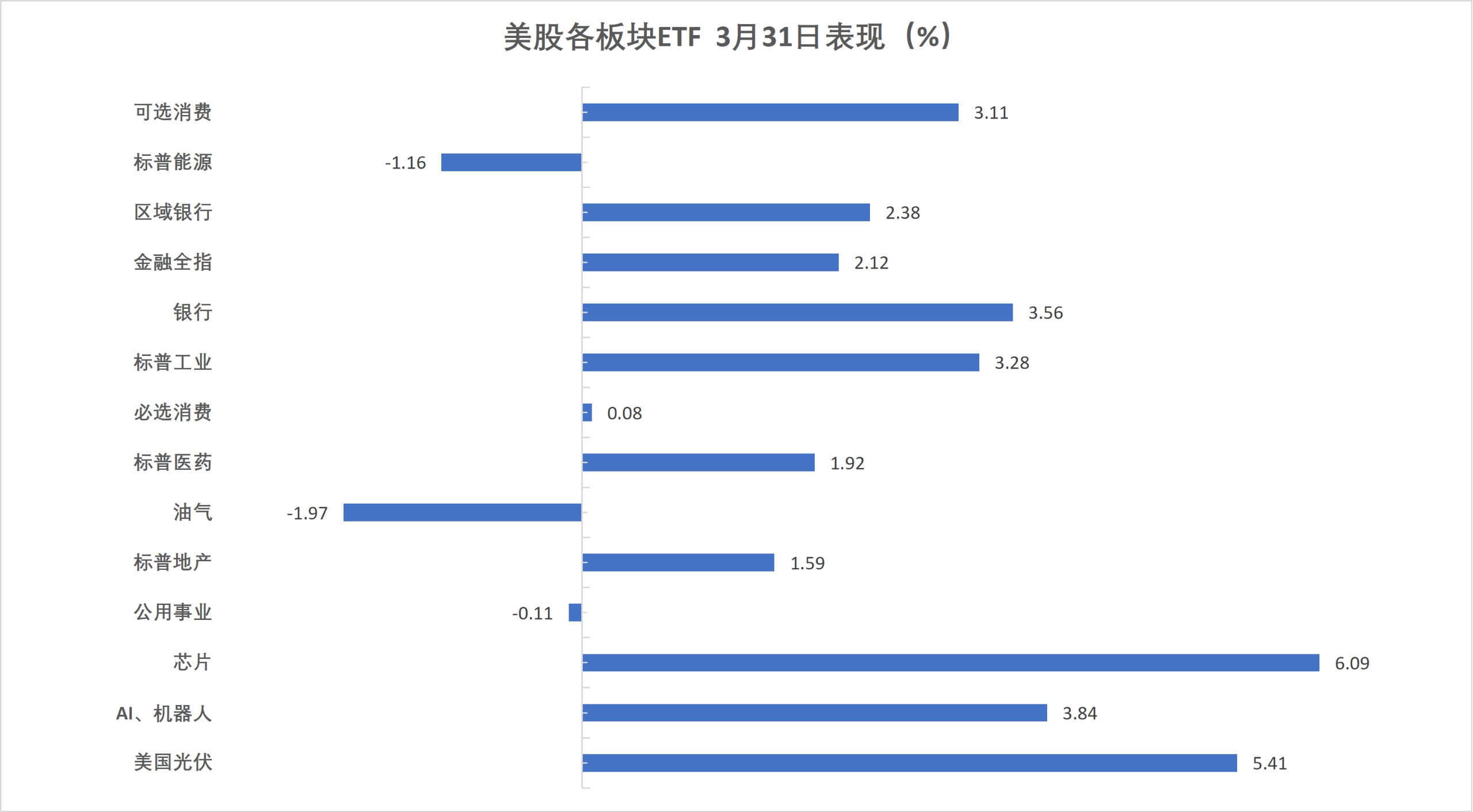
The United States and Iran have both expressed a willingness to end the conflict in the Middle East, leading to a significant rise in US stocks, with the S&P 500 gaining 2.9% and the Nasdaq surging 3.8%, marking the largest daily increase since May of last year. The Communication Services sector led the gains, up 4.42%, followed by Information Technology, up 4.24%. The Energy index, however, fell 1.2%, although it still rose 10% in March
Market Overview
Both the United States and Iran have signaled their willingness to end the conflict in the Middle East, leading to a surge in US stocks, which recorded their largest daily gains since May of last year. The S&P 500 rose 2.9%, and the Nasdaq soared 3.8%. The Communication Services sector led the market, climbing 4.42%, while the Information Technology sector gained 4.24%. The energy index declined 1.2%, though it still managed a 10% rise in March.
US Treasury yields continued to fall, with the 10-year yield down 3 basis points and the 2-year yield down 3.29 basis points.
The dollar ended its five-day winning streak, falling sharply by 0.7% during the day and breaking below the 100 mark. Cryptocurrencies saw a volatile upward trend, with Bitcoin rising 2.4% and Ethereum gaining over 4%.
Metals rallied, with spot gold up 3.5% for the third consecutive trading day, but still down 11% for March. Spot silver surged over 7%, reclaiming the $75 level, but fell nearly 20% for March. LME copper rose 3% on Tuesday, ending March down nearly 7%.
US oil fell 3.6% in spot prices, while Brent crude dropped over 5.2%, widening the price gap to its widest since December 2013.
During Asian trading, on the final day of March, the Shanghai Composite Index once again fell below 3900 points, the ChiNext Index dropped over 2%, motorcycles bucked the trend to gain, the Hang Seng Index turned positive in late trading, and semiconductors experienced a sharp decline.
Key News
China
People's Bank of China: Leverage the integrated effect of incremental and stock policies to strengthen monetary policy regulation.
China's manufacturing PMI rose to 50.4 in March, and the non-manufacturing PMI increased for the second consecutive month.
Huawei expects moderate revenue and net profit growth in 2025, with smart vehicle revenue surging 72% and cloud computing slightly declining.
Zhipu AI expects revenue to surge 132% in 2025, with cloud services and intelligent agent businesses both experiencing explosive growth; massive R&D investment led to an expanded loss.
Domestic storage giant Demingli turns losses into profits, expecting Q1 net profit to reach up to 3.65 billion yuan, five times its full-year 2025 profit.
Sungrow Power expects revenue to grow 15% and net profit to grow 22% in 2025, with continued expansion of its global market share in energy storage and inverter business.
Shandong Mo Long expects revenue to grow 30% in 2025, with net profit of 5.16 million yuan, turning losses into profits year-on-year, and overseas revenue surging 50%.
Overseas
Buffett: Made $100 billion betting on Apple but sold too early; current US stocks are not cheap, not buying the dip, and warns of fragile banking system signs.
Trump says he will end the Iran war in "two to three weeks." Trump's "exit roadmap" emerges: willing to end the war first, and hand over the reopening of the Strait of Hormuz to European and Gulf allies. Trump: Countries should "grab oil" from the Strait of Hormuz themselves.
Iranian President states willingness to end the war, provided aggression is guaranteed to cease; Iran's Foreign Minister says there is communication with the US but no negotiations. Iran warns of striking 18 US companies, with Mag 7 accounting for six.
USS "Bush" sets sail, US military may deploy a third aircraft carrier in the Middle East. US and Israel attack Iran's largest island. Iran claims its core domestic steel mills were attacked on Tuesday.
Report: Some Gulf countries hope the US will continue the war against Iran.
US JOLTS job openings fell to 6.882 million in February, with the hiring rate hitting a 6-year low and the layoff rate rising slightly.
Eurozone inflation surged to 2.5% in March, the largest increase since 2022, fueling strong expectations for interest rate hikes.
Epic leak: 512,000 lines of Claude Code source code have been open-sourced!
Market Close
European and US stock markets: The S&P 500 rose 2.91% to 6528.52 points, down 5.09% for March and down 4.63% for the first quarter. The Dow rose 2.49% to 46341.51 points, down 5.38% for March and down 3.58% for the first quarter. The Nasdaq rose 3.83% to 21590.629 points, down 4.75% for March and down 7.10% for the first quarter. The European STOXX 600 index closed up 0.41% at 583.14 points, down 8.00% for March and down 1.53% for the first quarter.
A-shares: The Shanghai Composite Index closed at 3891.86 points, down 0.80%. The Shenzhen Component Index closed at 13478.06 points, down 1.81%. The ChiNext Index closed at 3184.95 points, down 2.70%.
Bond market: The yield on the US 10-year benchmark Treasury bond fell 3.16 basis points to 4.3166%, up 37.91 basis points for March and up 14.96 basis points for the first quarter. The yield on the 2-year US Treasury bond fell 3.49 basis points to 3.7930%, up 41.81 basis points for March and up 31.99 basis points for the first quarter.
Commodities: US oil spot price fell 3.6%, Brent crude fell over 5.2%. US oil rose nearly 50% for March and about 75% for the first quarter. Brent crude rose over 40% for March and nearly 70% for the first quarter. Spot gold rose 3.49% to $4668.20/ounce, down 11.58% for March and up 4.90% for the first quarter.
Key News Details
Global Highlights
China
PBOC: Leverage integrated effect of incremental and stock policies to strengthen monetary policy regulation. The meeting pointed out the need to guide large banks to play their main role in serving the real economy, and to guide small and medium-sized banks to focus on their core businesses and strengthen their capital strength. It is necessary to make good use of various structural monetary policy tools, optimize tool management, and solidly carry out the "five major articles" of finance, strengthening financial support for key areas such as expanding domestic demand, technological innovation, and small, medium, and micro enterprises. Continue to do a good job in financial services to support the development and growth of private enterprises. Maintain the stable operation of the financial market. Effectively promote high-level two-way opening-up of finance, and improve the ability of economic and financial management and risk prevention and control under the conditions of opening-up.
China's manufacturing PMI rose to 50.4 in March, and the non-manufacturing PMI increased for the second consecutive month. In March, China's manufacturing PMI returned to the expansion range, with both production and demand strengthening, and the business sentiment of large, medium, and small enterprises all improved, consolidating the trend of economic recovery and improvement; the non-manufacturing PMI rose to the expansion range of 50.1%, and the business sentiment of the service industry and construction industry improved. Huo Lihui, chief statistician of the Service Industry Survey Center of the National Bureau of Statistics, said that in March, as enterprises accelerated their return to work after the Spring Festival, market activity increased.
- Zhong Yumei of Guolian MinSheng Securities stated that the manufacturing PMI rose as expected in March, with the two major price indicators reaching new highs since the second quarter of 2022, and the new export orders index rising to its highest level since May 2024. On the demand side, the new orders index was 51.6%, a new high in a year; on the external demand side, the new export orders index was 49.1%, the highest since May 2024. The service industry PMI was 50.2% (a month-on-month increase of +0.5pp), returning to the expansion range.
- Zhao Wei's team at Shenwan Hongyuan stated that the PMI significantly rebounded in March, with the manufacturing PMI rising to 50.4%, returning to the expansion range. The core drivers are the natural recovery after the Spring Festival disruptions subsided and the acceleration of domestic and external demand recovery, especially the faster recovery of demand in the consumer goods sector. The slow resumption of work after the festival dragged down the production index. In the non-manufacturing sector, lifestyle services weakened, but the business sentiment of production services was high. Looking ahead, the expectation for domestic demand recovery is strong, but caution is needed regarding the potential negative impact of soaring oil prices on manufacturing.
Huawei expects moderate revenue and net profit growth in 2025, with smart vehicle revenue surging 72% and cloud computing slightly declining. The company achieved annual sales revenue of 880.9 billion yuan, a year-on-year increase of 2.2%, and net profit of 68 billion yuan, a year-on-year increase of 8.7%. The growth drivers are more clearly pointing to AI and vehicles: smart vehicle solution revenue was 45 billion yuan, a year-on-year increase of 72.1%; digital energy revenue was 77.3 billion yuan, a year-on-year increase of 12.7%. In contrast, the two major fundamental pillars of ICT infrastructure and terminals maintained small growth; cloud computing revenue of 32.1 billion yuan declined slightly.
Zhipu AI expects revenue to surge 132% in 2025, with cloud services and intelligent agent businesses both experiencing explosive growth; massive R&D investment led to an expanded loss. Zhipu AI's revenue in 2025 was 724 million yuan, a year-on-year increase of 131.9%. Revenue from open platform and API (cloud services) increased by 292.6% year-on-year to 190 million yuan; revenue from enterprise-level intelligent agent business increased by 248.8% year-on-year to 166 million yuan. The company's R&D investment was 3.18 billion yuan, a year-on-year increase of 44.9%, leading to a 59.5% year-on-year increase in net loss to 4.718 billion yuan.
Domestic storage giant Demingli turns losses into profits, expecting Q1 net profit to reach up to 3.65 billion yuan, five times its full-year 2025 profit. Driven by the storage chip cycle and strategic stocking benefits, Demingli expects first-quarter operating revenue to reach 7.3 billion to 7.8 billion yuan, an increase of 483% to 523% compared to 1.252 billion yuan in the same period last year. Net profit attributable to shareholders of the listed company is expected to be between 3.15 billion and 3.65 billion yuan, compared to a loss of 69.0877 million yuan in the same period last year. The median of this quarterly profit range is about 3.4 billion yuan, which is nearly five times the company's full-year 2025 net profit of 688 million yuan.
Sungrow Power expects revenue to grow 15% and net profit to grow 22% in 2025, with continued expansion of its global market share in energy storage and inverter business. Sungrow Power's revenue in 2025 was 89.184 billion yuan, a year-on-year increase of 14.55%; net profit was 13.461 billion yuan, a year-on-year increase of 21.97%. Energy storage shipments were 43GWh, and inverter shipments were 143GW, completing the world's largest grid-forming energy storage system; it ranked first globally in wind power converter installed capacity and first in China for hydrogen energy中标 share. The company also launched its Hong Kong H-share listing simultaneously, accelerating its global expansion.
Shandong Mo Long expects revenue to grow 30% in 2025, with net profit of 5.16 million yuan, turning losses into profits year-on-year, and overseas revenue surging 50%. Shandong Mo Long's revenue in 2025 was 1.762 billion yuan, a year-on-year increase of 29.88%; net profit attributable to parent was 5.1556 million yuan, reversing the loss of 43.7 million yuan in 2024. Revenue from overseas markets increased by about 50% year-on-year, significantly higher than the company's overall revenue growth. Net profit after deducting non-recurring items was a loss of 27.62 million yuan, and the main business segment is still in the phase of profit recovery.
Overseas
Buffett: Made $100 billion betting on Apple but sold too early; current US stocks are not cheap, not buying the dip, and warns of fragile banking system signs. Berkshire Hathaway held over $370 billion in cash and cash equivalents as of the end of last year and purchased another $17 billion in Treasury bills this week. Buffett stated that the current market is not cheap and he would consider entering the market only during a significant downturn; he admitted to selling Apple "too early" but current valuations are not attractive; regarding interest rate cuts, he is focused on inflation trends; he stated that maintaining financial system stability should be a top priority for the Federal Reserve, and panic within the system could lead to a rush of investor withdrawals.
Trump says he will end the Iran war in "two to three weeks." Trump stated that the US would end its war with Iran in "two to three weeks" and might reach an agreement with Iran before then; he expects US troops to withdraw from Iran within two to three weeks.
Iranian President states willingness to end the war, provided aggression is guaranteed to cease; Iran's Foreign Minister says there is communication with the US but no negotiations. Reports indicate that Trump is willing to cease hostilities when the Strait of Hormuz is not fully open; while military options are available, they are not his preferred choice. Trump stated that the war with Iran would not last long and other countries could reopen the strait; allies must "step in and handle" the issue of the strait, and the US will withdraw its troops at some point, but not now. The US carrier "Bush" is being deployed to the Middle East. The Iranian President stated that the only way to restore normal order in the region is to stop aggressive attacks. Iran's Foreign Minister: Iran will not agree to a ceasefire but demands a complete end to the war in the entire region. Russian Ambassador to Iran: According to official Iranian sources, Iran's Supreme Leader is in the country.
Trump's "exit roadmap" emerges: willing to end the war first, and hand over the reopening of the Strait of Hormuz to European and Gulf allies. Reports suggest that Trump has told aides that he is willing to end military operations against Iran even if the Strait of Hormuz remains largely closed, citing that forcing the strait open would exceed the planned 4-to-6-week operational timeframe. The subsequent reopening of the Strait of Hormuz could then be handed over to European and Gulf allies. However, reports also indicate he is considering a complex and high-risk operation to seize Iran's uranium reserves.
Trump: Countries should "grab oil" from the Strait of Hormuz themselves. Trump posted on social media on March 31st, saying that all countries that cannot obtain aviation fuel due to the closure of the Strait of Hormuz, such as the UK which refuses to participate in striking Iran, "I give you advice: first, buy from the US, we have plenty; second, summon the courage to go to the strait and grab it."
US and Israel attack Iran's largest island. From the evening of March 30th to noon on March 31st, Tehran, the capital of Iran, was subjected to two rounds of airstrikes, with explosions occurring in multiple locations and causing temporary power outages in some areas. In addition, an official from the Iranian Ministry of Health pointed out that the US and Israeli attack on Qeshm Island, Iran's largest island, completely paralyzed a desalination plant there, which cannot be repaired in the short term.
Iran claims its core domestic steel mills were attacked on Tuesday. Mobarakeh and Khuzestan steel mills constitute nearly half of Iran's steel industry, accounting for nearly half of the country's total output. Iran is an important steel exporter to the Middle East and Asian markets, especially in plates and billets, where it holds a significant share.
Tech giants on the "blacklist"! Iran warns of striking 18 US companies, with Mag 7 accounting for six. The Iranian military stated that starting April 1st, if its senior commanders are assassinated, relevant institutions and facilities of 18 US companies in the Middle East may be destroyed. JPMorgan Chase, General Electric, Boeing, and Mag 7 companies including Microsoft, Apple, Google, Meta, Nvidia, and Tesla, as well as Palantir, Cisco, and other tech companies were named; drone attacks were launched against Siemens and AT&T on the 31st as a response to US and Israeli attacks on Iranian infrastructure.
Report: Some Gulf countries hope the US will continue the war against Iran. According to US media reports on the 30th, some Gulf countries, such as the United Arab Emirates and Saudi Arabia, hope that the US will continue the war against Iran. Among them, the UAE is "strongly pushing" for the US military to launch a ground war, and Kuwait and Bahrain also hold supportive positions.
International oil prices rose over 3%, Kuwaiti oil tanker attacked in Dubai port. On March 31st, Kuwait National Petroleum Company confirmed that its oil tanker "Al-Salmi" was attacked by Iran in the port of Dubai, UAE, damaging the hull and causing a fire. The incident may also lead to oil spills in the surrounding waters. Coupled with attacks on Kuwaiti facilities, the actual closure of the Strait of Hormuz, and Trump's threat to attack Iranian infrastructure, international oil prices rose sharply, with both WTI and Brent crude rising over 3% in a short period.
A Russian oil tanker, creating a crack in Trump's Cuba blockade. According to reports, a Russian oil tanker carrying 730,000 barrels of crude oil is heading to Cuba. Trump previously stated "no problem," creating a crack in its two-month fuel blockade. The White House emphasized that this release is an isolated case and not a policy shift. Mexico immediately announced that it would resume oil exports to Cuba, and Russia also stated that it is willing to continue supplying oil. Analysts point out that the contradiction between Trump's tough stance on Cuba and practical pressures has been publicly exposed.
US JOLTS job openings fell to 6.882 million in February, with the hiring rate hitting a 6-year low and the layoff rate rising slightly. The number of voluntary departures also fell, indicating a clear cooling in the labor market. The decline in openings was concentrated in the accommodation and food services sector and manufacturing, reflecting a general contraction in companies' hiring intentions. Although large tech companies are proceeding with layoffs, they have not yet spread comprehensively. The rise in energy costs caused by the Iran war may further suppress subsequent hiring.
Eurozone inflation surged to 2.5% in March, the largest increase since 2022, fueling strong expectations for interest rate hikes. Affected by the Middle East conflict pushing up energy costs, Eurozone inflation rose 2.5% year-on-year in March, the largest monthly increase since 2022, while core inflation unexpectedly slowed to 2.3%. Markets are betting on the ECB to start raising interest rates as early as April. Officials warned that the risk of accelerating inflation cannot be ignored, and the policy focus is on preventing secondary transmission of energy price increases to wages and goods prices.
ECB President and US Treasury Secretary clash at G7 meeting! Lagarde questions Yellen's overly optimistic assessment of the Iran war's impact. Lagarde questioned Yellen's optimistic assessment during a G7 video conference on Monday that the economic impact of the Iran war would be brief. She stated that due to the extensive infrastructure damage already incurred, the impact of this shock will last for a considerable time. This clash between Lagarde and Yellen is not the first friction with US officials this year. In January, Lagarde left a speech by US Commerce Secretary Raimondo halfway through at the World Economic Forum, deeming his anti-European remarks too harsh.
Epic leak! 512,000 lines of Claude Code source code have been open-sourced! Over 510,000 lines of TypeScript code, more than 40 tool modules, and several unreleased features of Claude Code were publicly disclosed due to a packaging error. The leak did not affect Claude's core model weights. Industry insiders believe this incident will significantly reduce the threshold for AI agent engineering and accelerate the evolution of developer ecosystem competition. At the same time, the incident also raises questions about Anthropic's safety maturity.
Research Highlights
The most important change? US debt "decoupling", market smells "global fiscal stimulus". The Iran conflict enters its second month, and as oil prices break $100, US Treasury yields move inversely, making the "debt-oil decoupling" a key signal. The market logic has shifted from inflation panic to recession concerns and expectations of fiscal stimulus. Goldman Sachs predicts that bond yields will eventually fall, while Morgan Stanley points out that the market is pricing in fiscal stimulus after the energy shock.
US stocks have fallen more severely this time than during previous geopolitical conflicts, Deutsche Bank: Far from bottoming out. Statistics show that since the close of trading on February 27th, the S&P 500 index has fallen by 7.4%, exceeding the median level of drawdowns during historical similar events and breaking the historical pattern of short-term bottoms. Deutsche Bank analysis points out that active and systemic funds still have room for further reductions, coupled with the VIX fear index standing above 30, the market selling pressure has not yet been fully released, and the decline in US stocks is far from bottoming out.
Memory chip collapse? "Consumers can't afford it," but "AI demand remains explosive". Affected by the demand reduction concerns triggered by Google's compression algorithm and previous overstocking, the spot price of DDR5 memory has recently plunged by nearly 30%. However, the collapse is limited to the consumer retail market, which accounts for at most a low single-digit percentage of total market transactions; the core AI demand driven by servers remains explosive. Despite pressure on spot sentiment, server foundry revenue and DRAM export data continue to grow strongly, indicating stable industry fundamentals. Compared to spot fluctuations, the soaring energy costs caused by the Middle East conflict and the accumulation of debt in the AI industry are the real systemic risks facing the memory sector.
- Memory prices plummet, Citi significantly lowers Micron's target price! Google's new TurboQuant technology has impacted memory prices, with the spot price of mainstream 16GB DDR5 falling by 6%. Based on this, Citi has significantly lowered Micron's target price by 17%, from $510 to $425. At the same time, it points out that although the memory spot market is under pressure, the risk of declining long-term contract prices for Micron is controllable; the cost reduction and efficiency improvement of TurboQuant will further unleash applications and eventually boost overall computing power and total memory demand.
- Morgan Stanley: Downward revision of old memory valuations is inevitable, in the AI era, "unaffordability" has become the core constraint. Morgan Stanley stated that as AI computing power demand continues to be released, customer tolerance for high DRAM prices has become a substantial constraint, and DRAM-related manufacturers face pressure for valuation downward revisions. Technologies such as KV cache compression and server system optimization reduce the reliance on DRAM capacity. The investment logic shifts from cyclical drivers to cost constraints, with pure NAND manufacturers benefiting relatively.
Nvidia's valuation hits a seven-year low: Is the market systematically undervaluing the biggest winner of AI? As of the close of trading this Monday, Nvidia's stock price corresponded to a forward P/E ratio of 19.9 times, the lowest level in seven years; Apple's forward P/E ratio of 28.7 times is far higher than Nvidia's, but Apple's revenue is expected to grow by 12% this fiscal year, only 1/6 of Nvidia's expected growth of 71%. Analysts point out that the broader market decline caused by geopolitical conflicts cannot fully explain the magnitude of the valuation compression in the AI sector.
Buffer is about to run out! Morgan Stanley: Scale of oil market supply disruptions is several times that of 2022, the trickiest problem is refined oil. The "effective blockade" of the Strait of Hormuz enters its fourth week. Morgan Stanley warns that the oil market buffer is being rapidly depleted, with refined products becoming scarce even sooner than crude oil. Crude oil in the Atlantic basin is being repriced as the "last marginal rescue," and Asian buyers are scrambling for supplies. The longer the impact lasts, the more difficult it will be to sustain the narrative of a "simple and quick return to normal." Even if the Strait of Hormuz reopens, normalization will take time; and if Iran retains control of the passage, it will be difficult for the oil market to return to its previous equilibrium.
Goldman Sachs: If the Middle East conflict escalates and exacerbates Western fiscal concerns, gold will hit $6100! Goldman Sachs believes that the current decline in gold prices has "significantly overshot"; as prices stabilize, it is expected that central banks' gold purchases will accelerate, with monthly average purchases of about 60 tons; coupled with the expected two more interest rate cuts this year, the gold price target of $5400/ounce by the end of 2026 is maintained. If geopolitical conflicts accelerate private sector asset diversification and erode Western fiscal credibility, gold prices could rise to $6100.
Domestic Companies
Investors rush to invest in Zhang Xue. From a car repair apprentice to a world champion, Zhang Xue led her eponymous motorcycle brand to two consecutive championships in WSBK, breaking the monopoly of Europe and America. Capital followed, with investors inquiring about her contact information. This real-life "Pegasus" is igniting the venture capital circle's enthusiasm for Chinese intelligent manufacturing.
Farewell to the 1499 yuan era, adjusting to 1539 yuan/bottle! Why did Feitian Moutai "go against the trend" and raise prices? The price increase this time is restrained, aiming to cope with the peak of production capacity and pressure on wholesale prices. The core is to break the 8-year-old "guideline price" of 1499 yuan, and it does not limit the terminal pricing of distributors, marking Moutai's official entry into a market-oriented reform stage of "following market prices." The "against the trend" price adjustment also highlights its scarcity.
Pop Mart severely mispriced? Morgan Stanley: Overseas business "prematurely condemned" by the market, even in the worst-case scenario, the stock is still undervalued by about 20%. Pop Mart's stock price has been halved from its peak, and the market has priced in the worst-case scenario. Morgan Stanley believes that the severity of issues such as rising inventory, pressure on overseas profit margins, and controversies in new businesses may be overestimated: 40-45% of overseas SG&A are variable costs that change with sales and will not infinitely amplify losses; there is no risk of expired products or seasonal clearance; among new businesses, the truly noteworthy are theme parks and the animated short film to be premiered this year.
Overseas Macroeconomics
Global central banks selling US Treasuries at a frenzy, withdrawing $82 billion in one month, oil-producing countries in the Middle East selling bonds for cash. The Iran war has triggered an energy crisis, and global central banks are shedding US Treasuries at the fastest pace in over a decade – a drop of $82 billion in just a few weeks to the lowest level since 2012. Middle Eastern oil-exporting countries, holding about $300 billion in US Treasuries, may be partially responsible for this decline. With soaring oil prices, oil-importing countries like Turkey and India are bearing the brunt, forced to use reserves to support their currencies. Behind the largest increase in yields in over a year, the throne of US Treasuries as the "world's number one reserve asset" is rapidly being shaken.
For the first time since August 2022, the average US gasoline price exceeded the $4 per gallon mark. The average US gasoline price has exceeded $4/gallon, an increase of nearly $1 since the US and Israel attacked Iran on February 28th. JPMorgan Chase estimates that if oil prices rise to $5/gallon and persist, the approximately $200 billion in tax cut benefits from the "Inflation Reduction Act" will be completely consumed by gasoline bills. Furthermore, polls show that 55% of Americans say their household finances have been impacted by rising oil prices, and 87% expect oil prices to continue to rise.
Iran situation ignites Germany's energy crisis, May electricity prices surge to 4 times that of France, creating the largest historical price difference. Affected by the disruption of natural gas supply caused by the Iran war, Germany's electricity contract price for May is about four times that of France, and the electricity price spread has widened to a historical extreme. France, relying primarily on nuclear power, has stable supply and low costs; Germany, having abandoned nuclear power, is highly dependent on gas-fired power generation. Soaring gas prices have driven up electricity prices, and Germany is considering restarting coal-fired power units to alleviate the current supply pressure.
Tokyo CPI in March cools again, recording the lowest growth rate in four years, but the Bank of Japan still expects a rate hike in April. Tokyo's overall CPI in March increased by 1.4% year-on-year, the lowest growth rate since March 2022; the core CPI excluding fresh food rose by 1.7%, lower than the expected 1.8%, further falling below the Bank of Japan's annual target of 2%. Despite the current weak data, analysts believe that future inflation trends face significant upward risks, and the possibility of a 25 basis point rate hike in April still exists.
Japan terms the depreciation of the yen as "speculative," Finance Minister: "Comprehensive" response prepared. The yen is once again under pressure, and the Japanese government has rarely adopted a "comprehensive" response. The Finance Minister clearly defined the recent depreciation as speculative and deviating from fundamentals, a rare strong wording in recent years. The Iran conflict has triggered a global sell-off, and speculative forces have taken advantage of the momentum, inflicting a "double blow" on the yen. The threshold for intervention by authorities has been quietly lowered, and policy risks for short sellers are rapidly increasing.
South Korean stock market enters a "technical bear market," down 20% from February highs! The South Korean Kospi index has fallen 20% from its February high, officially entering a technical bear market. The escalating situation in the Middle East has pushed up oil prices and intensified inflation expectations. Coupled with market doubts about the sustainability of AI chip demand, SK Hynix and Samsung Electronics, which together account for nearly 40% of the KOSPI's weighting, have seen significant foreign selling, becoming the core of this decline.
Iran war disrupts supply chains, aluminum prices rise nearly 10% in a month, marking the largest monthly increase in nearly two years. The closure of the Strait of Hormuz has cut off the export channels for about 10% of global aluminum production capacity in the Persian Gulf. Alba in Bahrain has reduced production by over 20%, and the UAE's 1.6 million-ton smelting facility has been damaged. Natixis warns that the global market may shift from a surplus of 200,000 tons to a shortage of 1.3 million tons. LME aluminum prices have risen by nearly 10% this month, marking the largest monthly increase in nearly two years, making it a rare outlier in the broad decline of metals in March.
Overseas Companies
OpenAI completes $122 billion in financing, valuation reaches $852 billion. This round of financing includes the $110 billion financing amount disclosed by OpenAI in February of this year. Following this round of financing, OpenAI's IPO expectations are heating up. OpenAI's Chief Financial Officer Sarah Friar stated that the company needs to have "public company capabilities" and positions the IPO as an important node for building trust, but did not disclose specific details of its initial public offering plans.
Cook stands at the "siege," holding the 2.0 version of "Apple Tax". Apple is capitalizing on the AI era with its ecosystem advantage. Facing a shortage of self-developed models, iOS 27 will open Siri as a third-party AI platform, allowing users to freely access large models such as Gemini and Claude. This "Siri Extensions" feature essentially replicates the success path of the App Store – building a new "Apple Tax" by charging a 30% commission on third-party AI subscription services.
Jensen Huang makes another move! Nvidia invests $2 billion in Marvell, boosting AI integration in 5G/6G networks. Marvell will provide customized XPU (accelerated processor) and extended network solutions compatible with NVLink Fusion for the Nvidia ecosystem, and the two parties will conduct joint research and development in silicon photonics technology and 5G/6G networks.
Time to buy Meta? Morgan Stanley: Bad news has been fully priced in, Meta AI is expected to evolve into MetaClaw, opening a new growth engine. Morgan Stanley believes that Meta's current valuation of about 15 times P/E is at a ten-year low, with a discount of over 50% compared to its peers. In addition to cost reduction and efficiency improvements through layoffs, its core growth point lies in the potential AI agent product MetaClaw: this tool, relying on the Llama large model and 3.5 billion active users, integrates merchant inventory and payment capabilities to build a closed-loop "agent-based shopping" system, which is expected to shift Meta from ad display to transaction monetization.
Samsung advances advanced process technology: 2nm yield exceeds 60%, aims for 1nm by 2030. Samsung's 2nm yield has exceeded 60%, helping its foundry business turn losses into profits. The company plans to mass-produce AI chips for Tesla in 2027 and aims to introduce 1nm process technology by 2030, at which point it will adopt a "gate-all-around" (GAA) architecture. Facing fierce competition from TSMC and Rapidus, Samsung is striving to catch up by optimizing process variants.
Google warns: Quantum computing threshold may be significantly lower than expected, crypto industry needs to transition to post-quantum by 2029 to cope. Google researchers warn that future quantum computers may crack some encryption technologies protecting Bitcoin and other digital assets with significantly fewer resources than previously expected, making discussions on how the industry should cope more urgent. Google positions this paper as a warning to buy the industry time to prepare, rather than a prediction of imminent collapse, and it does not mean that Bitcoin or Ethereum are immediately at risk.
Today's News Preview
Manufacturing PMIs for March from China, the US, the Eurozone, the UK, and Japan.
US ADP employment for March.
US retail sales for February.
South Korea's imports and exports for March.
Speeches by Fed Governor Barr and St. Louis Fed President Musalem.
US EIA crude oil inventories for last week.
