


Iran Conflict Shows Few Signs of Easing, Brent Crude Poised to Break Largest Ever Monthly Gain Record!
With no signs of de-escalation in the Middle East conflict, Brent crude has seen its monthly gains approach 60%, potentially breaking the record for the largest monthly increase in history. Trump issued a new threat against Iran, vowing to "utterly destroy" all of the country's power plants, oil wells, and Kharg Island if a deal was not reached. Houthi involvement has extended the conflict to the Red Sea and the Strait of Mandeb. Both major global energy trade routes are under pressure simultaneously, narrowing options for rerouting and significantly increasing systemic risk
International oil prices surged significantly on Monday, with Brent crude's monthly gains approaching 60%, potentially setting a record for the largest monthly increase in history.
According to Xinhua News Agency, Trump issued a new threat to Iran regarding a ceasefire. Trump stated on the 30th that the United States is engaged in serious discussions with a "new, more rational regime" and vowed to "utterly destroy" all of the country's power plants, oil wells, and Kharg Island if an agreement with Iran is not reached. Iran believes that while the US is signaling negotiations, it is also planning a ground offensive, a view supported by the US troop buildup in the Middle East.
Signs of conflict escalation are further intensifying supply risks, and the continuous rise in oil prices is transmitting pressure to the broader global energy market. JPMorgan analysts pointed out that two major global energy trade routes, the Strait of Hormuz and the Red Sea/Strait of Mandeb, are simultaneously exposed to conflict risks. Rerouting options are narrowing, and systemic risks to the global supply chain are significantly increasing.
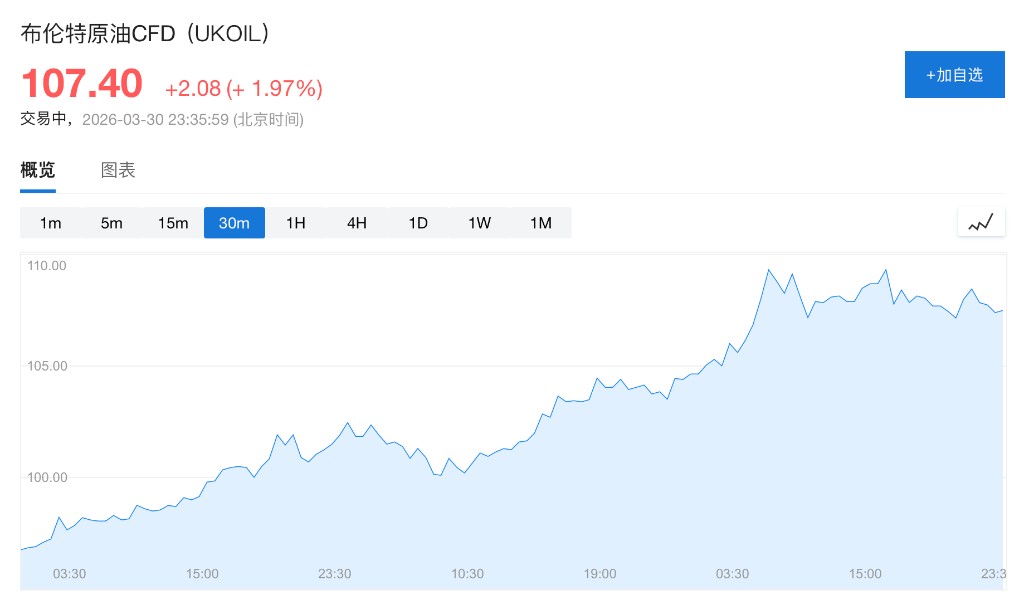
Trump Escalates Threats, Oil Prices Jump
On Monday, according to FactSet data, Brent crude's May contract rose by 2.1% to $114.71 per barrel, and the most active June contract rose by 2.1% to $107.39 per barrel. WTI crude's May contract rose by 2% to $100.77 per barrel.
Brent crude futures have seen their monthly gains approach 60%, potentially setting a record for the highest monthly increase in history. WTI crude futures have risen 51.2% so far this month. During intraday trading, Brent crude reached a high of $108.78 per barrel, and WTI reached a high of $101.78 per barrel.
Trump wrote on social media: "The United States is having serious discussions with a new, more rational regime to end our military presence in Iran. Great progress has been made, but if for any reason a deal is not reached soon (it is being reached), and the Strait of Hormuz is not immediately 'open for business,' we will end our pleasant 'stay' in Iran by bombing and utterly destroying all of their power plants, oil wells and Kharg Island (and possibly all of their water desalination plants) – targets we have deliberately 'not touched' previously."
Conflict Spreads, Two Major Energy Corridors Under Pressure Simultaneously
A team of JPMorgan analysts (led by Natasha Kaneva) stated in a research note released on Sunday that the conflict has extended beyond the Strait of Hormuz, with the Red Sea and the Strait of Mandeb – critical chokepoints for global oil trade – now involved. "In fact, two major corridors for global energy trade are simultaneously at risk, narrowing rerouting options and significantly increasing systemic risk to global supply chains."
Danni Hewson, AJ Bell's head of financial analysis, commented that Trump's remarks about seizing Iranian oil and Kharg Island, the US military buildup, and the involvement of Houthi forces collectively create a situation where the conflict appears to be escalating rather than de-escalating.
The continuous escalation of geopolitical conflicts, the obstruction of key shipping lanes, and the uncertain prospects of diplomatic negotiations are driving oil prices to remain strong at high levels, potentially impacting global energy supply chains and the Federal Reserve's monetary policy path.
