


If Saudi Arabia's "Plan B" Yanbu Port and Bab el-Mandeb Also Fail, Will Oil Prices Rise Another $20?
JP Morgan stated that as the situation in the Middle East escalates, crude oil supply chain risks have extended from the Strait of Hormuz to the Red Sea and the Bab el-Mandeb Strait. Saudi Arabia's alternative export channel via Yanbu Port (approx. 4.8 million bpd), designed to circumvent risks in the Strait of Hormuz, is facing a direct threat. The Suez Canal and SUMED pipeline, serving as backup routes, have limited capacity and would struggle to absorb the entire shortfall. Calculations indicate that if Yanbu Port or the Bab el-Mandeb Strait were disrupted, oil prices could rise by an additional $20 per barrel
As Saudi Arabia shifts its crude oil export focus to the Red Sea to circumvent risks at the Strait of Hormuz, this "safe corridor" is itself becoming the new eye of the storm.
According to the Follow the Wind Trading Desk, an oil market brief released by JP Morgan on March 29 pointed out that with the Houthi rebels officially joining the Middle East conflict, the risk landscape of the global crude oil supply chain is undergoing a fundamental shift. Previously, the market focused on the Strait of Hormuz, but now the Red Sea and the Bab el-Mandeb Strait are simultaneously exposed to war threats, creating a dual-line, superimposed risk.
Saudi Arabia's "detour plan" to bypass the Strait of Hormuz—the alternative export channel centered on Yanbu Port—is facing a crippling blow, with approximately 4.8 million bpd of bypass capacity hanging in the balance. The report's calculations indicate that if key nodes are disrupted, oil prices could rise by another $20 per barrel.
Conflict Map Expands: From a Single Chokepoint to a Dual-Line Blockade
Previously, Middle East conflicts were mainly concentrated around the Persian Gulf and the Strait of Hormuz. With the official intervention of the Houthi rebels, the geopolitical front has lengthened significantly.
This change is geographically crucial: The two most important channels for global energy trade—the Strait of Hormuz and the Bab el-Mandeb Strait—are now simultaneously exposed to potential threats. Both are strategic chokepoints that are difficult to bypass; a blockade of either would trigger a systemic supply chain shock. Pressure on both channels simultaneously means that "detour options" are drastically compressed and supply elasticity has plummeted.
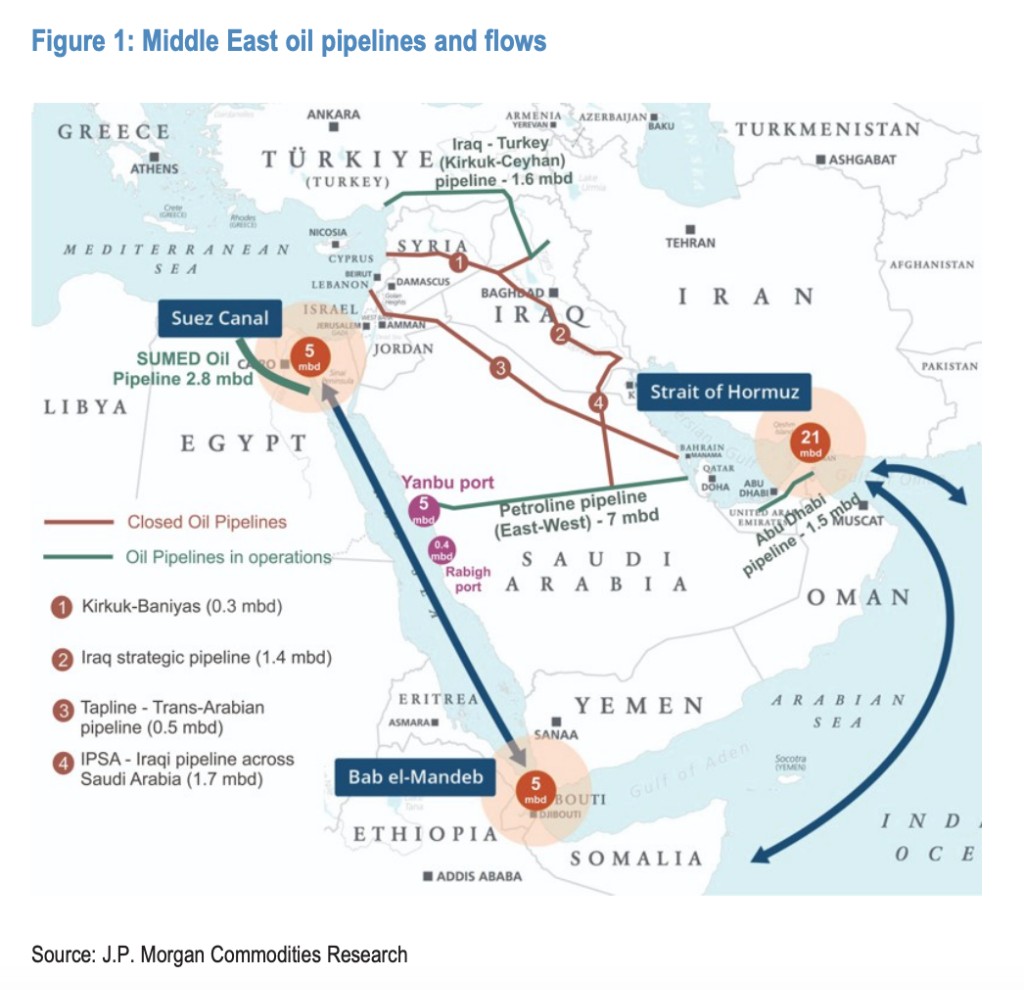
The Houthi rebels' strike capabilities primarily cover the following targets, which together constitute critical nodes for Saudi Arabia's Red Sea exports—crude oil and oil products exported from Yanbu Port and Rabigh Port must pass through the Bab el-Mandeb Strait to reach Asian markets:
-
Yanbu Port: The Red Sea terminus of the East-West Pipeline (Petroline), which integrates pipeline terminal and port functions, serves as Saudi Arabia's primary alternative crude oil export port;
-
Commercial Shipping in the Bab el-Mandeb Strait: The only navigable passage at the southern end of the Red Sea;
-
Rabigh Port: With an average daily export volume of approximately 200,000 barrels of oil products, it is also within the potential strike range.
Saudi Arabia's Detour Logic is Being Dismantled
The core of understanding this risk lies in clarifying the "Hormuz alternative channel" previously constructed by Saudi Arabia and its current structural vulnerabilities.
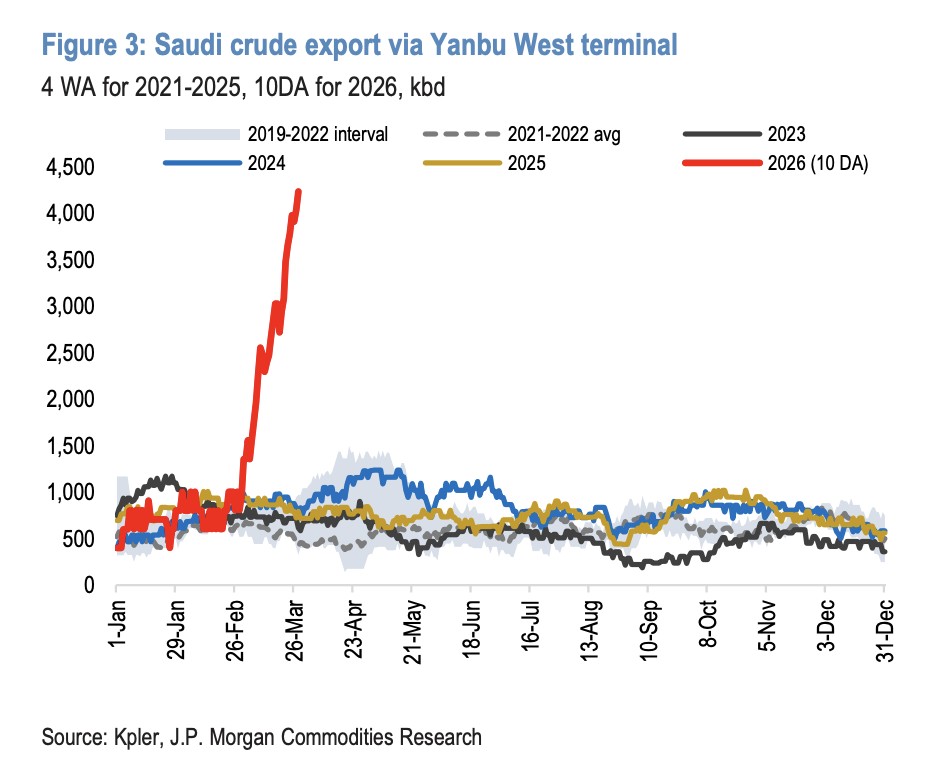
As tensions in the Strait of Hormuz persist, Saudi Arabia has shifted its crude oil export focus to the Red Sea route on a large scale. Data shows that crude oil exports via Yanbu Port have surged from approximately 750,000 bpd to 4.3 million bpd, with an additional potential transfer capacity of about 500,000 bpd. In total, nearly 4.8 million bpd of Red Sea export capacity is exposed to high risk. To support this shift, Saudi Arabia has deployed nearly 50 Very Large Crude Carriers (VLCCs) in the Red Sea, many of which are in a berthing-standby state—creating a highly concentrated and obvious fleet exposure.
This is precisely the crux of the problem: when Saudi Arabia moved its oil to the Red Sea to avoid Hormuz risks, the Houthi intervention made this "safe alternative channel" itself a source of risk.
Limited Backup Options, Obvious Logistics Bottlenecks
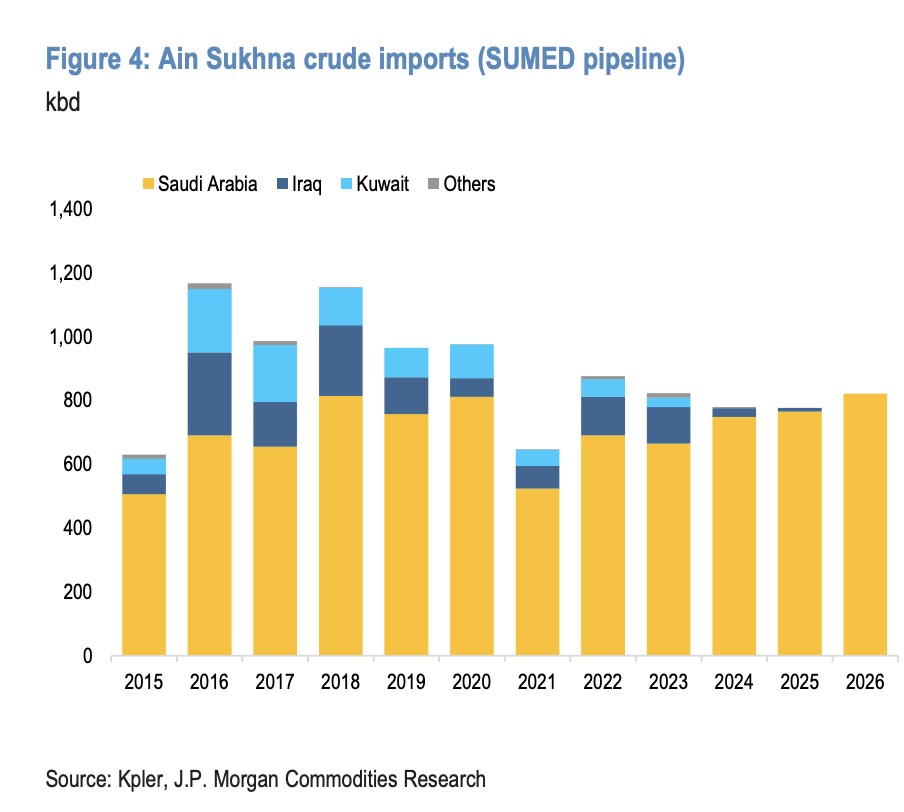
If the Bab el-Mandeb Strait faces a substantial blockade, Yanbu Port's 4.8 million bpd of crude oil exports would be forced to move northward, relying on the Suez Canal and the SUMED pipeline to find another way out. Regarding the capacity of this backup path, calculations show:
-
SUMED Pipeline: Connecting Ain Sukhna on the Red Sea and Sidi Kerir on the Mediterranean, it has a theoretical maximum capacity of 2.8 million bpd, but actual operations are typically only around 1 million bpd. Even running at full load, it still cannot absorb the entire 4.8 million bpd gap.
-
Suez Canal: The remaining cargo of approximately 2 million to 2.2 million bpd would need to pass through the Suez Canal. However, Saudi Arabia's crude oil exports rely heavily on VLCCs. This ship type can only be partially loaded when passing through the canal, meaning voyages must be significantly increased or smaller ship types used—both of which will drive up transportation costs and delay deliveries.
Detour times would be significantly extended. If oil cannot exit the Red Sea directly via the Bab el-Mandeb Strait, the round-trip voyage to the Asian market would be extended by approximately 40 days, requiring more than 130 additional tanker voyages to maintain the normal delivery volume of 4.8 million bpd.
Oil Price Shock: Potential Surge of $20 Per Barrel
Once the aforementioned ~5 million bpd of Saudi bypass capacity encounters a substantial threat, according to the bank's calculations, it could bring a price pressure of $20 per barrel to oil. This increase corresponds to a scenario where bypass capacity is forced to interrupt and supply cannot be replenished in time through alternative paths.
It is worth noting that this $20 upside risk is not based on the extreme assumption of Iran completely stopping exports, but is targeted only at the relatively localized shock of Saudi Arabia's Red Sea export channel being blocked—this shows that the current scale of risk should not be underestimated.
Is Escalation Just a Matter of Time?
Will the Houthi rebels choose to directly strike Saudi infrastructure and shipping channels, or will they keep this capability as a strategic bargaining chip to be used flexibly as the conflict evolves?
Analysis suggests that the question of escalation has shifted from "whether it will happen" to "when it will happen." As the conflict potentially spreads further toward Iran (including larger-scale GCC involvement, strikes against Iranian infrastructure, and even the possibility of ground operations), the risk of the situation expanding accumulates further every day.
For energy market investors, this means the current pricing of the geopolitical risk premium may still be insufficient, and the hedging value of oil price upside tail risk is rising significantly. The allocation logic for the energy sector, as well as the supply chain security assessments of global shipping and refining companies, all need to be re-examined under this framework.
