


Global "Stocks, Bonds, and Gold" Triple Sell-off Since March: "This Is the Worst Situation, Investors Have Nowhere to Hide"
Rising energy prices have fueled stagflation expectations, forcing central banks that had planned rate-cut paths to reconsider potential hikes, thereby simultaneously hitting the three major asset classes of stocks, bonds, and gold. The MSCI All Country World Index plunged 9% in a single month, gold plummeted 15%, and the "60-40" portfolio suffered its worst month in three years. Traditional safe haven logic has almost entirely failed as investors accelerate their move into cash
The energy shock triggered by the Iran war is pushing global financial markets into a rare synchronized Multi-Asset Class rout. Stocks, bonds, and gold fell in tandem in March, with traditional portfolio defense tools almost entirely failing, leaving investors facing their most severe Safe Haven dilemma in recent years.
According to the Financial Times, the MSCI All Country World Index, which tracks stocks in developed and emerging markets, has fallen by about 9% in March. In the U.S. market, the S&P 500 Index closed lower for the fifth consecutive week, its longest losing streak since 2022, while the Nasdaq 100 Index fell into correction territory within a single week.
Concurrently, a composite index of global government and corporate bonds fell by more than 3%, and the traditional "60-40" stock-bond portfolio is heading for its worst monthly performance since September 2022. Gold also plunged 15% this month as investors were forced to liquidate previously profitable long positions amid liquidity pressure.
The core fear of the market lies in stagflation risk. Following the outbreak of the war in the Middle East, the sharp rise in energy prices has fueled market concerns that the global economy is entering a stagflationary environment of slowing growth and rising inflation. This has forced central banks, which had originally planned rate-cut paths, to reconsider the possibility of rate hikes, thereby simultaneously hitting the three major asset classes of stocks, bonds, and gold.
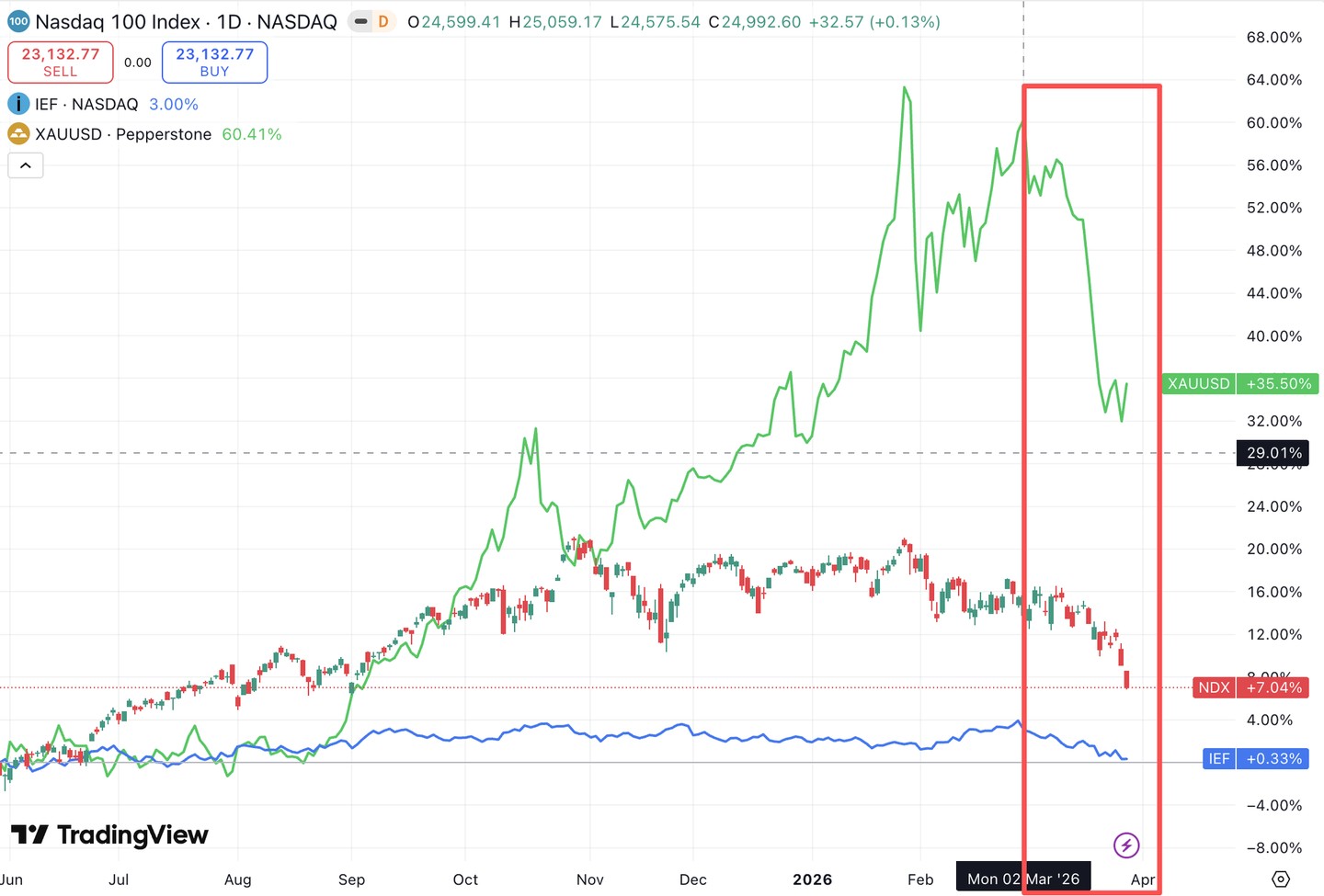
"Nothing Is Working": Three Major Assets Under Synchronized Pressure
The rarity of this sell-off lies in the simultaneous decline of stocks, bonds, and gold, rendering diversification strategies across a Multi-Asset Class almost ineffective.
In the stock market, the MSCI All Country World Index has fallen by about 9% in March. In the U.S. market, the S&P 500 Index closed lower for the fifth consecutive week, its longest losing streak since 2022, while the Nasdaq 100 Index fell into correction territory within a single week.
In the bond market, the 10-year U.S. Treasury yield briefly climbed to 4.48%, its highest level since July, and the 30-year yield approached 5%. European bond yields also touched highs reached since the conflict broke out. The bond sell-off does not merely reflect rising inflation expectations but also a repricing of the policy paths of major global central banks.
The collapse of gold was even more surprising. Gold had seen a strong rally over the past two years, peaking in January, but has plunged 15% this month. Sophie Huynh, a multi-asset portfolio manager at BNP Paribas Asset Management, noted that because there is "nowhere to hide," investors are "liquidating high-yielding assets like gold" to meet liquidity needs.
Raphaël Thuin, head of capital market strategies at Tikehau Capital, stated bluntly: "What works for investors? Nothing. This is truly one of the worst situations you can think of. Managing a portfolio has been extremely difficult over the past few weeks."
Trump's Remarks Fail to Halt the Bleeding as Market Trust Cracks
Trump extended the deadline for launching attacks on Iran's energy infrastructure, but this statement failed to soothe investor sentiment. The S&P 500 Index fell another 1.7% on Friday, extending its decline from the previous trading day—the worst single day since the conflict began—bringing the two-day total decline to its largest since the tariff turmoil last year.
Jordan Rochester, head of fixed income strategy at Mizuho, said Trump's deadline extension "did not resolve the cumulative issue of the blockade of the Strait of Hormuz," adding that "markets may begin to pay less attention to the White House's verbal pressure and focus more on the reality of physical energy shortages."
U.S. Secretary of State Marco Rubio predicted the war would end in "weeks rather than months," but the market had almost no reaction. Larry Weiss, head of equity trading at Instinet, stated:
"A few weeks ago, news like this would have driven the market significantly higher, but today there was no reaction. No one knows what will happen next, and there is an inherent distrust in the market regarding statements from both the U.S. government and Iran."
Steve Chiavarone, deputy chief investment officer for equities at Federated Hermes, also pointed out: "Trump previously stabilized the oil and bond markets through his rhetoric, and the market was waiting for the conflict to end, but today the market is no longer responding to that."
Defensive Tools Fail as Diversification Logic Is Challenged
This crisis is not just a market correction but a profound questioning of the Multi-Asset Class diversification investment framework of the past several decades.
Michael Purves, founder of Tallbacken Capital Advisors, explained in a note to clients: An investor who had perfect foresight on February 27 (the day before the conflict broke out) and preemptively bought bonds, gold, VIX call options, and S&P 500 protective puts would now be in a loss position on almost all of those holdings.
Research by Athanasios Psarofagis, an ETF analyst at Bloomberg Intelligence, shows that on days when stocks fell this year, the probability of bonds and gold rising simultaneously was only about 43%, and for Bitcoin, it was only about 25%—both significantly lower than the level of over 60% seen a decade ago.
Christian Mueller-Glissmann, head of asset allocation strategy at Goldman Sachs, noted that in the early stages of an inflation shock, the "only tools that work" are derivatives betting on rising inflation or commodity prices. His team shifted to an overweight position in cash one week after the conflict broke out.
A recent Bank of America fund manager survey shows that investors flooded into cash in March at the fastest pace since the COVID-19 pandemic.
Old Playbook Fails as Market Awaits a Turning Point
Despite the current grim situation, some market participants believe the sustainability of this trend depends on the direction of the conflict.
Michael Arone, chief investment strategist at State Street Global Advisors, said the failure of fixed-income diversification may be temporary. His team recently reduced equity exposure and increased bond holdings, expecting that once tensions between the U.S. and Iran begin to ease, receding inflation risks will drive the bond market back to the rate-cut narrative.
However, Mina Krishnan of Schroders warned that a deeper structural shift in the market environment has occurred: "The world has moved from demand-side shocks to supply-side shocks, and the old investment playbook needs to be revised." Her team purchased protection through credit default swaps before the Middle East conflict broke out and continues to hold it.
Raphaël Thuin of Tikehau Capital pointed directly to the core contradiction: "The traditional concept of Safe Haven assets is increasingly being challenged. The evolving dynamics of the global economy and financial markets have complicated this narrative."
