


Trump's "Verbal De-escalation" Fails, Oil's "Spot Shock" Approaches, US Stocks Truly Panicked!
Trump's three verbal interventions have proven ineffective, and oil is transmitting from futures prices to physical supply. Asian inventories are nearing their limit, with Africa facing pressure in early April and Europe in mid-April. Brent crude closed at $112.57 per barrel on Friday, its highest close since July 2022. The S&P 500 has fallen for five consecutive weeks, and the Nasdaq has dropped over 10%. Analysts state that the peak of fear has not yet arrived
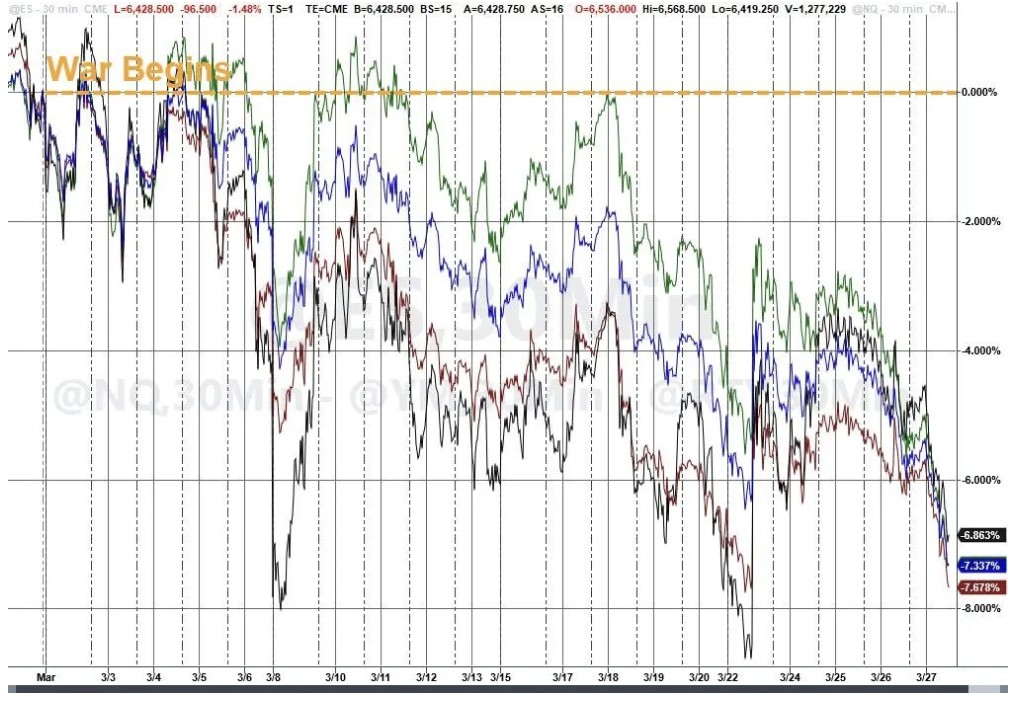
The ongoing conflict between the US and Iran continues to weigh on market sentiment, with the S&P 500 index falling for five consecutive weeks, and Trump's "verbal de-escalation" proving ineffective.
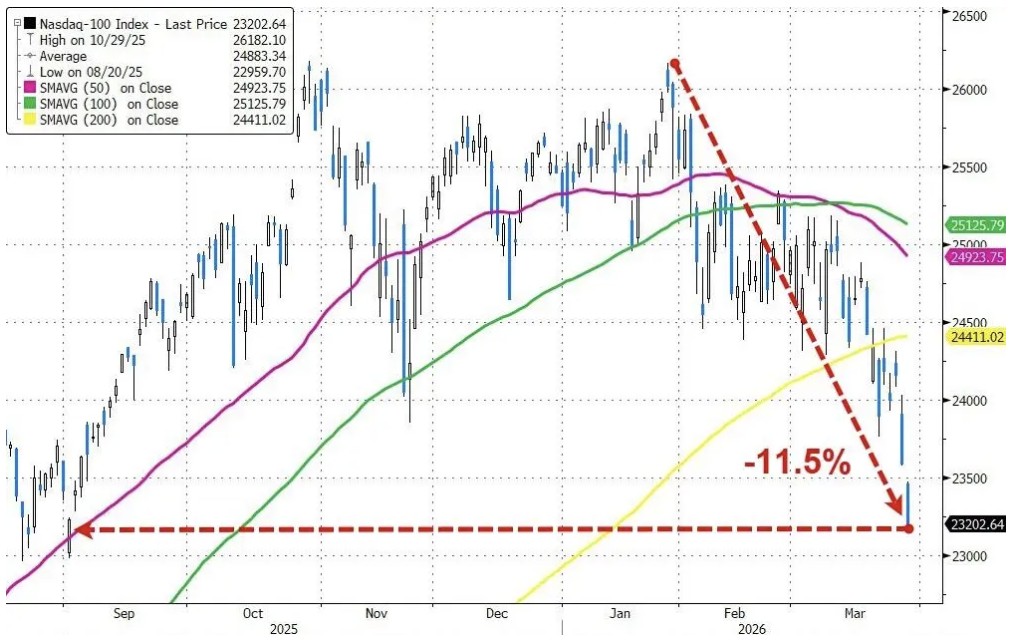
On Friday, US stock markets saw all three major indices close lower. The Dow Jones Industrial Average entered technical correction territory, and the Nasdaq Composite's decline widened to over 10%. The "spot shock" in the oil market is transmitting from futures prices to physical supply, and market confidence in Trump's verbal statements is continuously declining.
Brent crude closed at $112.57 per barrel on Friday, its highest closing price since July 2022. Over the past 13 trading days, Brent crude and the S&P 500 index have moved in opposite directions on 12 of those days. The blockade of the Strait of Hormuz persists, with analysts estimating that around 10 million barrels or more of oil passing through the strait daily has effectively come to a halt.
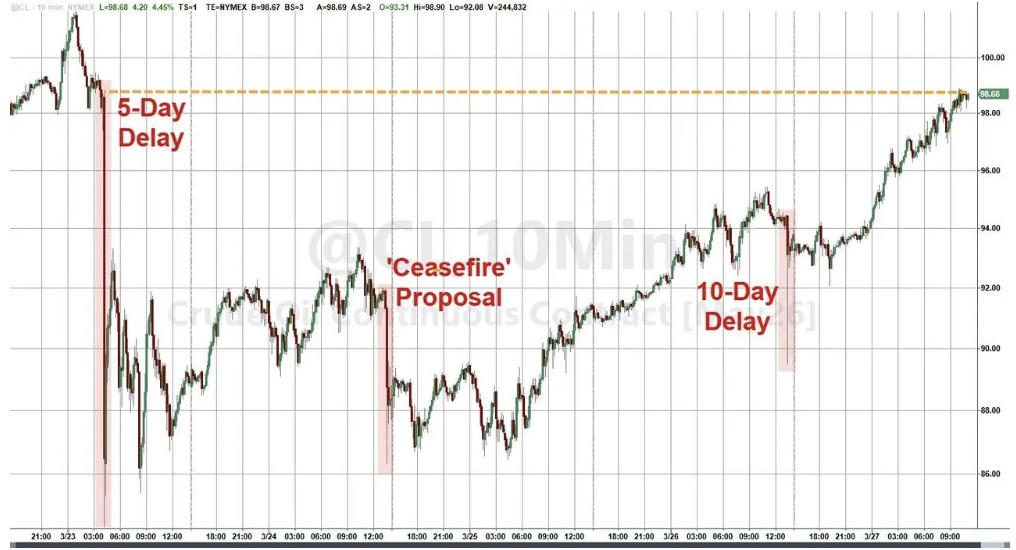
Trump posted on social media on Thursday, stating that Iran had allowed some commercial vessels to pass through the Strait of Hormuz. However, this statement failed to prevent oil prices from continuing to climb on Friday. Iranian media reported that all vessels supporting US and Israeli ports are prohibited from passing.
Trump's "Verbal De-escalation" Fails
In the past few weeks of trading, the expectation that "Trump might hit the brakes at any moment" has been the key support curbing larger market declines. However, as the conflict drags on, this support is showing cracks.
Barclays analysts wrote in a research note on Friday, "Constant flip-flopping and headline fatigue are severely eroding the effectiveness of the 'Trump put,' and the situation remains fluid and quite chaotic." The so-called "Trump put" refers to the market's trust in Trump's ability to boost market confidence through policy statements.
StoneX market analyst Fawad Razaqzada stated directly in a report, "Trump's control over the market is declining. Investors seem to no longer easily believe his statements and are even trading in reverse—they are waiting for substantive evidence, not rhetoric."
Dan Alamariu, Chief Geopolitical Strategist at Alpine Macro, also pointed out that this crisis is fundamentally different from Trump's previous "threat-and-retreat" patterns: "This time, Iran holds veto power, or at least voting power, and you can't 'TACO' (referring to Trump's usual pattern of threatening to withdraw) with this."
Despite Trump's three attempts to lower oil prices through verbal intervention (a 5-day extension, a "ceasefire" proposal, and a 10-day extension), WTI crude closed flat this week, with prices rising back to their pre-Trump verbal intervention levels.
Strait Blockade: Buffer Inventories Depleted, Physical Shock Looms
The market's core fear is evolving from "potential future oil shortages" to "actual current oil shortages."
In the initial weeks following the outbreak of the US-Iran conflict, vessels that had departed from the Persian Gulf before the escalation had completed their loading and set sail. These shipments provided some buffer for the market. According to Ole Hansen, Head of Commodity Strategy at Saxo Bank:
"Most of the tankers that departed from the Persian Gulf before the escalation had completed their voyages and unloading. As new supply is limited, the buffer that initially suppressed oil price surges is rapidly depleting."
Notably, the spot prices of Middle Eastern oil are already significantly higher than financial benchmarks like Brent or WTI. This spread is seen as a precursor to physical supply shortages spreading to other parts of the world, raising investor vigilance.
According to a previous article published by Wallstreetcn, the blockade of the Strait of Hormuz is triggering a "from East to West" oil shockwave: Asian inventories are nearing their limit, the Philippines has declared an energy state of emergency; Africa faces pressure in early April, and Europe in mid-April.
This means the "slow upward grinding mill" of oil prices is still turning. Macnamara stated, "As the actual situation gradually replaces headline effects, oil prices are slowly but steadily climbing."
Behind Five Consecutive Drops: Fear Has Not Peaked
Technically, the situation for the three major indices is already quite severe.
The S&P 500 index has fallen for five consecutive weeks, marking the longest losing streak since the Russia-Ukraine conflict impacted global markets in 2022, with a cumulative decline of 7.4% in March. The Dow Jones index plunged 1.7% or 793 points on Friday alone, officially entering correction territory; the Nasdaq index fell 2.1% on Friday, having confirmed its entry into correction the previous day.
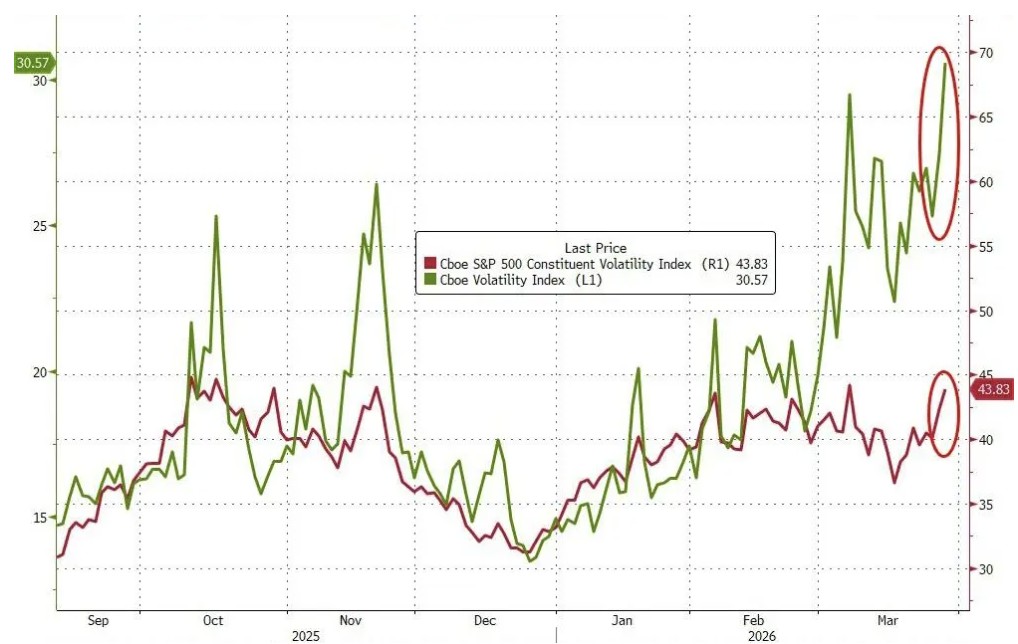
Sentiment indicators are also sounding alarms. The Cboe Volatility Index (VIX) rose above 31 on Friday, well above its long-term average of around 20. According to Citadel Securities data, demand for put options on further declines in the S&P 500 has surged, with the "skew" indicator measuring market asymmetry rising to its highest range in nearly five years.
Carol Schleif, Chief Market Strategist at BMO Wealth Management, stated, "From a psychological perspective, this war of attrition is exhausting, and the market is struggling to digest a crisis that was expected to end quickly."
Alamariu described the current market state more bluntly: "The peak of fear has not yet arrived. Fear, by definition, is irrational, and the market doesn't know how to price it."
Macro Transmission: Inflation Expectations Rise, Rate Cut Expectations Recede
The continuous rise in energy prices is transmitting to the macro economy through multiple channels. Wall Street has generally revised inflation expectations upward and reduced its bets on Federal Reserve rate cuts this year.
Mark Hackett, Chief Market Strategist at Nationwide, stated that although the US economy's fundamentals remain solid for now, "if the conflict cannot be clearly resolved and the energy market cannot stabilize, it is difficult for the market to see sustained gains."
Barclays analysts also warned, "Meanwhile, the war continues, and the longer the oil price shock lasts, the more severe the stagflationary shock will be." Currently, Iran shows no signs of rushing to compromise, Israel has intensified its airstrikes, and the US is reportedly sending more troops to the region.
BMO's Schleif summarized the market's demands: "The market wants to see a framework for stability in the Middle East and the reopening of the Strait of Hormuz for critical tanker transport. The market wants to get out of this predicament."
