


AI "Backfiring" on Cybersecurity? Anthropic's New Model Sparks Panic, Cybersecurity Stocks Plummet Collectively
From software development and search engines to today's cybersecurity, the market's way of pricing AI is changing—any signs of potential "replacement," "weakening," or "reconstruction" are quickly reflected in stock prices. For the cybersecurity industry, the real test may have just begun: when AI empowers both the offensive and defensive sides, who can run faster in this race will be the key to long-term victory
On Friday morning, March 27, stocks in the cybersecurity industry plunged.
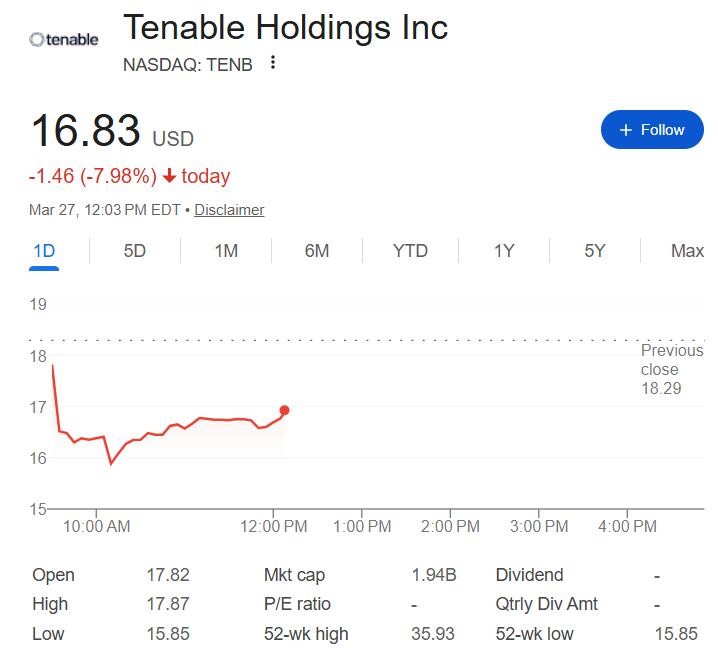
In early U.S. trading on Friday, Tenable once fell over 13%, Zscaler dropped more than 9.5%, Palo Alto Networks sank over 8.2%, and CrowdStrike fell more than 7.8%. The losses later moderated, with Tenable down about 8% and the latter three narrowing their declines to within 6%.
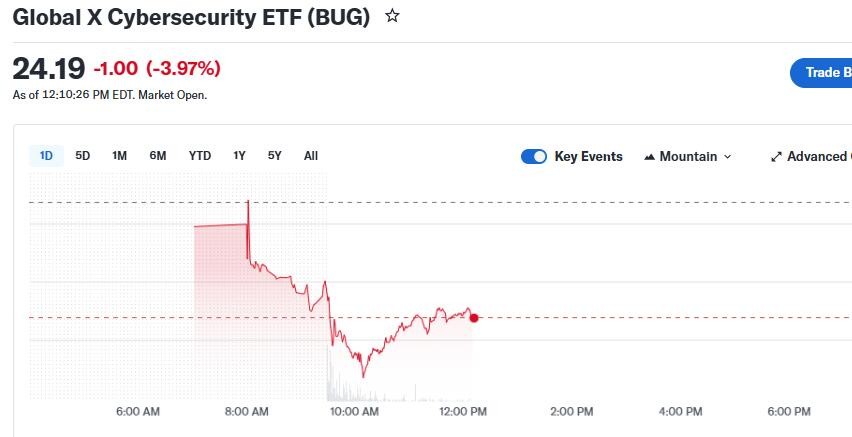
The Global X Cybersecurity ETF (BUG) saw its early trading decline reach 6.1% at one point, narrowing to around 4% by the end of the morning session.
The sharp drop in cybersecurity stocks was not driven by performance or macroeconomic data but was triggered by news regarding AI security risks: a yet-to-be-released model from Anthropic was reported to potentially enhance hacking capabilities, sparking market concerns that "AI could erode cybersecurity moats."
Media reports noted that other AI features from Anthropic had also triggered a chain reaction of sell-offs in the software and data analytics sectors earlier this year. In other words, this round of selling is not about performance but about the "narrative": the market fears that enhanced AI security capabilities will lower the threshold for attacks, forcing security vendors to invest more in R&D and computing power, and even putting pressure on customer budget allocations.
Meanwhile, some Wall Street analysts believe the market's reaction is excessive. Anthropic is also attempting to share risk test results of its new model with security firms, framing it more as an "offense-defense arms race" rather than the complete replacement of cybersecurity needs. Some analysts view such disclosures as "standard operating procedure" rather than a signal of industry obsolescence. Other media outlets suggest the sell-off may have been exaggerated.
AI Capabilities "Overstepping"? Anthropic Model Triggers Market Sensitivity
According to media reports, a new model being tested by Anthropic was deemed in internal evaluations to potentially pose "unprecedented cybersecurity risks." Specifically, if exploited maliciously, it could help attackers bypass existing defense systems.
Although Anthropic later responded that the details were from the testing phase and emphasized its collaboration with security vendors to share risk assessment results in advance, the market clearly chose to price in the potential impact first.
This is crucial—the current focus of competition in the AI industry is no longer just about "who is stronger," but "how strong does it need to be to change the industry structure." When model capabilities touch sensitive areas like automated vulnerability exploitation and attack script generation, the impact will directly affect the core value of cybersecurity vendors.
Not the First Time: A "Trading Template" for AI Impacting Cybersecurity Is Forming
In fact, this is not the first time the cybersecurity sector has plummeted due to Anthropic-related news.
Previously, after Anthropic released AI security tools, stocks like CrowdStrike and Datadog also experienced significant sell-offs. The market is gradually developing a Pavlovian response: once AI capabilities are perceived as potentially "siding with the attacker," the security sector takes the first hit.
Behind this trade is a re-examination of the industry logic by investors:
- Is AI lowering the threshold for hacking?
- Will automated attacks weaken the effectiveness of traditional detection and defense software?
- Will security vendors need to invest more to maintain the same level of protection?
Before these questions have clear answers, capital often chooses to "sell first and ask questions later."
Core Impact: AI Is Changing the Offense-Defense Balance, Not Simply Replacing It
On a deeper level, the essence of market panic is not "AI replacing cybersecurity," but "AI changing the offense-defense balance."
The business logic of traditional cybersecurity is built on a premise: defenders can gradually suppress attackers through rules, models, and data accumulation. However, the emergence of AI has given attackers "scale capabilities":
- Generating phishing emails faster
- Automating the writing and optimization of attack code
- Finding system vulnerabilities more efficiently
This means the security industry may enter a "dynamic arms race" phase: defensive capabilities must be continuously upgraded to offset the AI enhancement on the offensive side.
Under this framework, the long-term demand for security vendors may not necessarily decrease, but short-term profit models and valuation logic will be impacted—especially when corporate customer budgets are limited.
Divergence Remains: Overreaction or a Trend Inflection Point?
Despite the sharp fluctuations in stock prices, some analysts believe the market's reaction may be excessive.
On one hand, Anthropic is proactively conducting risk tests and collaborating with security vendors, meaning the industry is not passively taking the hit but is adapting in advance; on the other hand, AI is also enhancing defensive capabilities, such as automated threat detection and real-time response.
In other words, this is more likely a "repricing of expectations" rather than an immediate deterioration of fundamentals.
From historical experience, sell-offs driven by AI news often share two characteristics:
- Strong emotional drive with limited sustainability
- Gradual recovery of losses as more information is disclosed
The narrowing of losses in cybersecurity stocks during Friday's session already reflects, to some extent, that capital is starting to re-evaluate the actual degree of the impact.
AI Spillover Effects Intensify, Market Enters a "High Sensitivity Period"
What is more noteworthy is that this incident proves once again that the impact of AI is rapidly spilling over into more industries.
From software development and search engines to today's cybersecurity, the market's way of pricing AI is changing—any signs of potential "replacement," "weakening," or "reconstruction" are quickly reflected in stock prices.
At this stage, AI is not just a source of growth stories but is also becoming an amplifier of volatility.
For the cybersecurity industry, the real test may have just begun: when AI empowers both the offensive and defensive sides, who can run faster in this race will be the key to long-term victory.
