


Microsoft faces a dual blow from AI gambles and business disruption threats, experiencing its worst quarterly stock performance since 2008
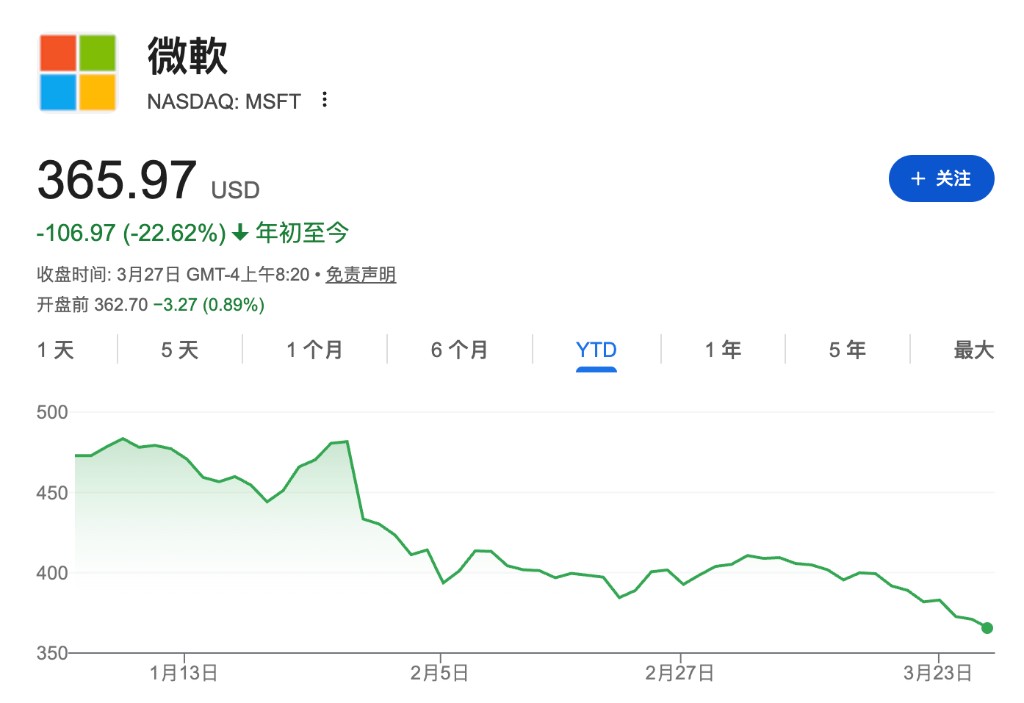
Microsoft faces a dual dilemma, with huge capital expenditures and AI startups threatening its core business, leading to its worst stock performance since 2008. The stock has fallen about 23% year-to-date and is expected to record its largest quarterly decline. Capital expenditures are projected to reach $146 billion in fiscal 2026, but revenue growth has not kept pace, Azure cloud computing growth has slowed, and AI product adoption is limited. Analysts are cautious about future stock performance
Microsoft is caught in a dual predicament of the artificial intelligence era—facing the pressure of enormous capital expenditures while also grappling with the threat of AI startups disrupting its core business. These two forces are pushing the software giant toward its most dismal quarterly performance since the 2008 global financial crisis.
Year-to-date, Microsoft's stock has fallen approximately 23%, potentially marking its steepest quarterly decline since the 27% drop in the fourth quarter of 2008. Among the "Magnificent Seven" tech giants, Microsoft has been the weakest performer this year by a significant margin, while the index tracking this group has fallen about 13% over the same period.
The core of market concerns lies in two aspects: firstly, Microsoft's continuous heavy investment in AI infrastructure, while Wall Street's patience for its return on investment is waning; secondly, intelligent agents developed by AI startups like Anthropic and OpenAI could directly replace Microsoft's products, thereby impacting its core business's pricing power and profit margins.
Soaring Capex, Doubts Over Return on Investment
Microsoft's capital expenditures are ballooning at an astonishing rate. According to average analyst forecasts compiled by Bloomberg, including leases, Microsoft's capital expenditures for fiscal year 2026, ending June 30 this year, are projected to reach $146 billion, a 66% increase from $88 billion in fiscal year 2025. This figure is expected to further expand to $170 billion in fiscal year 2027 and reach $191 billion in fiscal year 2028.
However, such massive investment has not yet translated into corresponding revenue acceleration. In the most recent quarterly earnings report, the growth rate of the closely watched Azure cloud computing division saw a slight slowdown compared to the previous quarter. Concurrently, the adoption rate of the Copilot AI product has been limited, and the company has begun adjusting its AI business architecture to improve service performance.
Jonathan Cofsky, a portfolio manager at Janus Henderson Investors, stated, "Microsoft's capital intensity has increased significantly. For the stock to perform better in the future, we need more confidence that the growth rate of the software business will not slow down substantially."
Copilot AI Assistant's Dilemma Unresolved
Ben Reitzes, an analyst at Melius Research, maintains a "hold" rating on Microsoft stock. In a client report dated March 23, he wrote, "Microsoft's upside in Azure is constrained as the company is busy fixing Copilot and its own models—a problem that won't be resolved in a single quarter."
Reitzes believes that the large number of "buy" ratings from Wall Street peers on Microsoft stock reflect a degree of complacency and points out that Microsoft's Productivity and Business Processes and the Personal Computing segments also face additional risks.
Among the 67 Bloomberg analysts tracking Microsoft, 63 have given a "buy" rating, 3 have a "hold," and 1 has a "sell." The average 12-month target price for the stock is $592, implying over 60% upside from the current stock price—this is the highest implied return rate on record, according to Bloomberg data dating back to 2009. Furthermore, the extent to which Microsoft's stock price is currently below its 200-day moving average is also the largest since 2009.
Valuation Drops to Near Decade Low, Divergence Widens
The continuous decline has led to a significant pullback in Microsoft's valuation. The stock's price-to-earnings ratio based on forward 12-month earnings estimates has fallen below 20 times, the lowest level since June 2016, only slightly above the overall valuation of the S&P 500 index, and at one point fell below the benchmark index, marking the first time this has happened since 2015.
Market divergence surrounding Microsoft's stock is intensifying. Bank of America analyst Tal Liani resumed coverage this week with a "buy" rating, citing Microsoft's "persistent multi-year growth momentum" in cloud computing and AI.
Jake Seltz, a portfolio manager at Allspring Global Investments, commented, "I believe this stock has significant long-term value, its AI strategy will eventually be validated, and it is largely insulated from the most severe AI disruption concerns. Meanwhile, these concerns are creating opportunities, especially for investors willing to be patient."
Risk Disclosure and Disclaimer
Markets carry risks, and investments require caution. This article does not constitute personal investment advice, nor does it consider the specific investment objectives, financial situation, or needs of individual users. Users should consider whether any opinions, views, or conclusions in this article are suitable for their particular circumstances. Investment based on this carries its own risks.
